







Question: Consider the following self-organising map: A E B The output layer of this map consists of six nodes, A, B, C, D, E and
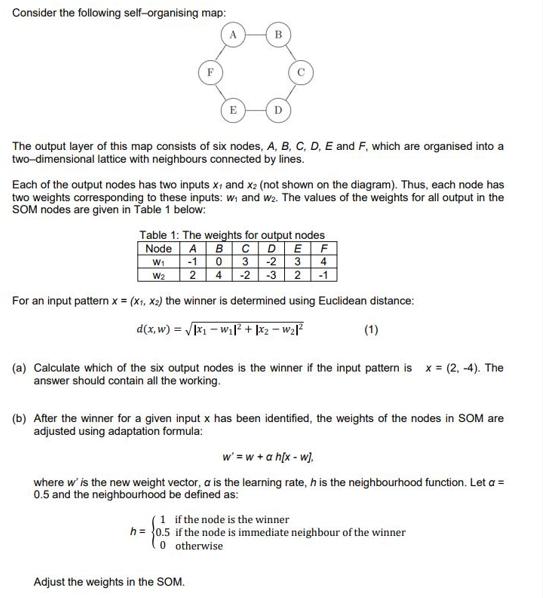
Consider the following self-organising map: A E B The output layer of this map consists of six nodes, A, B, C, D, E and F, which are organised into a two-dimensional lattice with neighbours connected by lines. Each of the output nodes has two inputs x, and x2 (not shown on the diagram). Thus, each node has two weights corresponding to these inputs: w and w2. The values of the weights for all output in the SOM nodes are given in Table 1 below: Table 1: The weights for output nodes Node A BCDEF -1 0 3-2 3 4 24-2 -3 2-1 W W2 For an input pattern x = (x, x2) the winner is determined using Euclidean distance: d(x, w)=x -w + 1x - W1 (1) (a) Calculate which of the six output nodes is the winner if the input pattern is x = (2, -4). The answer should contain all the working. (b) After the winner for a given input x has been identified, the weights of the nodes in SOM are adjusted using adaptation formula: Adjust the weights in the SOM. w' =w+ah[x-w], where w' is the new weight vector, a is the learning rate, h is the neighbourhood function. Let a = 0.5 and the neighbourhood be defined as: 1 if the node is the winner h = 0.5 if the node is immediate neighbour of the winner 0 otherwise
Step by Step Solution
There are 3 Steps involved in it

Get step-by-step solutions from verified subject matter experts
 Study Help