





Question: Explain age, the rotational delay will be 1.5 ms. TRANSFER TIME The transfer time to or from the disk depends on the rotation speed of

Explain
Explain age, the rotational delay will be 1.5 ms.
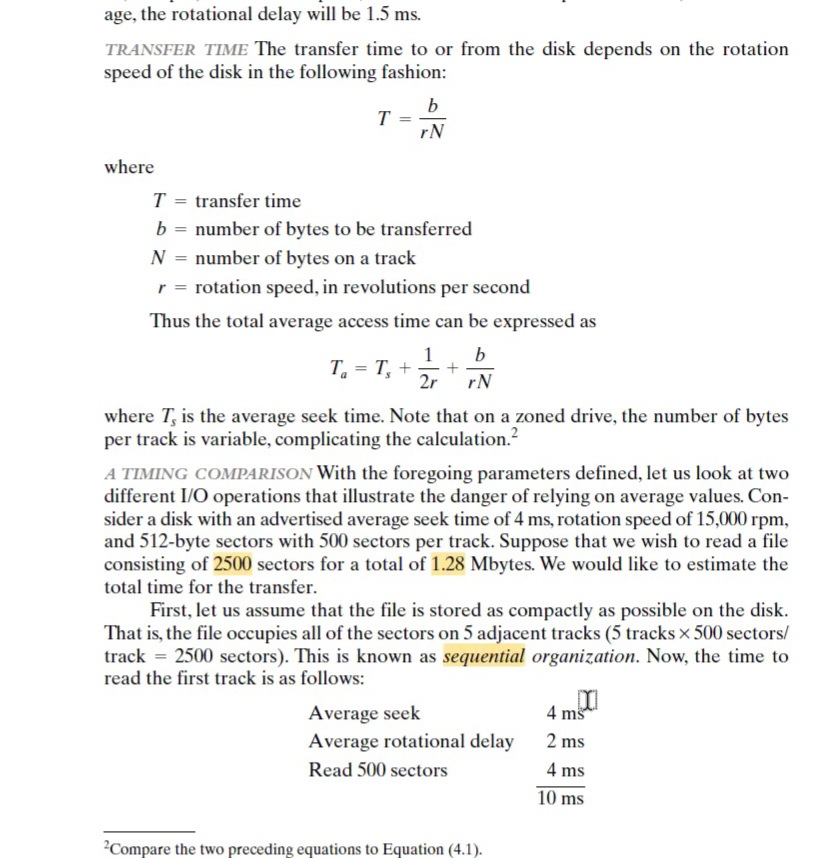
age, the rotational delay will be 1.5 ms. TRANSFER TIME The transfer time to or from the disk depends on the rotation speed of the disk in the following fashion: aa rN where T = transfer time b = number of bytes to be transferred N = number of bytes on a track r = rotation speed, in revolutions per second Thus the total average access time can be expressed as 1 b = a a a T= T, 2r rN where T, is the average seek time. Note that on a zoned drive, the number of bytes per track is variable, complicating the calculation.' A TIMING COMPARISON With the foregoing parameters defined, let us look at two different I/O operations that illustrate the danger of relying on average values. Con- sider a disk with an advertised average seek time of 4 ms, rotation speed of 15,000 rpm, and 512-byte sectors with 500 sectors per track. Suppose that we wish to read a file consisting of 2500 sectors for a total of 1.28 Mbytes. We would like to estimate the total time for the transfer. First, let us assume that the file is stored as compactly as possible on the disk. That is, the file occupies all of the sectors on 5 adjacent tracks (5 tracks x 500 sectors/ track = 2500 sectors). This is known as sequential organization. Now, the time to read the first track is as follows: Average seek 4m Average rotational delay 2ms Read 500 sectors 4ms 10 ms *Compare the two preceding equations to Equation (4.1)

Step by Step Solution

There are 3 Steps involved in it

1 Expert Approved Answer
Step: 1 Unlock blur-text-image

Question Has Been Solved by an Expert!

Get step-by-step solutions from verified subject matter experts

Step: 2 Unlock
Step: 3 Unlock

Students Have Also Explored These Related Accounting Questions!