







Question: Explain the answer to a) and b), step by step very detailed please = Consider the elementary reaction of an organic molecule in an atmosphere
 Explain the answer to a) and b), step by step very detailed please
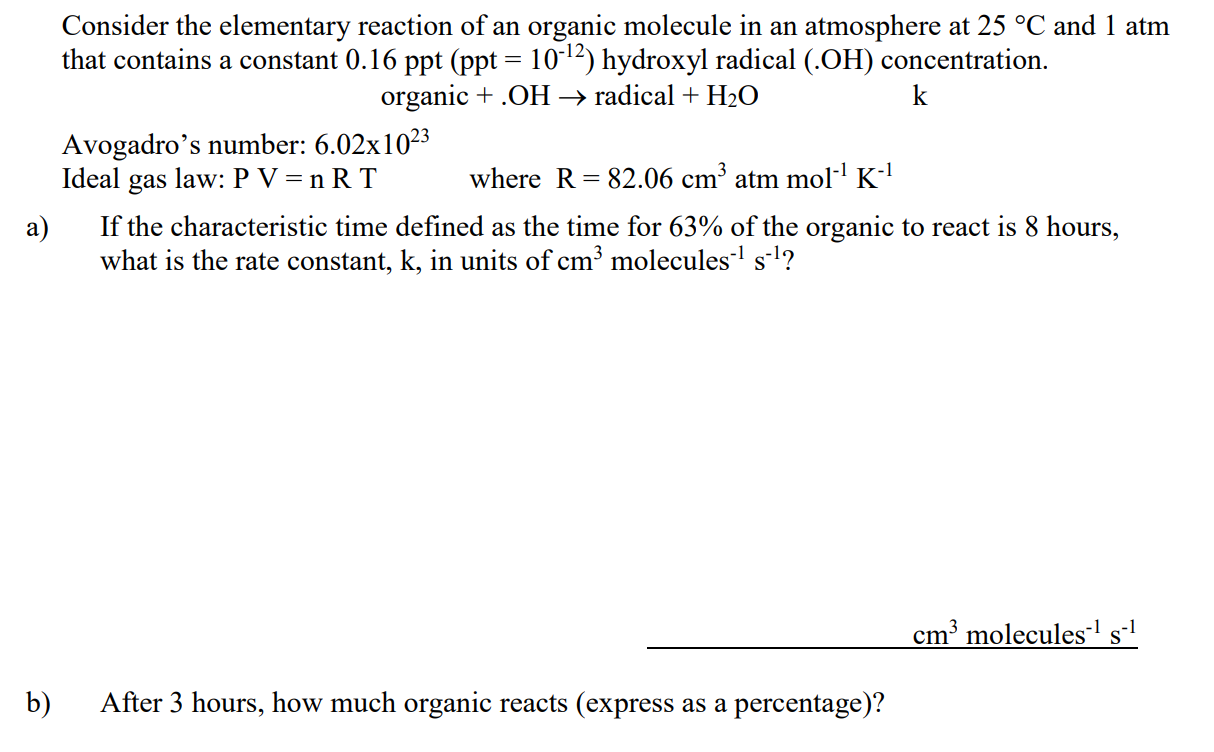
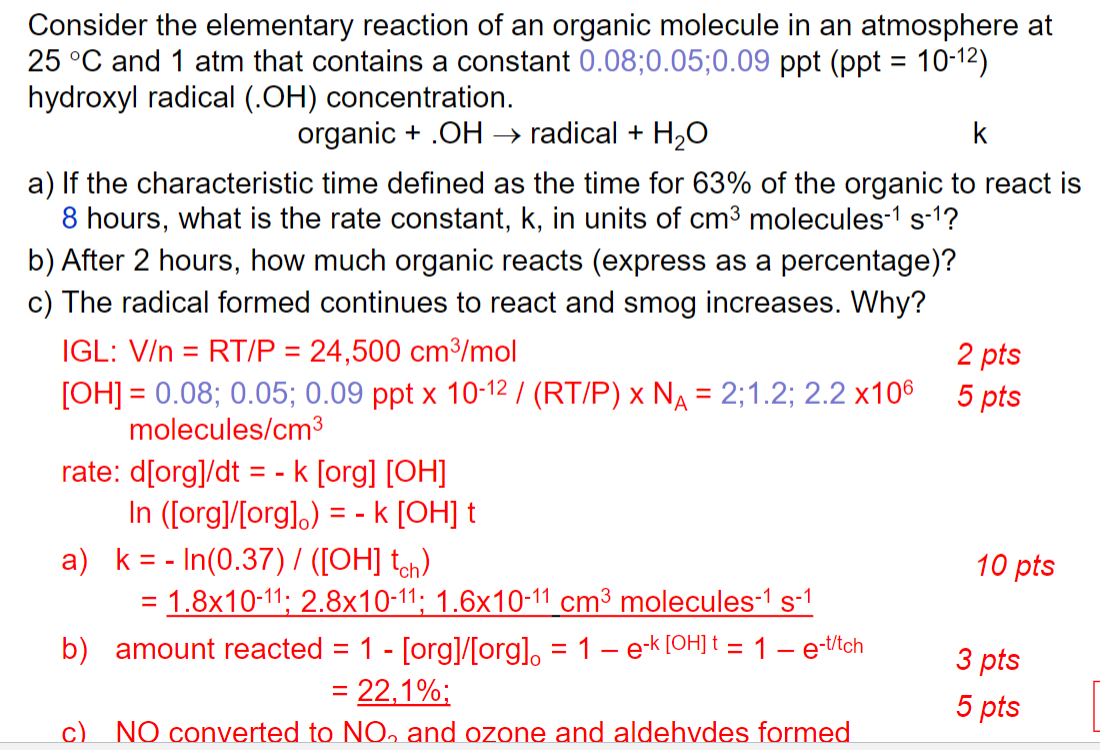
= Consider the elementary reaction of an organic molecule in an atmosphere at 25 C and 1 atm that contains a constant 0.16 ppt (ppt = 10-12) hydroxyl radical (.OH) concentration. organic +.OH radical + H2O Avogadro's number: 6.02x10²³ Ideal gas law: P V=nRT where R = 82.06 cm3 atm mol-K-1 a) If the characteristic time defined as the time for 63% of the organic to react is 8 hours, what is the rate constant, k, in units of cm3 molecules 7 s-l? = cm? molecules-1 s-1 b) After 3 hours, how much organic reacts (express as a percentage)? - Consider the elementary reaction of an organic molecule in an atmosphere at 25 C and 1 atm that contains a constant 0.08;0.05;0.09 ppt (ppt = 10-12) hydroxyl radical (.OH) concentration. organic + .OH radical + H2O k a) If the characteristic time defined as the time for 63% of the organic to react is 8 hours, what is the rate constant, k, in units of cm3 molecules-1 s-1? b) After 2 hours, how much organic reacts (express as a percentage)? c) The radical formed continues to react and smog increases. Why? IGL: V = RT/P = 24,500 cm3/mol 2 pts [OH] = 0.08; 0.05; 0.09 ppt x 10-12 / (RT/P) x NA = 2;1.2; 2.2 x10⁶ molecules/cm3 rate: d[org]/dt = - k [org] [OH] In ([org]/[org].) = - k [OH] t a) k = - In(0.37) / (OH] tch) 10 pts = 1.8x10⁻¹¹; 2.8x10⁻¹¹; 1.6x10⁻¹¹ cm3 molecules-1 s-1 b) amount reacted = 1 - [org]/[orgl. = 1 e-k [OH] t = 1 e-titch = 22,1%; 5 pts c) NO converted to NO, and ozone and aldehydes formed 5 pts - - = 3 pts
Step by Step Solution
There are 3 Steps involved in it

Get step-by-step solutions from verified subject matter experts
 Study Help