







Question: Figure 2 shows a point mass with mass m connected by a massless rod of length 2a to a point mass M. The centre
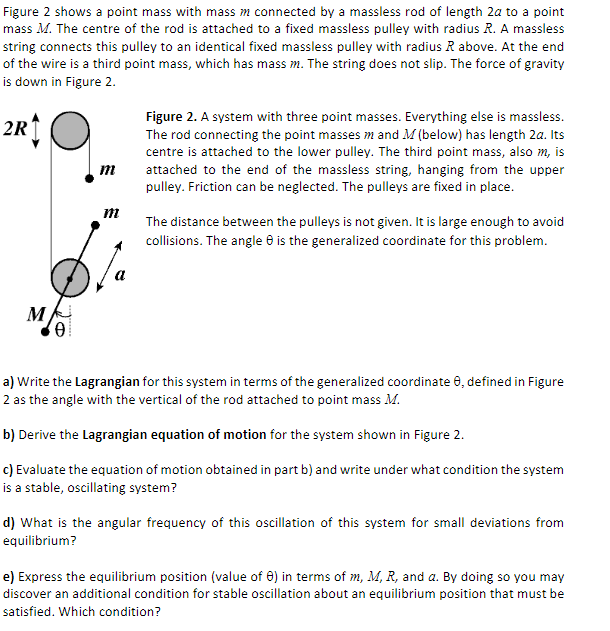
Figure 2 shows a point mass with mass m connected by a massless rod of length 2a to a point mass M. The centre of the rod is attached to a fixed massless pulley with radius R. A massless string connects this pulley to an identical fixed massless pulley with radius R above. At the end of the wire is a third point mass, which has mass m. The string does not slip. The force of gravity is down in Figure 2. 2R m m Figure 2. A system with three point masses. Everything else is massless. The rod connecting the point masses m and M (below) has length 2a. Its centre is attached to the lower pulley. The third point mass, also m, is attached to the end of the massless string, hanging from the upper pulley. Friction can be neglected. The pulleys are fixed in place. The distance between the pulleys is not given. It is large enough to avoid collisions. The angle e is the generalized coordinate for this problem. M a) Write the Lagrangian for this system in terms of the generalized coordinate e, defined in Figure 2 as the angle with the vertical of the rod attached to point mass M. b) Derive the Lagrangian equation of motion for the system shown in Figure 2. c) Evaluate the equation of motion obtained in part b) and write under what condition the system is a stable, oscillating system? d) What is the angular frequency of this oscillation of this system for small deviations from equilibrium? e) Express the equilibrium position (value of 0) in terms of m, M, R, and a. By doing so you may discover an additional condition for stable oscillation about an equilibrium position that must be satisfied. Which condition?
Step by Step Solution
There are 3 Steps involved in it

Get step-by-step solutions from verified subject matter experts
 Study Help