







Question: Final Answer b) How rapidly was BAC increasing after 10 minutes (i.e. 1 = 10 min.) ? Final Answer c) How rapidly was it decreasing
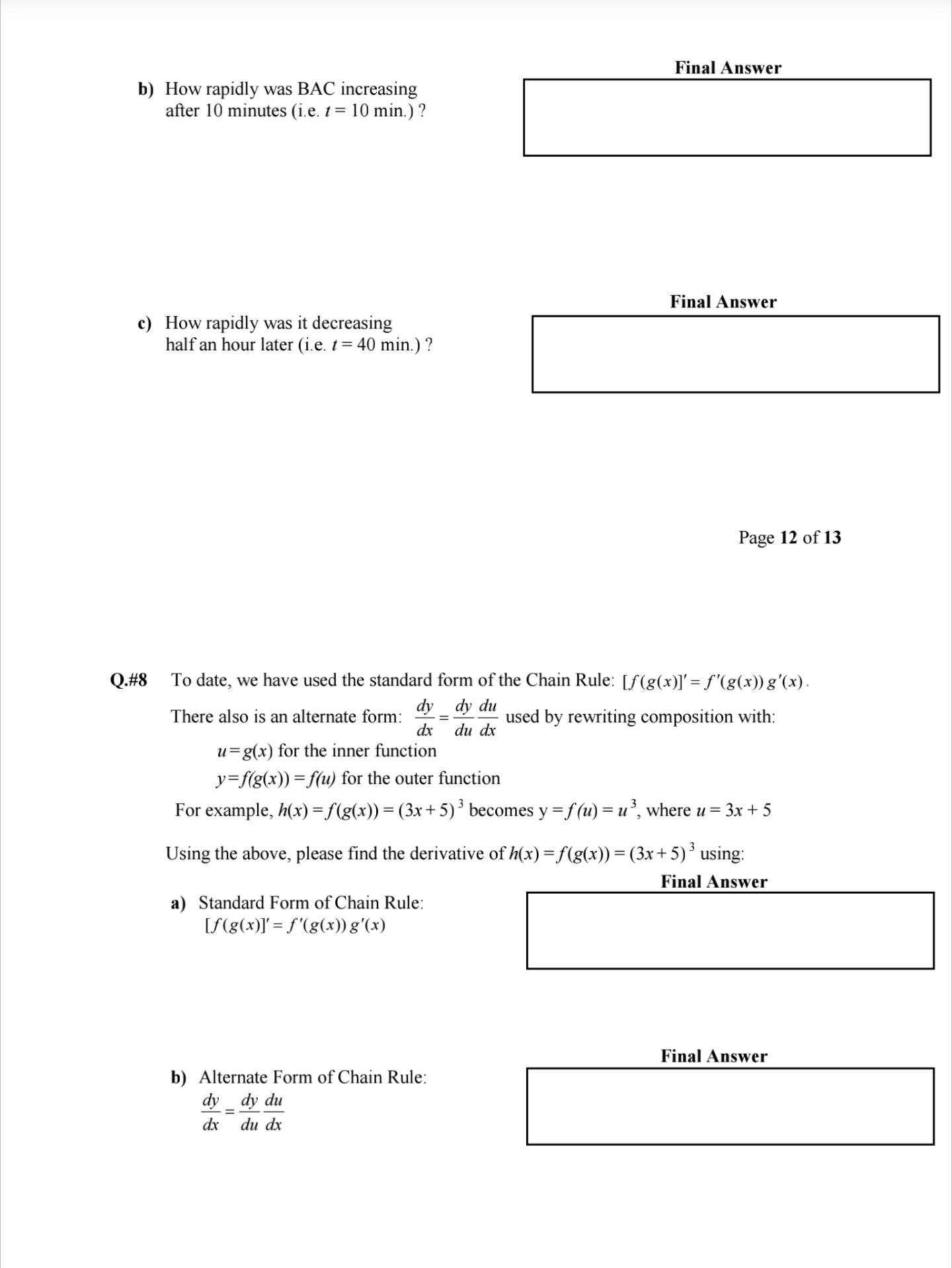
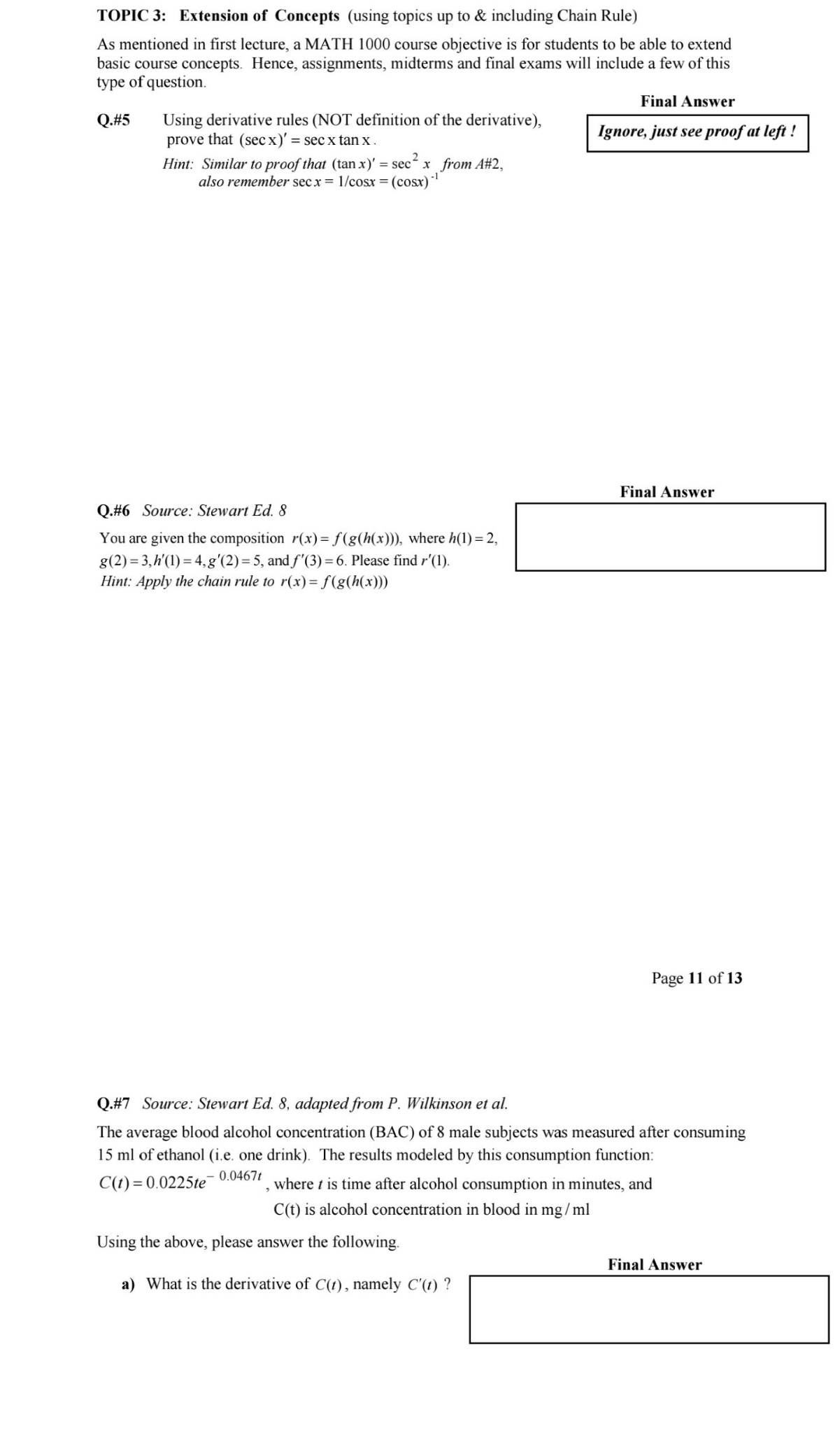
Final Answer b) How rapidly was BAC increasing after 10 minutes (i.e. 1 = 10 min.) ? Final Answer c) How rapidly was it decreasing half an hour later (i.e. t = 40 min.) ? Page 12 of 13 Q.#8 To date, we have used the standard form of the Chain Rule: If(g(x)]' = f'(8(x)) g'(x). There also is an alternate form: dy _dy du dx du dx - used by rewriting composition with: u=g(x) for the inner function y=fig(x)) = flu) for the outer function For example, h(x) = f(g(x)) = (3x + 5) becomes y =f(u) = u', where u = 3x + 5 Using the above, please find the derivative of h(x) = f(g(x)) = (3x + 5) using: Final Answer a) Standard Form of Chain Rule: If(g(x)]' = f'(8(x))g'(x) Final Answer b) Alternate Form of Chain Rule: dy _dy du dx du dxTOPIC 3: Extension of Concepts (using topics up to & including Chain Rule) As mentioned in first lecture, a MATH 1000 course objective is for students to be able to extend basic course concepts. Hence, assignments, midterms and final exams will include a few of this type of question. Final Answer Q.#5 Using derivative rules (NOT definition of the derivative), prove that (sec x)' = sec x tan x . Ignore, just see proof at left ! Hint: Similar to proof that (tan x)' = sec x from A#2, also remember sec x = 1/cosx = (cosx) " Final Answer Q.#6 Source: Stewart Ed. 8 You are given the composition r(x) = f(g(h(x))), where h(1) = 2, g(2) = 3, h'(1) = 4,g'(2) = 5, and f'(3) = 6. Please find r'(1). Hint: Apply the chain rule to r(x) = f(g(h(x))) Page 11 of 13 Q.#7 Source: Stewart Ed. 8, adapted from P. Wilkinson et al. The average blood alcohol concentration (BAC) of 8 male subjects was measured after consuming 15 ml of ethanol (i.e. one drink). The results modeled by this consumption function: C(1) = 0.0225te- 0.04671 , where i is time after alcohol consumption in minutes, and C(t) is alcohol concentration in blood in mg/ml Using the above, please answer the following. Final Answer a) What is the derivative of C(1) , namely C'(1)
Step by Step Solution
There are 3 Steps involved in it

Get step-by-step solutions from verified subject matter experts
 Study Help