







Question: find someone to answer this. everything is needed to answer the questions refund Chapter 09 deals with the Sales Process in organizations. Read the Ethics
find someone to answer this. everything is needed to answer the questions
refund
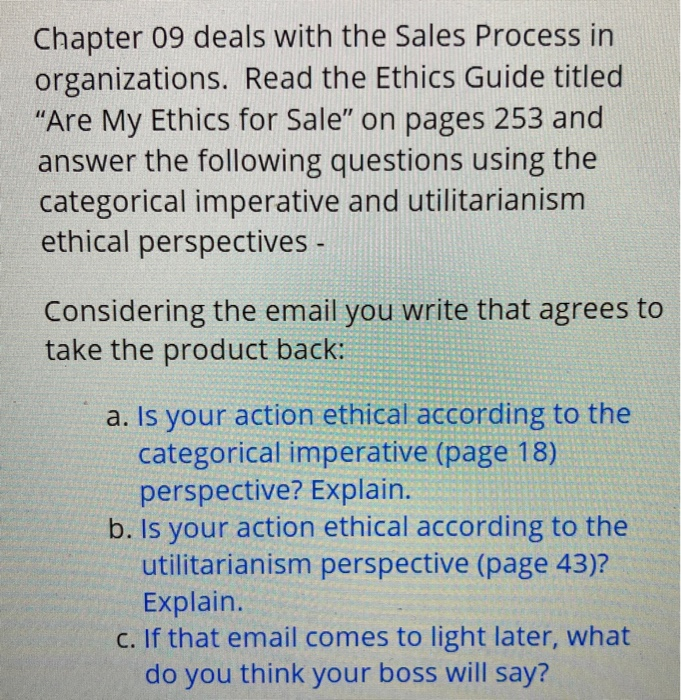
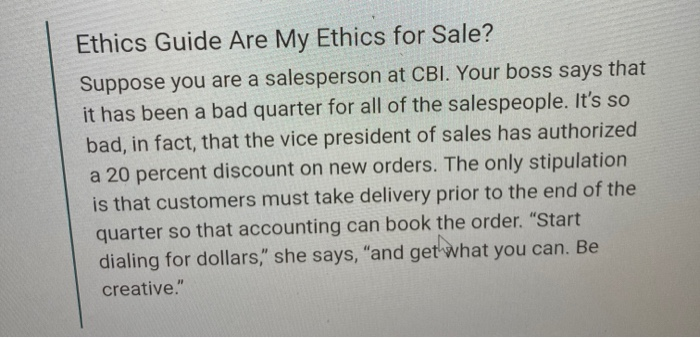
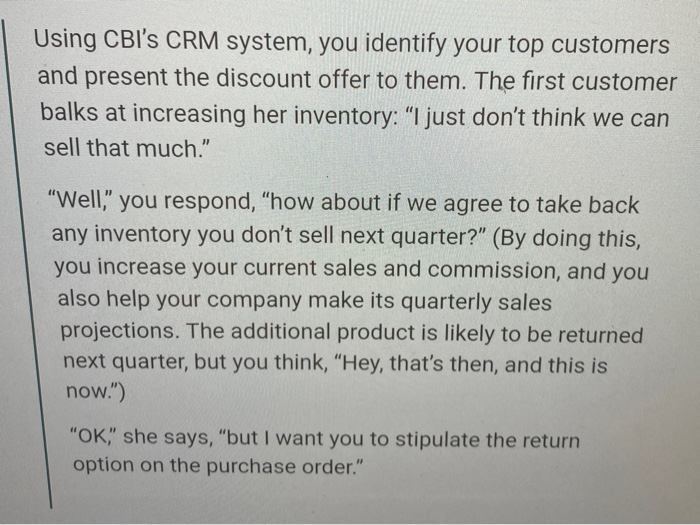
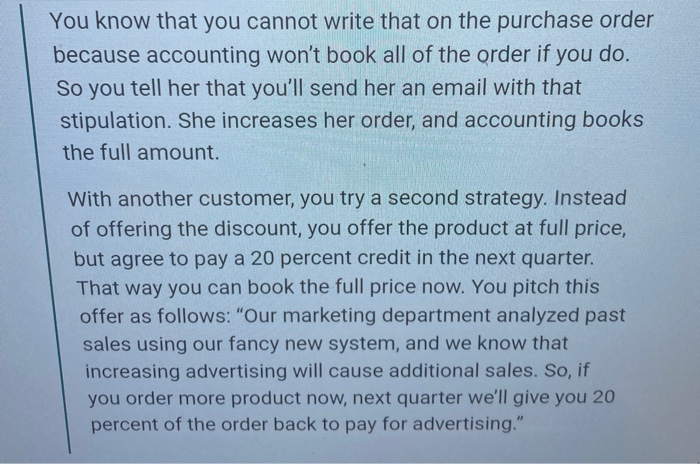
Chapter 09 deals with the Sales Process in organizations. Read the Ethics Guide titled "Are My Ethics for Sale" on pages 253 and answer the following questions using the categorical imperative and utilitarianism ethical perspectives - Considering the email you write that agrees to take the product back: a. Is your action ethical according to the categorical imperative (page 18) perspective? Explain. b. Is your action ethical according to the utilitarianism perspective (page 43)? Explain. c. If that email comes to light later, what do you think your boss will say? Ethics Guide Are My Ethics for Sale? Suppose you are a salesperson at CBI. Your boss says that it has been a bad quarter for all of the salespeople. It's so bad, in fact, that the vice president of sales has authorized a 20 percent discount on new orders. The only stipulation is that customers must take delivery prior to the end of the quarter so that accounting can book the order. "Start dialing for dollars," she says, and get what you can. Be creative." Using CBI's CRM system, you identify your top customers and present the discount offer to them. The first customer balks at increasing her inventory: I just don't think we can sell that much." "Well," you respond, "how about if we agree to take back any inventory you don't sell next quarter?" (By doing this, you increase your current sales and commission, and you also help your company make its quarterly sales projections. The additional product is likely to be returned next quarter, but you think, "Hey, that's then, and this is now.") "OK," she says, "but I want you to stipulate the return option on the purchase order." You know that you cannot write that on the purchase order because accounting won't book all of the order if you do. So you tell her that you'll send her an email with that stipulation. She increases her order, and accounting books the full amount. With another customer, you try a second strategy. Instead of offering the discount, you offer the product at full price, but agree to pay a 20 percent credit in the next quarter. That way you can book the full price now. You pitch this offer as follows: "Our marketing department analyzed past sales using our fancy new system, and we know that increasing advertising will cause additional sales. So, if you order more product now, next quarter we'll give you 20 percent of the order back to pay for advertising." In truth, you doubt the customer will spend the money on advertising. Instead, they'll just take the credit and sit on a bigger inventory. That will kill your sales to it next quarter, but you'll solve that problem then. Even with these additional orders, you're still under quota. In desperation, you decide to sell product to a fictitious company that you say is owned by your brother-in-law. You set up a new account, and when accounting calls your brother-in-law for a credit check, he cooperates with your scheme. You then sell $40,000 of product to the fictitious company and ship the product to your brother-in-law's garage. Accounting books the revenue in the quarter, and you have finally made quota. A week into the next quarter, your brother-in-law returns the merchandise. Meanwhile, unknown to you, CBI's SAP system is scheduling bike assemblies. The assembly schedule reflects the sales from your activities (and those of the other salespeople) and finds a sharp increase in product demand. Accordingly, it generates a schedule that calls for substantial assembly increases and schedules workers for the assemblies. The production system, in turn, schedules the material requirements with the inventory application, which increases raw materials purchases to meet the increased production schedule
Step by Step Solution
There are 3 Steps involved in it
1 Expert Approved Answer
Step: 1 Unlock

Question Has Been Solved by an Expert!
Get step-by-step solutions from verified subject matter experts
Step: 2 Unlock
Step: 3 Unlock
 Study Help