Question: For the first three question please read the case study below, and for the others please consider your self working as procurement in a general
For the first three question please read the case study below,
and for the others please consider your self working as procurement in a general trading - oil and gas company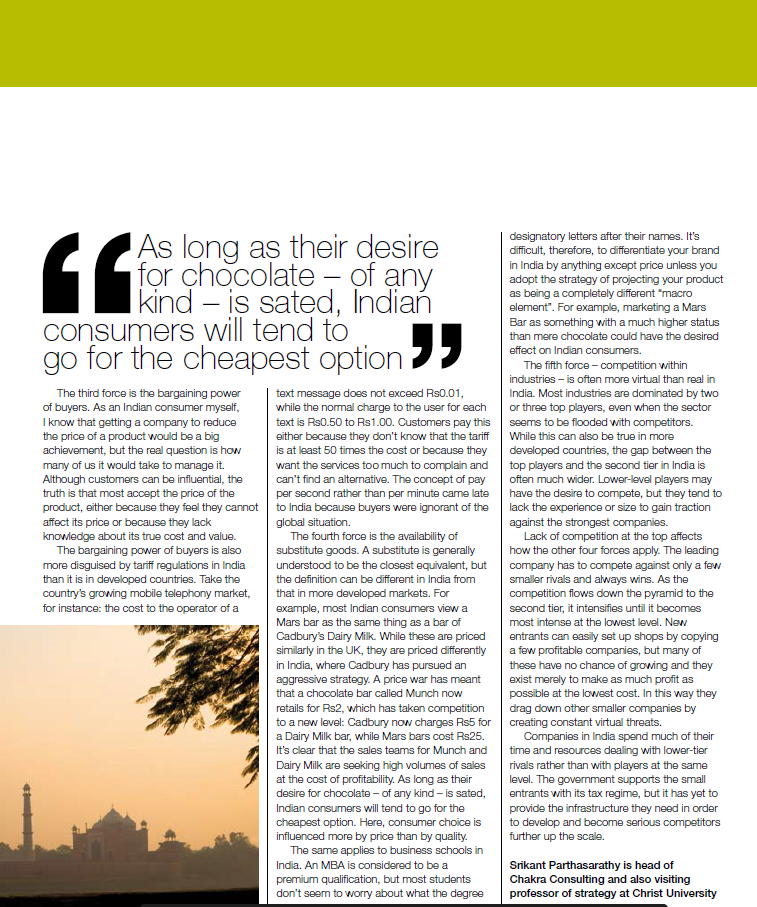
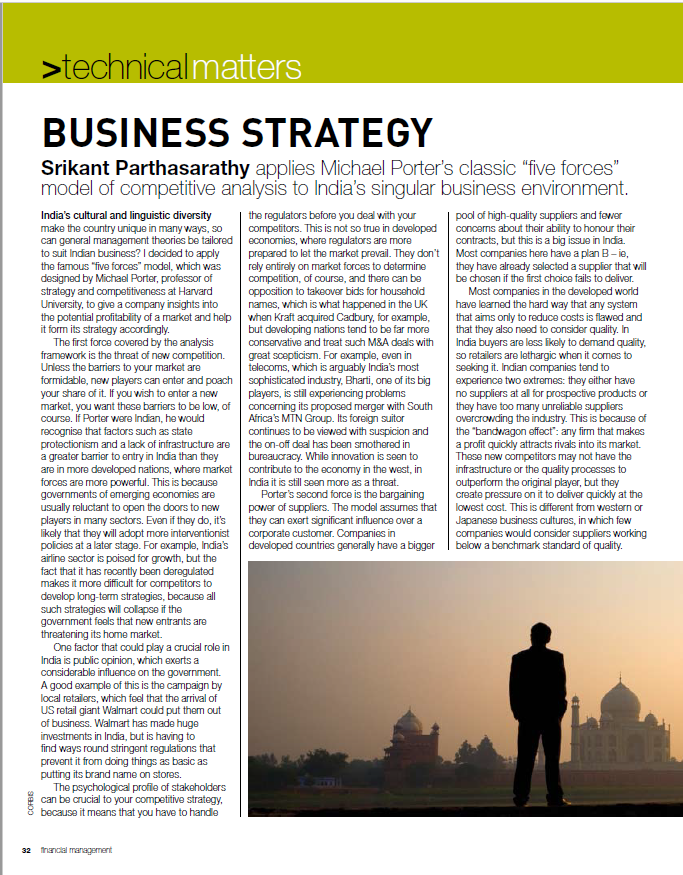
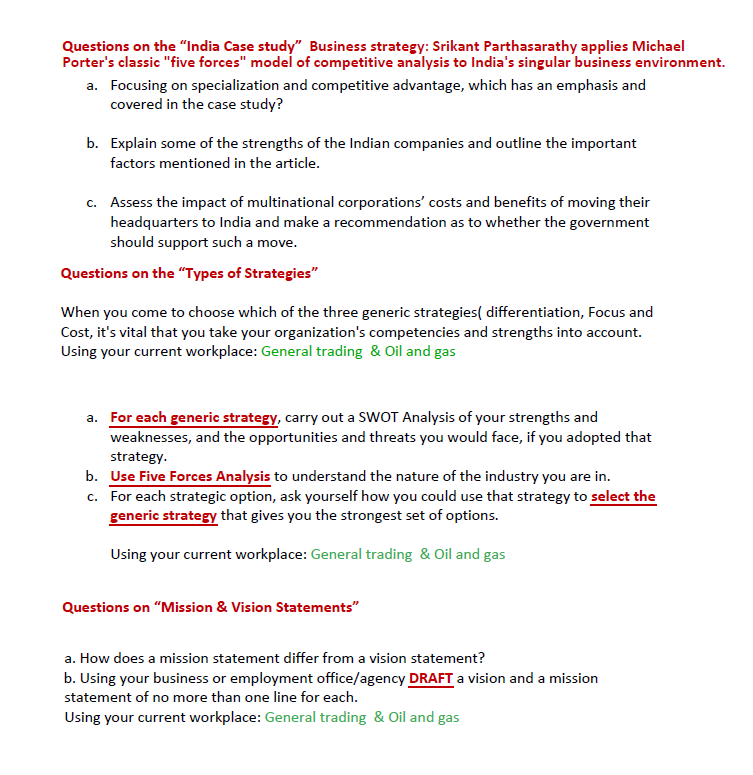
As long as their desire for chocolate - of any I kind - is sated, Indian consumers will tend to go for the cheapest option The third force is the bargaining power of buyers. As an Indian consumer myself, I know that getting a company to reduce the price of a product would be a big achievement, but the real question is how many of us it would take to manage it. Although customers can be influential, the truth is that most accept the price of the product, either because they feel they cannot affect its price or because they lack knowledge about its true cost and value. The bargaining power of buyers is also more disguised by tariff regulations in India than it is in developed countries. Take the country's growing mobile telephony market, for instance: the cost to the operator of a designatory letters after their names. It's difficult, therefore, to differentiate your brand in India by anything except price unless you adopt the strategy of projecting your product as being a completely different macro element". For example, marketing a Mars Bar as something with a much higher status than mere chocolate could have the desired effect on Indian consumers. The fifth force - competition within industries - is often more virtual than real in text message does not exceed Rs0.01, India. Most industries are dominated by two while the normal charge to the user for each or three top players, even when the sector text is Rs0.50 to R$1.00. Customers pay this seems to be flooded with competitors. either because they don't know that the tariff While this can also be true in more is at least 50 times the cost or because they developed countries, the gap between the want the services too much to complain and top players and the second tier in India is can't find an alternative. The concept of pay often much wider. Lower-level players may per second rather than per minute came late have the desire to compete, but they tend to to India because buyers were ignorant of the lack the experience or size to gain traction global situation against the strongest companies. The fourth force is the availability of Lack of competition at the top affects substitute goods. A substitute is generally how the other four forces apply. The leading understood to be the closest equivalent, but company has to compete against only a few the definition can be different in India from smaller rivals and always wins. As the that in more developed markets. For competition flows down the pyramid to the example, most Indian consumers view a second tier, it intensifies until it becomes Mars bar as the same thing as a bar of most intense at the lowest level. New Cadbury's Dairy Milk. While these are priced entrants can easily set up shops by copying similarly in the UK, they are priced differently a few profitable companies, but many of in India, where Cadbury has pursued an these have no chance of growing and they aggressive strategy. A price war has meant exist merely to make as much profit as that a chocolate bar called Munch now possible at the lowest cost. In this way they retails for Rs2, which has taken competition drag down other smaller companies by to a new level: Cadbury now charges Rs5 for creating constant virtual threats. a Dairy Milk bar, while Mars bars cost Rs25. Companies in India spend much of their It's clear that the sales teams for Munch and time and resources dealing with lower-tier Dairy Milk are seeking high volumes of sales rivals rather than with players at the same at the cost of profitability. As long as their level. The government supports the small desire for chocolate - of any kind - is sated, entrants with its tax regime, but it has yet to Indian consumers will tend to go for the provide the infrastructure they need in order cheapest option. Here, consumer choice is to develop and become serious competitors influenced more by price than by quality. further up the scale. The same applies to business schools in India. An MBA is considered to be a Srikant Parthasarathy is head of premium qualification, but most students Chakra Consulting and also visiting don't seem to worry about what the degree professor of strategy at Christ University >technical matters BUSINESS STRATEGY Srikant Parthasarathy applies Michael Porter's classic "five forces" model of competitive analysis to India's singular business environment. India's cultural and linguistic diversity the regulators before you deal with your pool of high-quality suppliers and fewer make the country unique in many ways, so competitors. This is not so true in developed concerns about their ability to honour their can general management theories be tailored economies, where regulators are more contracts, but this is a big issue in India. to suit Indian business? I decided to apply prepared to let the market prevail. They don't Most companies here have a plan B-ie, the famous "five forces" model, which was rely entirely on market forces to determine they have already selected a suppler that will designed by Michael Porter, professor of competition, of course, and there can be be chosen if the first choice fails to deliver. strategy and competitiveness at Harvard opposition to takeover bids for household Most companies in the developed world University, to give a company insights into names, which is what happened in the UK have learned the hard way that any system the potential profitability of a market and help when Kraft acquired Cadbury, for example, that aims only to reduce costs is flawed and it for its strategy accordingly. but developing nations tend to be far more that they also need to consider quality. In The first force covered by the analysis conservative and treat such M&A deals with India buyers are less likely to demand quality, framework is the threat of new competition. great scepticism. For example, even in so retailers are lethargic when it comes to Unless the barriers to your market are telecoms, which is arguably India's most seeking it. Indian companies tend to formidable, new players can enter and poach sophisticated industry, Bharti, one of its big experience two extremes: they either have your share of it. If you wish to enter a new players, is still experiencing problems no suppliers at al for prospective products or market, you want these barriers to be low, of concerning its proposed merger with South they have too many unreliable suppliers course. If Porter were Indan, he would Africa's MTN Group. Its foreign suitor overcrowding the industry. This is because of recognise that factors such as state continues to be viewed with suspicion and the "bandwagon effect': any firm that makes protectionism and a lack of infrastructure are the on-off deal has been smothered in a profit quickly attracts rivals into its market. a greater barrier to entry in India than they bureaucracy. While innovation is seen to These new competitors may not have the are in more developed nations, where market contribute to the economy in the west, in infrastructure or the quality processes to forces are more powerful. This is because India it is still seen more as a threat. outperform the original player, but they governments of emerging economies are Porter's second force is the bargaining create pressure on it to deliver quickly at the usually reluctant to open the doors to new power of suppliers. The model assumes that lowest cost. This is different from western or players in many sectors. Even if they do, it's they can exert significant influence over a Japanese business cultures, in which few likely that they will adopt more interventionist corporate customer. Companies in companies would consider suppliers working policies at a later stage. For example, India's developed countries generally have a bigger below a benchmark standard of quality. airline sector is poised for growth, but the fact that it has recently been deregulated makes it more difficult for competitors to develop long-term strategies, because all such strategies wil colapse if the government feels that new entrants are threatening its home market. One factor that could play a crucial role in India is public opinion, which exerts a considerable influence on the government A good example of this is the campaign by local retailers, which feel that the arrival of US retail giant Walmart could put them out of business. Walmart has made huge investments in India, but is having to find ways round stringent regulations that prevent it from doing things as basic as putting its brand name on stores. The psychological profile of stakeholders can be crucial to your competitive strategy, because it means that you have to handle COBE 32 francial management Questions on the "India Case study" Business strategy: Srikant Parthasarathy applies Michael Porter's classic "five forces" model of competitive analysis to India's singular business environment. a. Focusing on specialization and competitive advantage, which has an emphasis and covered in the case study? b. Explain some of the strengths of the Indian companies and outline the important factors mentioned in the article. C. Assess the impact of multinational corporations' costs and benefits of moving their headquarters to India and make a recommendation as to whether the government should support such a move. Questions on the "Types of Strategies" When you come to choose which of the three generic strategies( differentiation, Focus and Cost, it's vital that you take your organization's competencies and strengths into account. Using your current workplace: General trading & Oil and gas a. For each generic strategy, carry out a SWOT Analysis of your strengths and weaknesses, and the opportunities and threats you would face, if you adopted that strategy. b. Use Five Forces Analysis to understand the nature of the industry you are in. c. For each strategic option, ask yourself how you could use that strategy to select the generic strategy that gives you the strongest set of options. Using your current workplace: General trading & Oil and gas Questions on Mission & Vision Statements a. How does a mission statement differ from a vision statement? b. Using your business or employment office/agency DRAFT a vision and a mission statement of no more than one line for each. Using your current workplace: General trading & Oil and gas









 Study Help