







Question: Force and Torque on a Dipole First we will explore how a dipole responds to an electric field. That is, when a dipole is
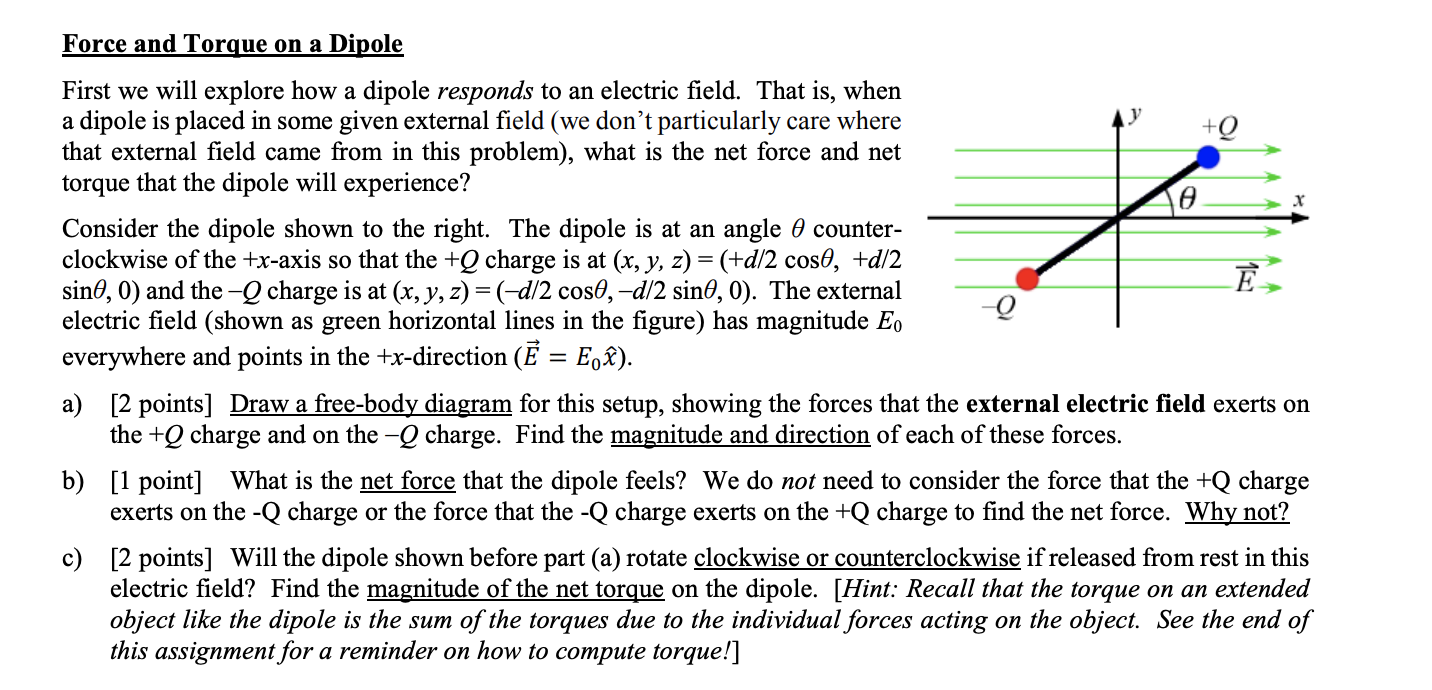
Force and Torque on a Dipole First we will explore how a dipole responds to an electric field. That is, when a dipole is placed in some given external field (we don't particularly care where that external field came from in this problem), what is the net force and net torque that the dipole will experience? Consider the dipole shown to the right. The dipole is at an angle counter- clockwise of the +x-axis so that the +Q charge is at (x, y, z) = (+d/2 cos0, +d/2 sin, 0) and the -Q charge is at (x, y, z) = (-d/2 cos, -d/2 sin0, 0). The external electric field (shown as green horizontal lines in the figure) has magnitude Eo everywhere and points in the +x-direction ( = E). a) [2 points] Draw a free-body diagram for this setup, showing the forces that the external electric field exerts on the +Q charge and on the -Q charge. Find the magnitude and direction of each of these forces. b) [1 point] What is the net force that the dipole feels? We do not need to consider the force that the +Q charge exerts on the -Q charge or the force that the -Q charge exerts on the +Q charge to find the net force. Why not? c) [2 points] Will the dipole shown before part (a) rotate clockwise or counterclockwise if released from rest in this electric field? Find the magnitude of the net torque on the dipole. [Hint: Recall that the torque on an extended object like the dipole is the sum of the torques due to the individual forces acting on the object. See the end of this assignment for a reminder on how to compute torque!]
Step by Step Solution
3.45 Rating (168 Votes )
There are 3 Steps involved in it
Solution b a LLN force on both equal in Q F force on Q F F Q clock w... View full answer

Get step-by-step solutions from verified subject matter experts
 Study Help