







Question: From this study case 1) I want make summary with key points 2) and identification business of Kringler and IT Activities in details INTRODUCTION This

From this study case 1) I want make summary with key points 2) and identification business of Kringler and IT Activities in details
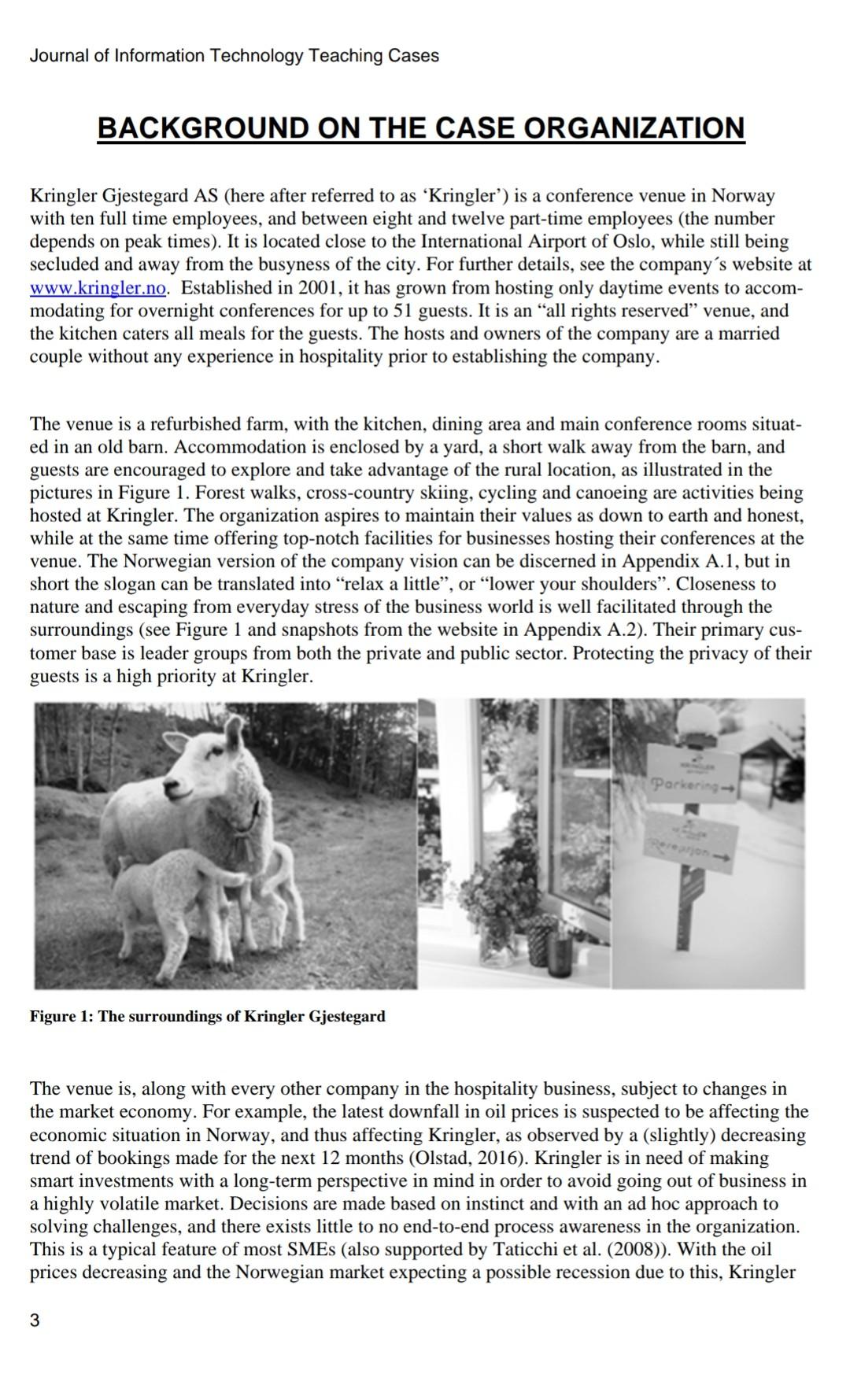
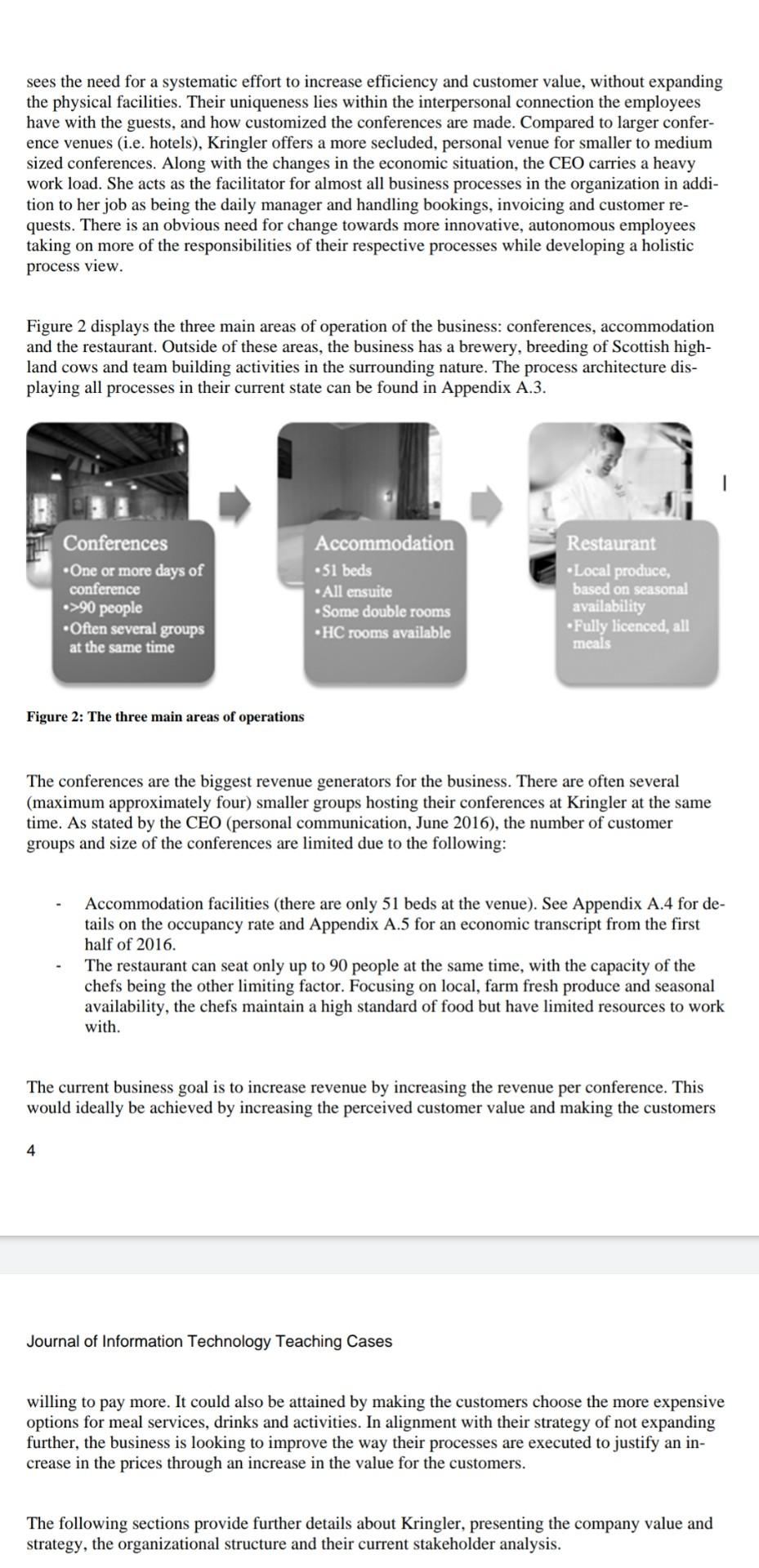
INTRODUCTION This case study is based on a real-life conference venue company in Norway named; Kringler Gjestegard AS (hereafter referred to as Kringler'). In order to avoid being forced to go out of business in a highly competitive market, Kringler is in need of making smart investments with a long-term perspective in mind. Currently, decisions are made based on instinct and individuals' tacit knowledge and experiences, and there exists little or no end-to-end process awareness in the organization. Employees lack an understanding or appreciation on how their day-to-day work affects the company's existence and longevity. Employee support for improvements is very min- imal; they are reluctant to bring about any of the essential changes. A need to have a systematic approach to manage the processes across the organization or in other words to have a more pro- cess centric organization is recognized by senior staff at Kringler. As defined by Tregear (2010), a process centric organization is an organization that uses its pro- cesses consciously to improve business results. Underlying this definition is the attention to man- aging processes as a system, by seeing the linkage between processes and associated elements as well as other processes. Process management is coordinating all the value-creating processes of the organization. But to be able to establish process thinking, an organization needs to undergo a BPM transformation (Davis, 2010). Vom Brocke and Rosemann (2010) describe a set of key points that need to be addressed for an organization to become process centric. They recommend that BPM Maturity of the organization needs to be assessed, along with appointing process own- ers and developing performance measurement targets. With SMEs comprising of the vast majority of worldwide business activities, developing compet- itive advantages with SMEs through the implementation of BPM is gaining attention from a mul- tiple of governments (Kirchmer, 2011; Riley & Brown, 2001). As proposed by Chong (2014) and Imanipour, Talebi, and Rezazadeh (2012), the actual knowledge of BPM within SMEs in any industry is alarmingly low. Culture and people are known to be the most influential factors for value creation in SMEs, as they are so much more reliant on the individuals in the workforce (Taticchi, Cagnazzo, & Botarelli, 2008). Employees are expected to be innovative and evoke improvements on their everyday business processes at a regular basis, especially in SMEs. temberger (2009) claims the only way of assuring a sustained enterprise-wide approach, is through developing and thoroughly embedding sound BPM practices to bring together all parts of the organization. Such an enterprise wide BPM effort could facilitate innovative practices that can support the organization's strategic directions, survival and success. People capabilities are recognized to be a core pillar and also one of the biggest challenges for successful E-BPM efforts (Bandara, Alibabaei, & Aghdasi, 2009; Schmiedel, vom Brocke, & Recker, 2013; vom Brocke, Petry, Schmiedel, & Sonnenberg, 2015). Different mechanisms to train people in Enterprise wide BPM are sought for to address this (Bandara et al., 2010; Leyer & Wollersheim, 2013). Teaching cases are an established mechanism to assist in BPM capability building (Bandara, Thennakoon, Syed, Mathiesen, & Ranaweera, 2016). A teaching case provides an applied example from the real world, allowing students/trainees to be creative and solution oriented in their way of thinking. Such resources are called for in BPM (Bandara et al., 2016). This case addresses a previously untapped resource gap by presenting a teaching case that is on E-BPM within an SME context. 2 Journal of Information Technology Teaching Cases BACKGROUND ON THE CASE ORGANIZATION Kringler Gjestegard AS (here after referred to as Kringler') is a conference venue in Norway with ten full time employees, and between eight and twelve part-time employees (the number depends on peak times). It is located close to the International Airport of Oslo, while still being secluded and away from the busyness of the city. For further details, see the company's website at www.kringler.no. Established in 2001, it has grown from hosting only daytime events to accom- modating for overnight conferences for up to 51 guests. It is an all rights reserved venue, and the kitchen caters all meals for the guests. The hosts and owners of the company are a married couple without any experience in hospitality prior to establishing the company. The venue is a refurbished farm, with the kitchen, dining area and main conference rooms situat- ed in an old barn. Accommodation is enclosed by a yard, a short walk away from the barn, and guests are encouraged to explore and take advantage of the rural location, as illustrated in the pictures in Figure 1. Forest walks, cross-country skiing, cycling and canoeing are activities being hosted at Kringler. The organization aspires to maintain their values as down to earth and honest, while at the same time offering top-notch facilities for businesses hosting their conferences at the venue. The Norwegian version of the company vision can be discerned in Appendix A.1, but in short the slogan can be translated into relax a little, or "lower your shoulders. Closeness to nature and escaping from everyday stress of the business world is well facilitated through the surroundings (see Figure 1 and snapshots from the website in Appendix A.2). Their primary cus- tomer base is leader groups from both the private and public sector. Protecting the privacy of their guests is a high priority at Kringler. Parkering- pero Figure 1: The surroundings of Kringler Gjestegard The venue is, along with every other company in the hospitality business, subject to changes in the market economy. For example, the latest downfall in oil prices is suspected to be affecting the economic situation in Norway, and thus affecting Kringler, as observed by a (slightly) decreasing trend of bookings made for the next 12 months (Olstad, 2016). Kringler is in need of making smart investments with a long-term perspective in mind in order to avoid going out of business in a highly volatile market. Decisions are made based on instinct and with an ad hoc approach to solving challenges, and there exists little to no end-to-end process awareness in the organization. This is a typical feature of most SMEs (also supported by Taticchi et al. (2008)). With the oil prices decreasing and the Norwegian market expecting a possible recession due to this, Kringler 3 sees the need for a systematic effort to increase efficiency and customer value, without expanding the physical facilities. Their uniqueness lies within the interpersonal connection the employees have with the guests, and how customized the conferences are made. Compared to larger confer- ence venues (i.e. hotels), Kringler offers a more secluded, personal venue for smaller to medium sized conferences. Along with the changes in the economic situation, the CEO carries a heavy work load. She acts as the facilitator for almost all business processes in the organization in addi- tion to her job as being the daily manager and handling bookings, invoicing and customer re- quests. There is an obvious need for change towards more innovative, autonomous employees taking on more of the responsibilities of their respective processes while developing a holistic process view. Figure 2 displays the three main areas of operation of the business: conferences, accommodation and the restaurant. Outside of these areas, the business has a brewery, breeding of Scottish high- land cows and team building activities in the surrounding nature. The process architecture dis- playing all processes in their current state can be found in Appendix A.3. Conferences One or more days of conference >90 people Often several groups at the same time Accommodation 51 beds All ensuite Some double rooms HC rooms available Restaurant Local produce, based on seasonal availability Fully licenced, all meals Figure 2: The three main areas of operations The conferences are the biggest revenue generators for the business. There are often several (maximum approximately four) smaller groups hosting their conferences at Kringler at the same time. As stated by the CEO (personal communication, June 2016), the number of customer groups and size of the conferences are limited due to the following: Accommodation facilities (there are only 51 beds at the venue). See Appendix A.4 for de- tails on the occupancy rate and Appendix A.5 for an economic transcript from the first half of 2016. The restaurant can seat only up to 90 people at the same time, with the capacity of the chefs being the other limiting factor. Focusing on local, farm fresh produce and seasonal availability, the chefs maintain a high standard of food but have limited resources to work with. The current business goal is to increase revenue by increasing the revenue per conference. This would ideally be achieved by increasing the perceived customer value and making the customers 4 Journal of Information Technology Teaching Cases willing to pay more. It could also be attained by making the customers choose the more expensive options for meal services, drinks and activities. In alignment with their strategy of not expanding further, the business is looking to improve the way their processes are executed to justify an in- crease in the prices through an increase in the value for the customers. The following sections provide further details about Kringler, presenting the company value and strategy, the organizational structure and their current stakeholder analysis. Report Structure: 1. Introduction 2. Identification of busines and IT activities
Step by Step Solution
There are 3 Steps involved in it

Get step-by-step solutions from verified subject matter experts
 Study Help