



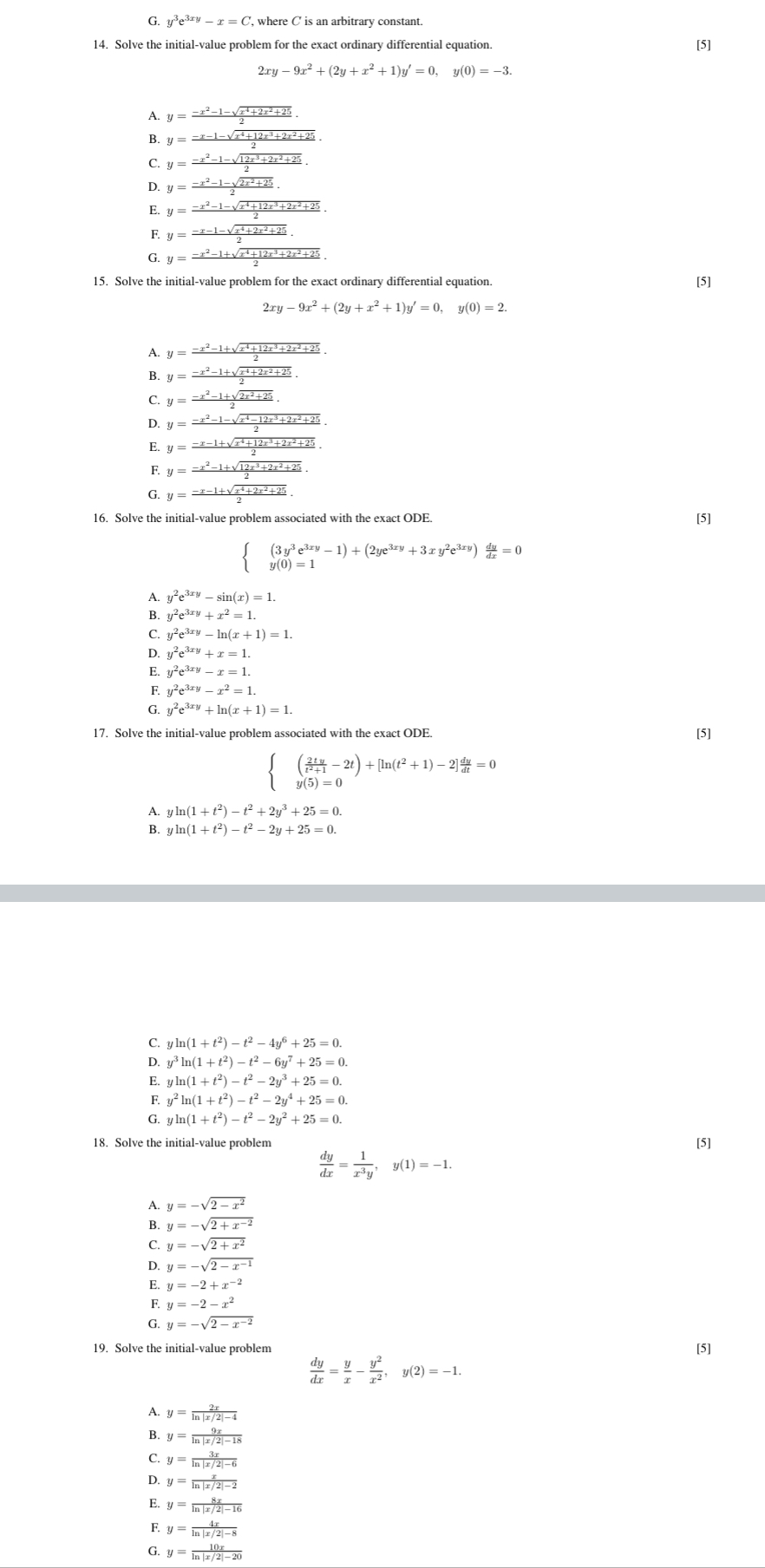
Question: G. yedry - x = C, where C is an arbitrary constant. 14. Solve the initial-value problem for the exact ordinary differential equation. [5] 2xy
![[5] 2xy - 9x2 + (2y + x2 + 1)y' = 0,](https://dsd5zvtm8ll6.cloudfront.net/si.experts.images/questions/2024/10/67068fd5866a6_28567068fd55a4b7.jpg)
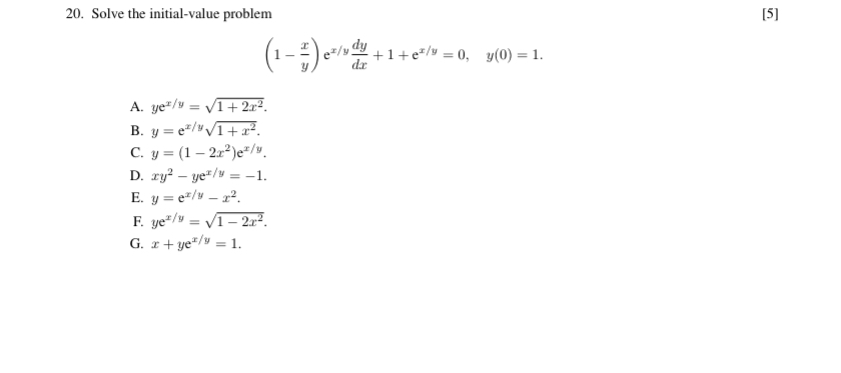
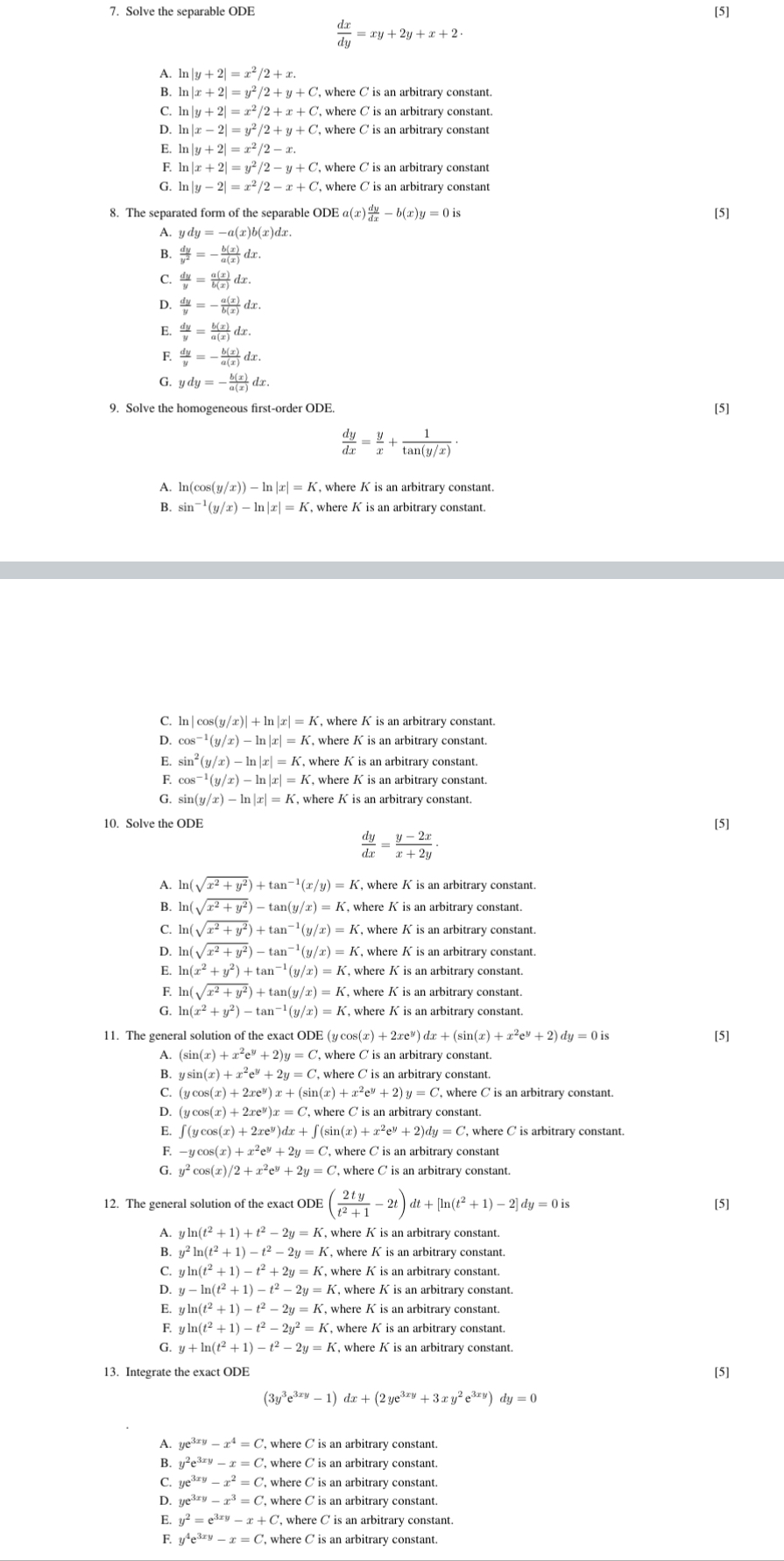
G. yedry - x = C, where C is an arbitrary constant. 14. Solve the initial-value problem for the exact ordinary differential equation. [5] 2xy - 9x2 + (2y + x2 + 1)y' = 0, y(0) = -3. A. y = =x'-1-yr +2r-+25 B. y= =x-1-v+123+2+2+25 C. y = =x'-1-v12r +2r-+25 D. y = =x2-1-v/2r-+25 E. y = =x2-1-v +12r +2r-+25 F. y = =x-1-vx*+2+2+25 G. y = =x'-1+2 412r- 42r-425 15. Solve the initial-value problem for the exact ordinary differential equation. [5] 2xy - 9x2 + (2y + x2 + 1)y' =0, y(0) = 2. A. y = =x'-1+vr +12r +2r-425 B. y = =x-1+vx4+2r2+25 C. y = =23-lty2r2+25 D. y = =x3-1-vx-12r +2x-+25 . E. y= =x-l+vx 412r +2r-+25 F. y = ='-1+v123+2+2+25 G. y = =x-1+vx-42+2+25 16. Solve the initial-value problem associated with the exact ODE. [5] (343 eazy - 1) + (2ye3zy + 3xyleazy) dy = 0 y(0) = 1 A. yedry - sin(x) = 1. B. y?e3ry + x2 = 1. C. yeary - In(x + 1) = 1. D. yeary + x = 1. E. ye3ry - r = 1. F. ye3xy - x2 = 1. G. yeary + In(x + 1) = 1. 17. Solve the initial-value problem associated with the exact ODE. [5] (341 - 21) + [In(12 + 1) - 21 =0 y(5) = 0 A. yln(1 + 12) - 12 + 2y3 + 25 = 0. B. yln(1 + (2) - 12 - 2y + 25 = 0. C. yln(1 + t2) - 12 - 4y6 + 25 = 0. D. y3 In(1 + t2) - 12 - 6y7 + 25 = 0. E. yln(1 + (?) - 12 - 2y3 + 25 = 0. F. y? In(1 + t?) - 12 - 2y' + 25 = 0. G. yln(1 + t2) - 12 - 2y? + 25 = 0. 18. Solve the initial-value problem [5] dy d y(1) = -1. A. y = -V2 - x2 B. y = -V2+x- C. y = -V2+ 12 D. y = -v2-x-I E. y= -2+x-2 F. y = -2-x2 G. y = -V2-1-2 19. Solve the initial-value problem [5] dy da = 2: y(2) = -1. A. y = In |x/2|-4 B. y = In x/2 - 18 C. y = In |x/2-6 D. y = In x/2 -2 E. y = In x/2-16 Ar F. y = In |x/2)-8 G. y = In |x/2)-207. Solve the separable ODE [5] dy 1= xy + 2y + 2+ 2. A. In ly + 21 = x2/2 + x. B. In|x + 2) = y?/2 + y + C, where C is an arbitrary constant. C. In ly + 2) = x2/2 + x + C, where C is an arbitrary constant. D. In|x - 21 = y?/2 + y + C, where C is an arbitrary constant E. In ly + 2| = 22/2 - x. F. In |x + 2) = y?/2 - y + C, where C is an arbitrary constant G. Inly - 2) = 12/2 - x + C, where C is an arbitrary constant 8. The separated form of the separable ODE a(x) 24 - b(x)y = 0 is [5] A. ydy = -a(x)b(x)dx. B. # = -27 _LE dr. C. = odr. D. = -de dx. E. du = LO dr. a(x) F. = - a(x) G. ydy = - [LE dr. a(x) 9. Solve the homogeneous first-order ODE. [5] dy = 2+ da tan(y/x) A. In(cos(y/x)) - In |x] = K, where K is an arbitrary constant. B. sin '(y/x) - In|z| = K, where K is an arbitrary constant. C. In | cos(y/x)| + In |z| = K, where K is an arbitrary constant. D. cos-1(y/x) - In |x] = K, where K is an arbitrary constant. E. sin'(y/x) - In |x] = K, where K is an arbitrary constant. F. cos '(y/x) - In |x) = K, where K is an arbitrary constant. G. sin(y/x) - In |x) = K, where K is an arbitrary constant. 10. Solve the ODE [5] dy y - 2x da x + 2y A. In(vx2 + y?) + tan-1(x/y) = K, where K is an arbitrary constant. B. In(vx2 + y?) - tan(y/x) = K, where K is an arbitrary constant. C. In( vx2 + y?) + tan '(y/x) = K, where K is an arbitrary constant. D. In(vx2 + y?) - tan '(y/x) = K, where K is an arbitrary constant. E. In(x2 + y?) + tan '(y/x) = K, where K is an arbitrary constant. F. In(vx2 + y?) + tan(y/x) = K, where K is an arbitrary constant. G. In(x2 + y?) - tan '(y/x) = K, where K is an arbitrary constant. 11. The general solution of the exact ODE (y cos(x) + 2rev) dx + (sin(x) + x2e" + 2) dy = 0 is [5] A. (sin(x) + xe + 2)y = C, where C is an arbitrary constant. B. ysin(x) + xe + 2y = C, where C is an arbitrary constant. C. (ycos(x) + 2re") a + (sin(x) + xle" + 2) y = C, where C is an arbitrary constant. D. (ycos(x) + 2xev)x = C, where C is an arbitrary constant. E. J(ycos(x) + 2xe")dx + /(sin(x) + x2e" + 2)dy = C, where C is arbitrary constant. F. -ycos(x) + xle + 2y = C, where C is an arbitrary constant G. y' cos(x)/2 + x2e" + 2y = C, where C is an arbitrary constant. 12. The general solution of the exact ODE 2ty - 2t ) at + [In(t2 + 1) - 2] dy = 0 is [5] A. yln(t2 + 1) + 12 - 2y = K, where K is an arbitrary constant. B. y" In(t2 + 1) - 12 - 2y = K, where K is an arbitrary constant. C. yln(t2 + 1) - 12 + 2y = K, where K is an arbitrary constant. D. y - In(t2 + 1) - 12 - 2y = K, where K is an arbitrary constant. E. yln(t2 + 1) - 12 - 2y = K, where K is an arbitrary constant. F. y In(t2 + 1) - 12 - 2y? = K, where K is an arbitrary constant. G. y + In(t2 + 1) - 12 - 2y = K, where K is an arbitrary constant. 13. Integrate the exact ODE [5] (3y e3zu - 1) dx + (2yev + 3xyearv) dy = 0 A. yeazy - x* = C. where C is an arbitrary constant. B. y?eazy - x = C, where C is an arbitrary constant. C. yeazy - x? = C. where C is an arbitrary constant. D. yeazy - x3 = C. where C is an arbitrary constant. E. y? = eazy - x + C, where C is an arbitrary constant. F. yeary - x = C, where C is an arbitrary constant.1. Evaluate the indefinite integral f tan in 2) dr using an appropriate substitution. [5] A. tan(x)[In (x) - 1] + K, where K is an arbitrary constant B. tan' [In(x?)] + 4In(x) + K, where K is an arbitrary constant. C. csc(x)[In(x) + 1] + K, where K is an arbitrary constant D. cot(x) [sin(In(x)) - 1] + K, where K is an arbitrary constant. E. sec(x) [cos(In(x)) + 1] + K, where K is an arbitrary constant F. sin(x)[1 - 41n(x)] + K/x, where K is an arbitrary constant G. tan(In(x)) - In(x) + K, where K is an arbitrary constant. 2. Compute the indefinite integral 4 fear In(er + 1) dax by using a convenient substitution. [5] A. (e* + 1)? In(e" + 1) - 4e" + C, where C is an arbitrary constant. B. ve2x + I In(e* + 1) + ex - e2x + C, where C is an arbitrary constant. C. (e2x - 1) In(e# + 1) + e2 + C, where C is an arbitrary constant. D. 2(e2x - 1) In(e* + 1) - e"(e" - 2) + C, where C is an arbitrary constant. E. ve2x + 1 In(e* + 1) - 2e + C, where C is an arbitrary constant. F. (e2x - 2) In(e* + 1) - ex + C, where C is an arbitrary constant. G. 4(e2 + 1)3 In(e# + 1) - e" + C, where C is an arbitrary constant. 3. Evaluate the indefinite integral 2 f a tan-1(x) dar using integration by parts. [5] A. x2 tan 1(x) - In(1 + x2) + A, where A is an arbitrary constant. B. 2rcot-1(x) - In(1 + z?) + A, where A is an arbitrary constant. C. 2xtan-1(x) - In(1 + z?) + A, where A is an arbitrary constant. D. 2:x2 cot(x) - In(1 + x?) + A, where A is an arbitrary constant. E. (x2 + 1) tan (x) - r + A, where A is an arbitrary constant. F. xtan(x) - x2 In(1 + z?) + A, where A is an arbitrary constant. G. (x2 + 4) cot 1(x) - In(1 + z?) + A, where A is an arbitrary constant. 4. Compute the indefinite integral J (x-1)(r+2) 3x-de by employing a partial fraction decomposition of the inte- [5] grand. A. 3r + + C, where C is an arbitrary constant. B. 3x + In (742) + C, where C is an arbitrary constant. C. In 2-D + x' In|x - 1|C, where C is an arbitrary constant. D. 3In + + C, where C is an arbitrary constant. E. 3x2 + + C, where C is an arbitrary constant. F. 3 + In #+ + C, where C is an arbitrary constant. G. 3x + # + C, where C is an arbitrary constant. 5. Evaluate the indefinite integral 8 fav1 - a2 dax by using a convenient trigonometric substitution. [5] A. EV1 - 12 - 4cot-1(x) + 2x2 + K, where K is an arbitrary constant. B. x'VI-r'(23 - 1) - 4cot-1(x) + K, where K is an arbitrary constant. C. EV1 - 2' - 4sec-1(x) + K, where K is an arbitrary constant. D. xV1 - 12 - 4cos-1(x) + K, where K is an arbitrary constant. E. xv1 - x2(2x2 - 1) + sin (x) + K, where K is an arbitrary constant. F. 4xv1 - 12 - 4tan-1(2) + K, where K is an arbitrary constant. G. 8v1 -12 - 4(2x2 - 1) tan '(x) + K, where K is an arbitrary constant. 6. Solve the separable ODE [5] dy 82 + 3y + 2 A. y = 46+2, where K is an arbitrary constant. B. 1 = K(a+1) 2+2 2. where K is an arbitrary constant. C. 2y3 + 9y' + 12y = 3x2 + K, where K is an arbitrary constant. D. y = In K(+1)) (7+2 ), where K is an arbitrary constant. E. y = Ke-2, where K is an arbitrary constant. F. y = In (Ke+2 ), where K is an arbitrary constant. G. y = Il .\f
Step by Step Solution
There are 3 Steps involved in it

Get step-by-step solutions from verified subject matter experts