







Question: GEREN ER Bookmark Show all steps Chapter 5, Problem 1CDQ1 Quincy Snodgrass Enterprises,Forecasting Quincy Snodgrass is an entrepreneur and a lover of the outdoors. He
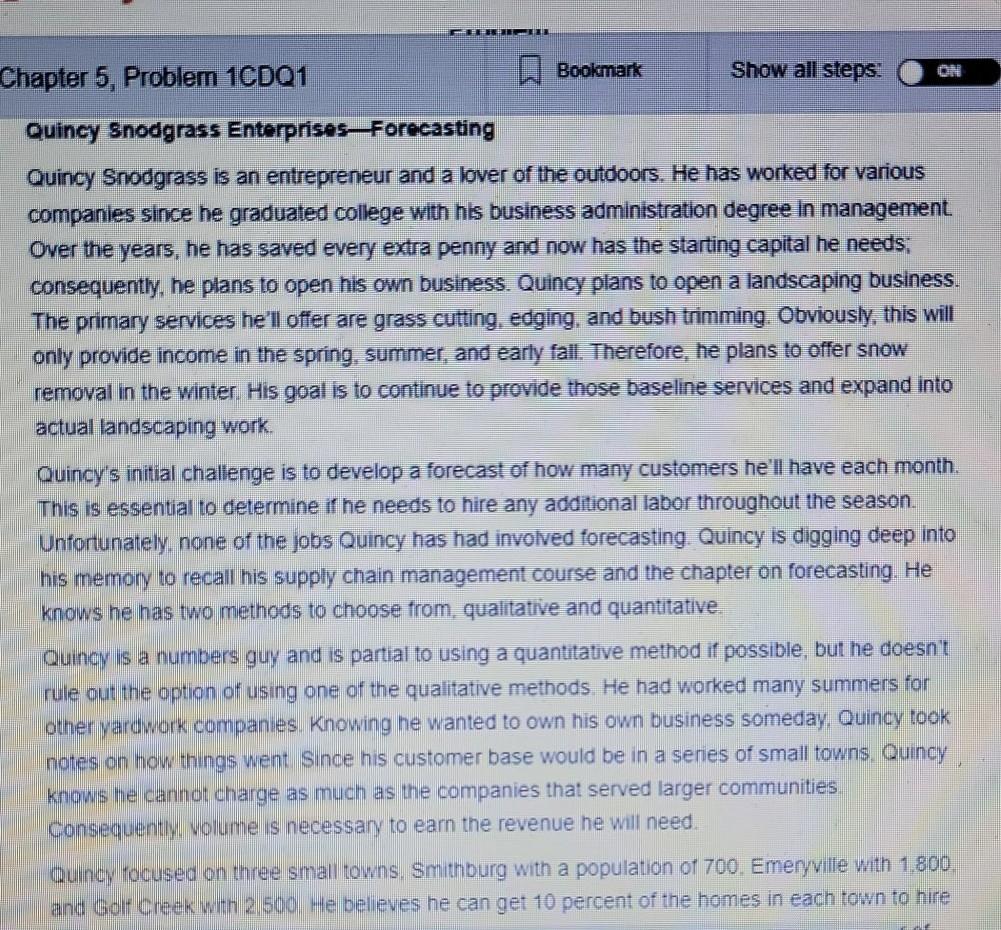
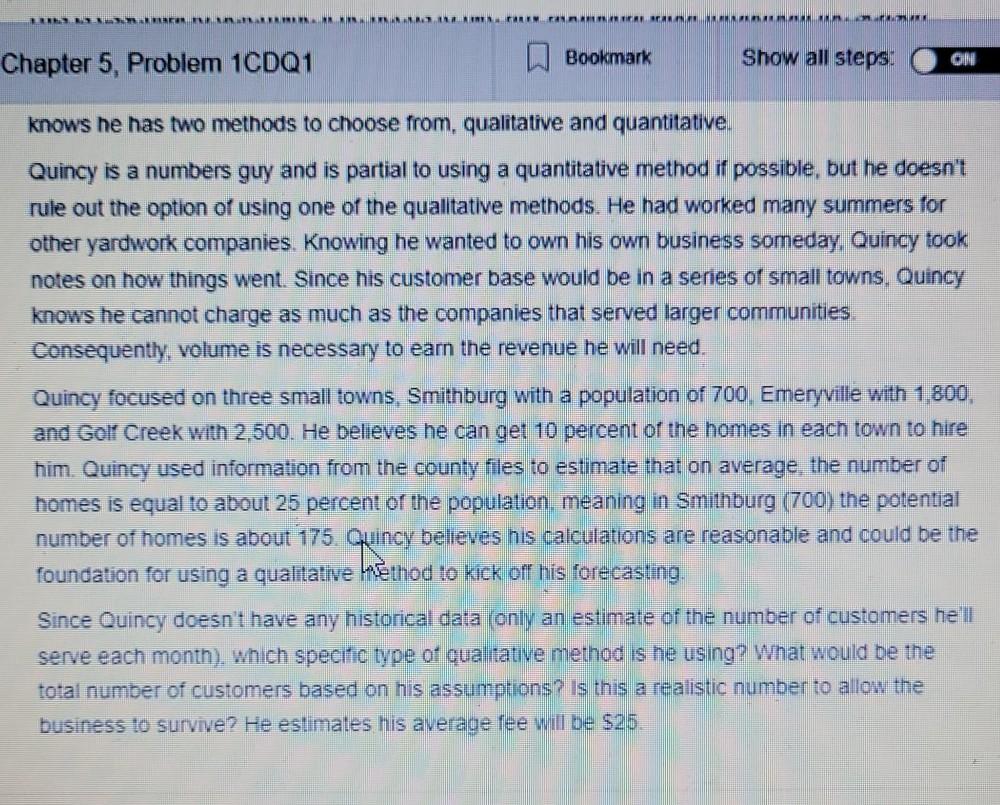
GEREN ER Bookmark Show all steps Chapter 5, Problem 1CDQ1 Quincy Snodgrass Enterprises,Forecasting Quincy Snodgrass is an entrepreneur and a lover of the outdoors. He has worked for various companies since he graduated college with his business administration degree in management Over the years, he has saved every extra penny and now has the starting capital he needs: consequently, he plans to open his own business. Quincy plans to open a landscaping business. The primary services he'll offer are grass cutting edging, and bush trimming. Obviously, this will only provide income in the spring summer, and early fall. Therefore, he plans to offer snow removal in the winter. His goal is to continue to provide those baseline services and expand into actual landscaping work. Quincy's initial challenge is to develop a forecast of how many customers he'll have each month. This is essential to determine if he needs to hire any additional labor throughout the season. Unfortunately none of the jobs Quincy has had involved forecasting. Quincy is digging deep into his memory to recall his supply chain management course and the chapter on forecasting. He knows he has two methods to choose from, qualitative and quantitative. Quincy is a numbers guy and is partial to using a quantitative method if possible, but he doesn't rule out the option of using one of the qualitative methods. He had worked many summers for other yardwork companies. Knowing he wanted to own his own business someday. Quincy took notes on how things went Since his customer base would be in a series of small towns. Quincy knows he cannot charge as much as the companies that served larger communities Consequently, volume is necessary to earn the revenue he will need. Quincy focused on three small towns. Smithburg with a population of 700. Emeryville with 1.800. and Golf Creek with 2 500 He believes he can get 10 percent of the homes in each town to hire 21MERRNr. Innun. Chapter 5, Problem 1CDQ1 A Bookmark Show all steps ON knows he has two methods to choose from, qualitative and quantitative. Quincy is a numbers guy and is partial to using a quantitative method if possible, but he doesn't rule out the option of using one of the qualitative methods. He had worked many summers for other yardwork companies. Knowing he wanted to own his own business someday, Quincy took notes on how things went. Since his customer base would be in a series of small towns. Quincy knows he cannot charge as much as the companies that served larger communities Consequently, volume is necessary to earn the revenue he will need. Quincy focused on three small towns. Smithburg with a population of 700. Emeryville with 1.800, and Golf Creek with 2.500. He believes he can get 10 percent of the homes in each town to hire him. Quincy used information from the county files to estimate that on average, the number of homes is equal to about 25 percent of the population, meaning in Smithburg (700) the potential number of homes is about 175. Quincy believes his calculations are reasonable and could be the foundation for using a qualitative hethod to kick off his forecasting. Since Quincy doesn't have any historical data (only an estimate of the number of customers he'll serve each month), which specific type of qualitative method is he using? What would be the total number of customers based on his assumptions? Is this a realistic number to allow the business to survive? He estimates his average fee will be $25
Step by Step Solution
There are 3 Steps involved in it
1 Expert Approved Answer
Step: 1 Unlock

Question Has Been Solved by an Expert!
Get step-by-step solutions from verified subject matter experts
Step: 2 Unlock
Step: 3 Unlock
 Study Help