







Question: Given a positive integer n , the following rules will always create a sequence that ends with 1 , called the hailstone sequence If n
Given a positive integer the following rules will always create a sequence that ends with called the hailstone sequence
If is even, divide it by
If is odd, multiply it by and add ie
Continue until is
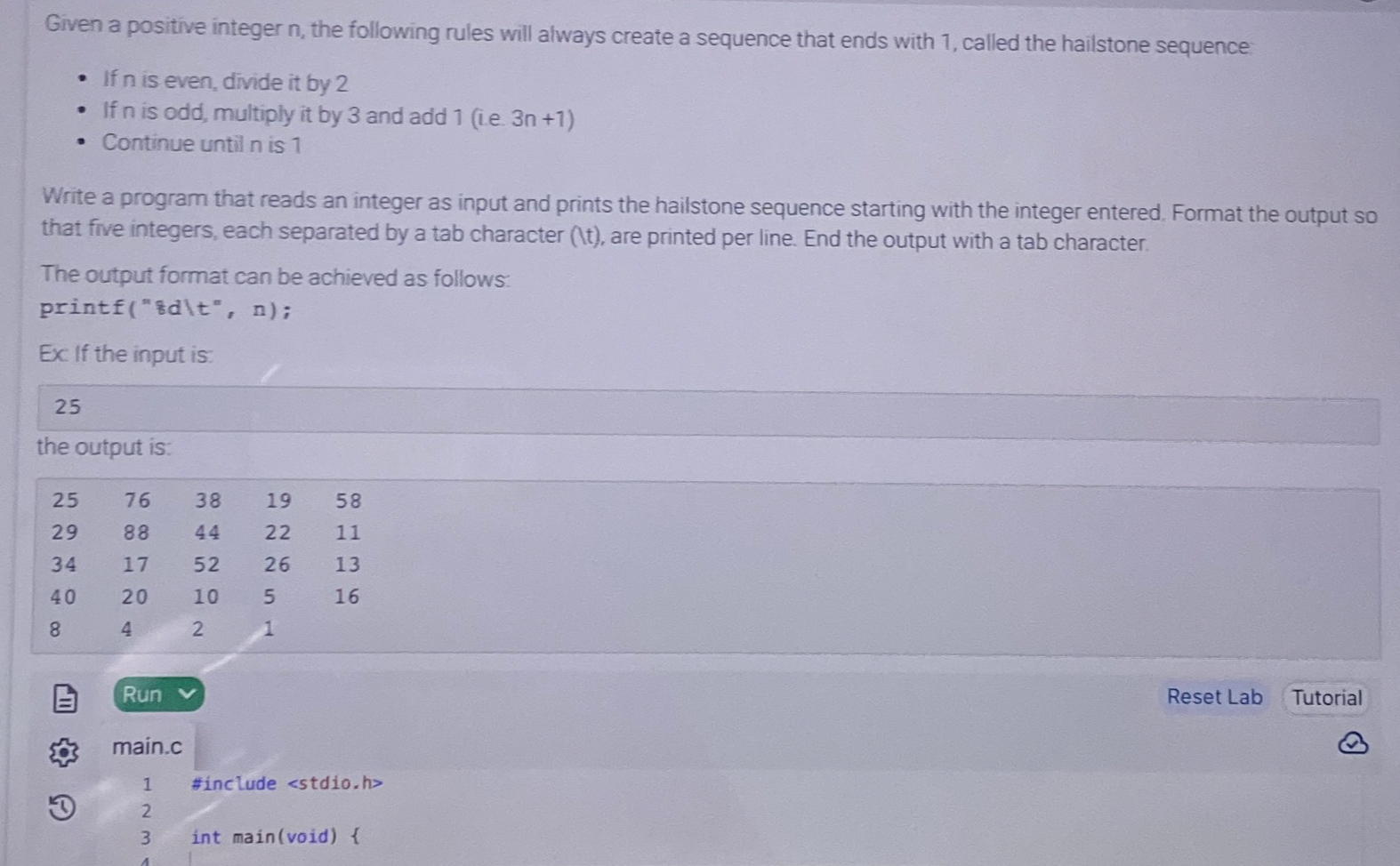
Write a program that reads an integer as input and prints the hailstone sequence starting with the integer entered. Format the output so that five integers, each separated by a tab character are printed per line. End the output with a tab character.
The output format can be achieved as follows:
printft ;
Ex If the input is:
the output is:
table
Run
Reset Lab
main.c
#include
Step by Step Solution
There are 3 Steps involved in it
1 Expert Approved Answer
Step: 1 Unlock

Question Has Been Solved by an Expert!
Get step-by-step solutions from verified subject matter experts
Step: 2 Unlock
Step: 3 Unlock
 Study Help