







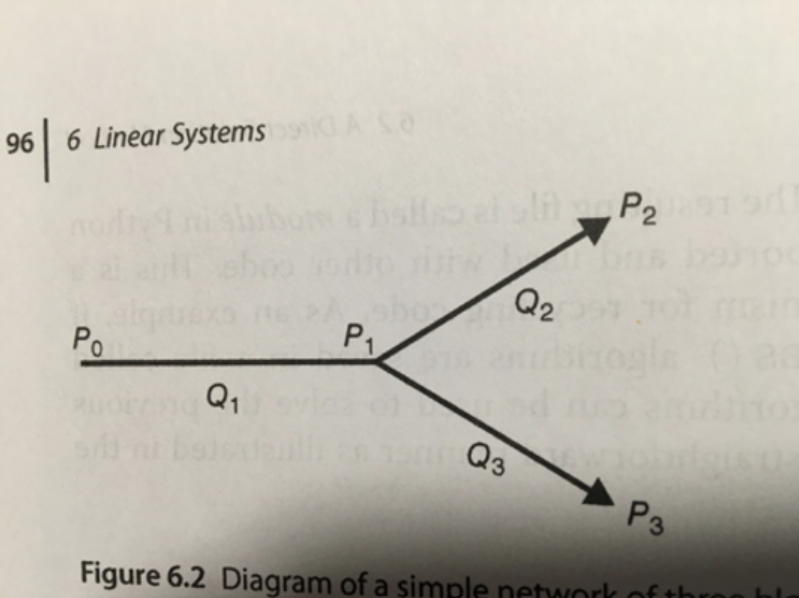
Question: Given Information: Vessel 1 : Unknown flow rate Q 1 and pressure drop Delta P = P 0 P 1 Vessel 2 : Unknown
Given Information:
Vessel : Unknown flow rate Q and pressure drop Delta PPP
Vessel : Unknown flow rate Q and pressure drop Delta PPP
Vessel : Unknown flow rate Q and pressure drop Delta PPP
P dyncm; PP dyncm; Vessel : d cm L cm; Vessel : d cm L cm; Vessel : d cm L cm; mu
The simplest mathematical model of blood flow assumes that the flow is steady, the vessel walls are rigid, and the blood vessels are straight cylinders. Under these assumptions, the flow inside a vessel can be approximated using the Poiseuille flow solution, which states that the flow rate, Q through the vessel is proportional to the pressure decrease, Delta P given by the equation: Delta P mu Lpi dQ Here, Delta P is the pressure decrease, mu is the viscosity of the blood, L is the length of the vessel, and d is the diameter of the vessel.
Goal: To model flow through three vessels in the below figure.
IN PYTHON CODE:
Derive linear algebraic equations for unknowns by applying the Poiseuille flow equation and mass balance
Write the above Equation in the form of Ax B where x is a vector of unknown variables. Use Python to write matrix A and vector B
Determine the element of rd row and th column of the matrix A using Python.
Step by Step Solution
There are 3 Steps involved in it
1 Expert Approved Answer
Step: 1 Unlock

Question Has Been Solved by an Expert!
Get step-by-step solutions from verified subject matter experts
Step: 2 Unlock
Step: 3 Unlock
 Study Help