







Question: Hello, Is there Anyone for Helps? Why is hydroxide ion a strong base in water solutions? A. OH is the only base. B. OH is
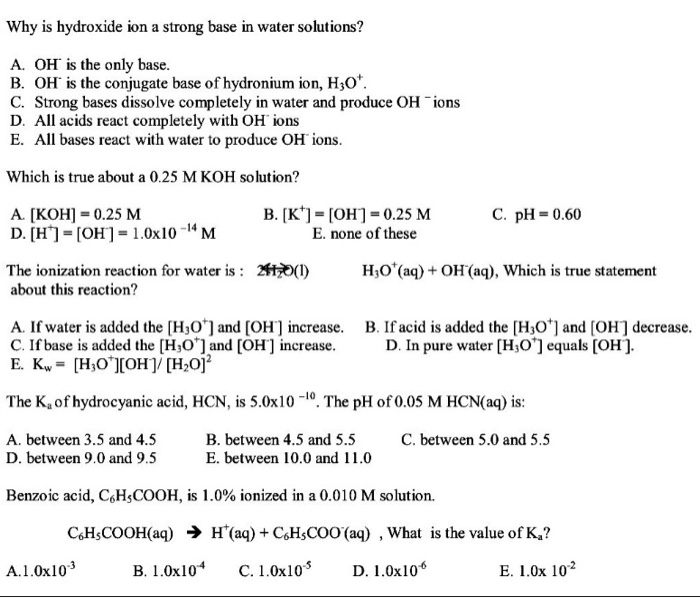
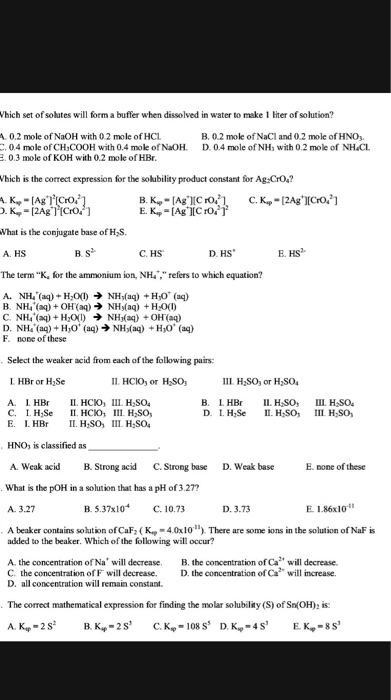
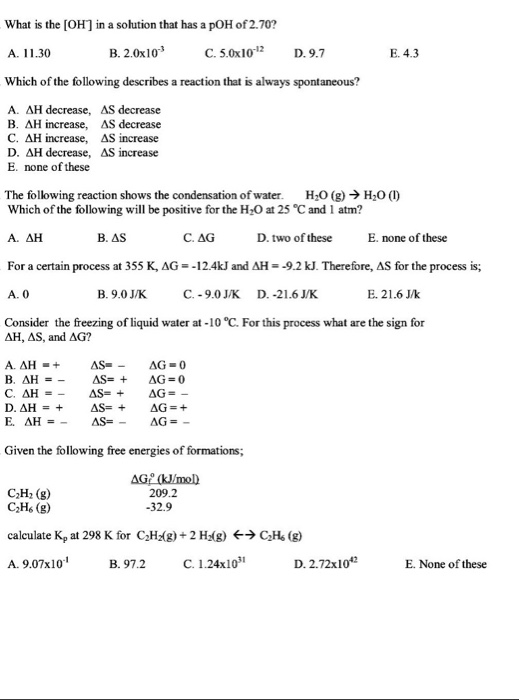
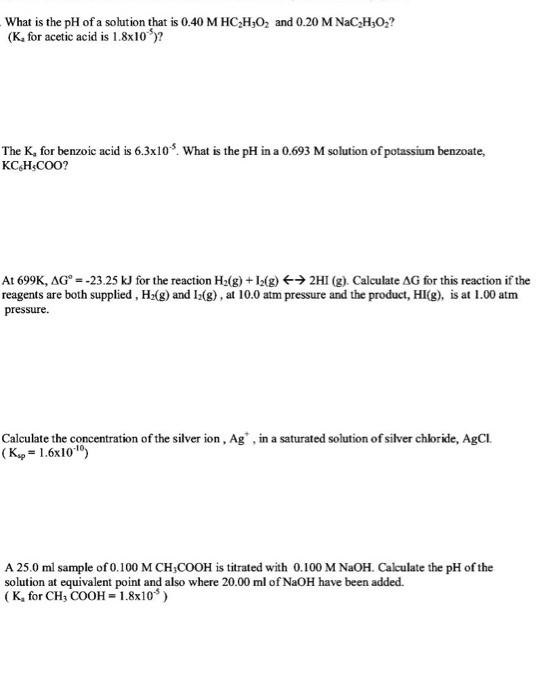
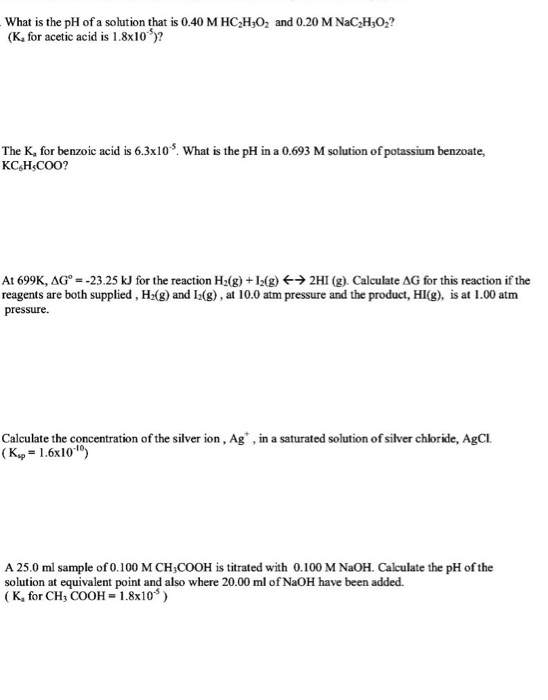
Why is hydroxide ion a strong base in water solutions? A. OH is the only base. B. OH is the conjugate base of hydronium ion, H3O*. C. Strong bases dissolve completely in water and produce OH-ions D. All acids react completely with OH ions E. All bases react with water to produce OH ions. Which is true about a 0.25 M KOH solution? A. [KOH] = 0.25 M D. [H] = [OH] = 1.0x10⁻⁴ M The ionization reaction for water is: 170(1) about this reaction? B. [K]= [OH] = 0.25 M E. none of these A. between 3.5 and 4.5 D. between 9.0 and 9.5 A. If water is added the [H3O*] and [OH] increase. C. If base is added the [H3O*] and [OH] increase. E. Kw = [HO*][OH]/[HO] The K of hydrocyanic acid, HCN, is 5.0x10⁻¹⁰. The pH of 0.05 M HCN(aq) is: C. between 5.0 and 5.5 C. pH=0.60 HO (aq) + OH(aq), Which is true statement B. between 4.5 and 5.5 E. between 10.0 and 11.0 Benzoic acid, C6H5COOH, is 1.0% ionized in a 0.010 M solution. A.1.0x10 B. If acid is added the [H3O*] and [OH] decrease. D. In pure water [HO*] equals [OH]. C6H5COOH(aq) H(aq) + CH,COO (aq), What is the value of K? B. 1.0x10⁴ C. 1.0x10⁵ D. 1.0x10⁶ E. 1.0x 10² Which set of solutes will form a buffer when dissolved in water to make 1 liter of solution? A. 0.2 mole of NaOH with 0.2 mole of HCL. C. 0.4 mole of CHCOOH with 0.4 mole of NaOH. 3. 0.3 mole of KOH with 0.2 mole of HBr. Which is the correct expression for the solubility product constant for Ag-CrO? A. K, -[Ag1[Cro.] D. Kap-[2Ag ] [Cro] B. Kup-[Ag][Cro E. Kap-[Ag ][Cro] C.HS B. 0.2 mole of NaCl and 0.2 mole of HNO3. D. 0.4 mole of NH; with 0.2 mole of NH.CL What is the conjugate base of HS. A. HS B. S D. HS* The term K, for the ammonium ion, NH. , refers to which equation? A. NH (aq) + H_O(I) NH,(aq) +H;O (aq) B. NH(sq)+OH(m) NH(aq) +HOI) C. NH, (sq) + HyO!) NH() +OH (ng) D. NH (34) + HO (aq) NH(q) +HO* (aq) F. none of these Select the weaker acid from each of the following pairs: L. HBr or HSe II. HCIO, or HSO, A. LHBr C. L. HSe E. I. HBr II. HCIO, III. HSO II. HCIO, III. HSO, II. HSO, III HSO4 A. the concentration of Na will decrease. C. the concentration of F will decrease. D. all concentration will remain constant. C. Kap-[2Ag ][Cro.] B. L. HBr D. I. HSe III HSO, or HSO4 II. HSO, II. HSO, E. HS .HNO, is classified as A. Weak acid B. Strong acid C. Strong base What is the pOH in a solution that has a pH of 3.27? A. 3.27 B. 5.37x10 C. 10.73 D. 3.73 E. 1.86x10 A beaker contains solution of CaF2 (K-4.0x10 ). There are some ions in the solution of NaF is added to the beaker. Which of the following will occur? D. Weak base III. HSO III HSO, E. none of these B. the concentration of Ca will decrease. D. the concentration of Ca will increase. The correct mathematical expression for finding the molar solubility (S) of Sn(OH) is: A. K-28 B. Kup-2 S C. Kp-108 S D. K-45 E.K-8S What is the [OH] in a solution that has a pOH of 2.70? A. 11.30 B. 2.0x10 C. 5.0x10⁻² D. 9.7 Which of the following describes a reaction that is always spontaneous? A. AH decrease, AS decrease B. AH increase, AS decrease C. AH increase, AS increase D. AH decrease, AS increase E. none of these The following reaction shows the condensation of water. HO(g) H0 (1) Which of the following will be positive for the HO at 25 C and 1 atm? A. AH B. AS C. AG D. two of these E. none of these For a certain process at 355 K, AG = -12.4kJ and AH = -9.2 kJ. Therefore, AS for the process is; A. 0 B. 9.0 J/K C.-9.0 J/K D.-21.6 J/K E. 21.6 J/k Consider the freezing of liquid water at -10 C. For this process what are the sign for AH, AS, and AG? . = + . = - C. = D. = + E. AH AS-- AS + CH(g) CH6 (g) AS=+ AS=+ AS=- AG=0 AG=0 AG=- AG=+ AG= Given the following free energies of formations; AG (kJ/mol) 209.2 -32.9 calculate K, at 298 K for CH(g) + 2 H(g) CH6 (g) A. 9.07x10 B. 97.2 C. 1.24x10 E. 4.3 D. 2.72x10 E. None of these What is the pH of a solution that is 0.40 M HCHO and 0.20 M NaCHO? (K, for acetic acid is 1.8x10 )? The K, for benzoic acid is 6.3x10⁵. What is the pH in a 0.693 M solution of potassium benzoate, KCH,COO? At 699K, AG* = -23.25 kJ for the reaction H(g) +12(g) 2HI (g). Calculate AG for this reaction if the reagents are both supplied, H(g) and I2(g), at 10.0 atm pressure and the product, HI(g), is at 1.00 atm pressure. Calculate the concentration of the silver ion, Ag, in a saturated solution of silver chloride, AgCl. (Kap=1.6x10.10) A 25.0 ml sample of 0.100 M CHCOOH is titrated with 0.100 M NaOH. Calculate the pH of the solution at equivalent point and also where 20.00 ml of NaOH have been added. (K, for CH3 COOH = 1.8x10) What is the pH of a solution that is 0.40 M HCHO and 0.20 M NaCHO? (K, for acetic acid is 1.8x10 %)? The K, for benzoic acid is 6.3x10⁵. What is the pH in a 0.693 M solution of potassium benzoate, KCH,COO? At 699K, AG* = -23.25 kJ for the reaction H(g) +12(g) 2HI (g). Calculate AG for this reaction if the reagents are both supplied, H(g) and I2(g), at 10.0 atm pressure and the product, HI(g), is at 1.00 atm pressure. Calculate the concentration of the silver ion, Ag, in a saturated solution of silver chloride, AgCl. (Kap=1.6x10.10) A 25.0 ml sample of 0.100 M CHCOOH is titrated with 0.100 M NaOH. Calculate the pH of the solution at equivalent point and also where 20.00 ml of NaOH have been added. (K, for CH3 COOH = 1.8x10)
Step by Step Solution
3.43 Rating (143 Votes )
There are 3 Steps involved in it
1 The correct answer is C Strong bases by definition are bases that dissociate completely in water producing hydroxide ions 2 The correct answer is A ... View full answer

Get step-by-step solutions from verified subject matter experts
 Study Help