







Question: Help Question 2! Question 1 2 - Draw complete chemical reactions for reactions involving molecules from question 1 and the following reagents: a) Cl2+ molecule
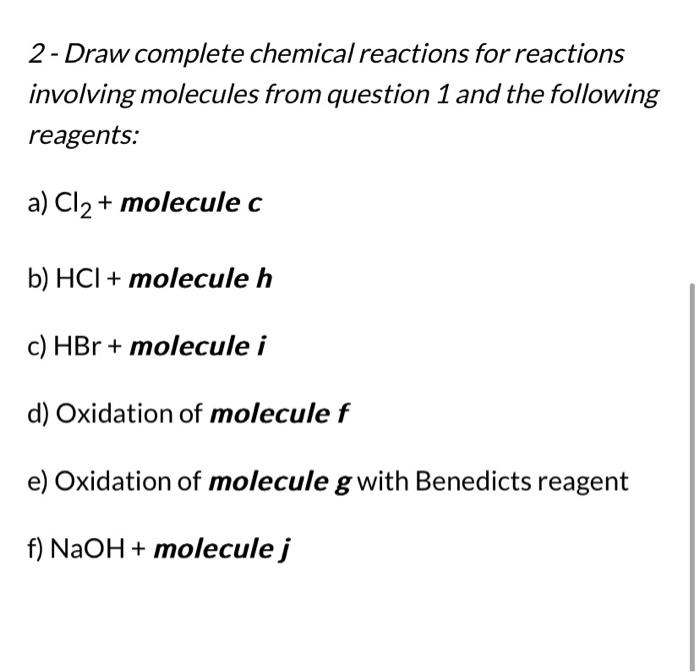
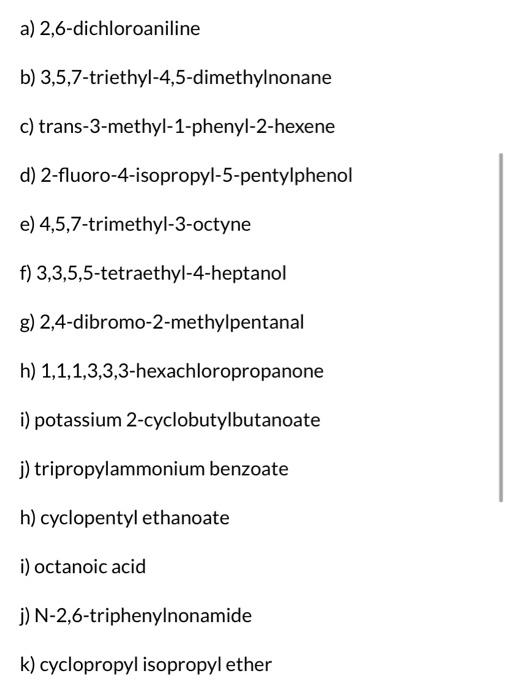
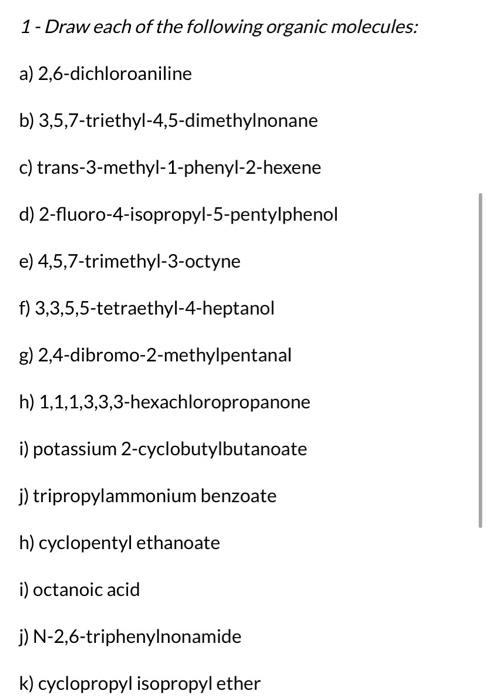
2 - Draw complete chemical reactions for reactions involving molecules from question 1 and the following reagents: a) Cl2+ molecule c b) HCl+ molecule h c) HBr+ molecule i d) Oxidation of molecule f e) Oxidation of molecule g with Benedicts reagent f) NaOH+ molecule j a) 2,6-dichloroaniline b) 3,5,7-triethyl-4,5-dimethylnonane c) trans-3-methyl-1-phenyl-2-hexene d) 2-fluoro-4-isopropyl-5-pentylphenol e) 4,5,7-trimethyl-3-octyne f) 3,3,5,5-tetraethyl-4-heptanol g) 2,4-dibromo-2-methylpentanal h) 1,1,1,3,3,3-hexachloropropanone i) potassium 2-cyclobutylbutanoate j) tripropylammonium benzoate h) cyclopentyl ethanoate i) octanoic acid j) N-2,6-triphenylnonamide k) cyclopropyl isopropyl ether 1 - Draw each of the following organic molecu a) 2,6-dichloroaniline b) 3,5,7-triethyl-4,5-dimethylnonane c) trans-3-methyl-1-phenyl-2-hexene d) 2-fluoro-4-isopropyl-5-pentylphenol e) 4,5,7-trimethyl-3-octyne f) 3,3,5,5-tetraethyl-4-heptanol g) 2,4-dibromo-2-methylpentanal h) 1,1,1,3,3,3-hexachloropropanone i) potassium 2-cyclobutylbutanoate j) tripropylammonium benzoate h) cyclopentyl ethanoate i) octanoic acid j) N-2,6-triphenylnonamide k) cyclopropyl isopropyl ether 2 - Draw complete chemical reactions for reactions involving molecules from question 1 and the following reagents: a) Cl2+ molecule c b) HCl+ molecule h c) HBr+ molecule i d) Oxidation of molecule f e) Oxidation of molecule g with Benedicts reagent f) NaOH+ molecule j a) 2,6-dichloroaniline b) 3,5,7-triethyl-4,5-dimethylnonane c) trans-3-methyl-1-phenyl-2-hexene d) 2-fluoro-4-isopropyl-5-pentylphenol e) 4,5,7-trimethyl-3-octyne f) 3,3,5,5-tetraethyl-4-heptanol g) 2,4-dibromo-2-methylpentanal h) 1,1,1,3,3,3-hexachloropropanone i) potassium 2-cyclobutylbutanoate j) tripropylammonium benzoate h) cyclopentyl ethanoate i) octanoic acid j) N-2,6-triphenylnonamide k) cyclopropyl isopropyl ether 1 - Draw each of the following organic molecu a) 2,6-dichloroaniline b) 3,5,7-triethyl-4,5-dimethylnonane c) trans-3-methyl-1-phenyl-2-hexene d) 2-fluoro-4-isopropyl-5-pentylphenol e) 4,5,7-trimethyl-3-octyne f) 3,3,5,5-tetraethyl-4-heptanol g) 2,4-dibromo-2-methylpentanal h) 1,1,1,3,3,3-hexachloropropanone i) potassium 2-cyclobutylbutanoate j) tripropylammonium benzoate h) cyclopentyl ethanoate i) octanoic acid j) N-2,6-triphenylnonamide k) cyclopropyl isopropyl ether
Step by Step Solution
There are 3 Steps involved in it

Get step-by-step solutions from verified subject matter experts
 Study Help