







Question: Hi, Could someone let me know if I answer correctly, please? Thank you. Answer: = 1310 m s (in 3 sig-figs). Explanation: Using Newton's second
Hi,
Could someone let me know if I answer correctly, please? Thank you.
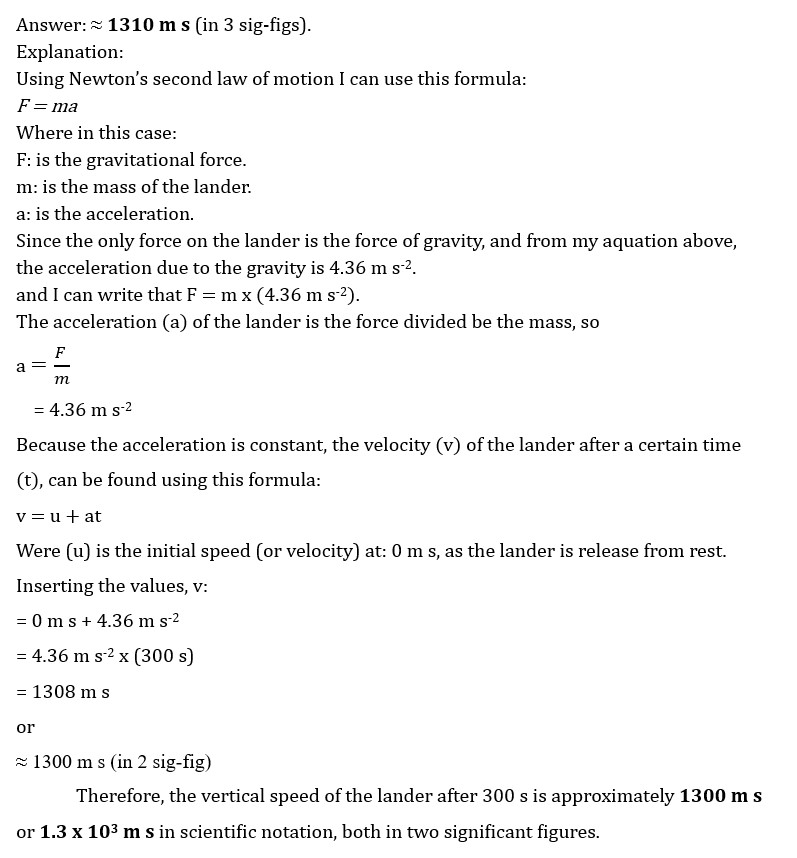
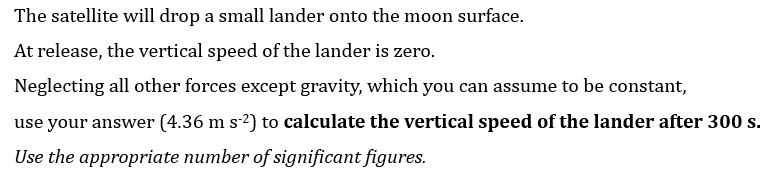
Answer: = 1310 m s (in 3 sig-figs). Explanation: Using Newton's second law of motion I can use this formula: F=ma Where in this case: F: is the gravitational force. m: is the mass of the lander. a: is the acceleration. Since the only force on the lander is the force of gravity, and from my aquation above, the acceleration due to the gravity is 4.36 m s2. and I can write that F = m x (4.36 m s2). The acceleration (a) of the lander is the force divided be the mass, so __F a _ m =4.36ms? Because the acceleration is constant, the velocity (v) of the lander after a certain time (t), can be found using this formula: v=u-+at Were (u) is the initial speed (or velocity) at: 0 m s, as the lander is release from rest. Inserting the values, v: =0ms+4.36ms? =436 ms?2x(300s) =1308ms or = 1300 m s (in 2 sig-fig) Therefore, the vertical speed of the lander after 300 s is approximately 1300 m s or 1.3 X 10³ m s in scientific notation, both in two significant figures. The satellite will drop a small lander onto the moon surface. At release, the vertical speed of the lander is zero. Neglecting all other forces except gravity, which you can assume to be constant, use your answer (4.36 m s2) to calculate the vertical speed of the lander after 300 s. Use the appropriate number of significant figures
Step by Step Solution
There are 3 Steps involved in it

Get step-by-step solutions from verified subject matter experts
 Study Help