



Question: Hi here is the question Thanks!! 3. This exercise explores the nature of insurance contracts. We examine a pervasive feature of actual insurance contractsa requirement-
Hi here is the question Thanks!!
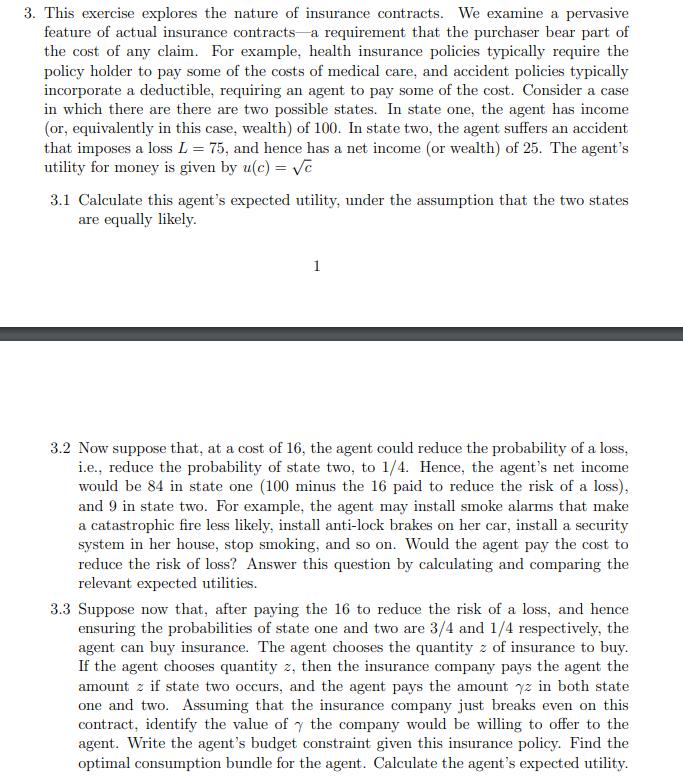
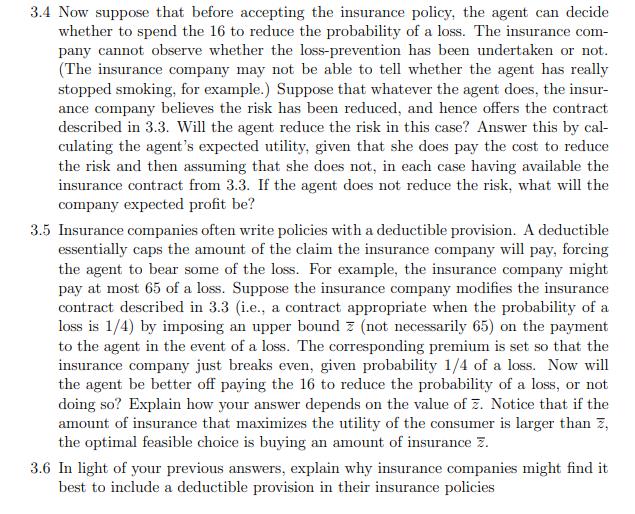
3. This exercise explores the nature of insurance contracts. We examine a pervasive feature of actual insurance contractsa requirement- that the purchaser bear part of the cost of any claim. For ecsample1 health insurance policies typically require the policy holder to pay some of the costs of medical care, and accident policies typically incorporate a deductible, requiring an agent to pay some of the cost. i:ronsider a case in which there are there are two possible states. In state one, the agent has income (or, equivalently in this case, wealth} of l. In state two, the agent- suffers an accident that imposes a loss L = 75, and hence has a net income [or wealth} of 25. The agent's utility for money is given by u[c) = VIE 3.1 Calculate this agent's expected utility, under the assumption that the two states are equally likely. 3.2 Now suppose that, at a cost of 16, the agent could reduce the probability of a loss, i.e., reduce the probability of state two, to lf. Hence, the agent's net income muld be $4 in state one {10:} minus the 115 paid to reduce the risk of a loss}, and 9 in state two. For example, the agent may install smoke alarms that make a catastrophic re less likely, install anti-lock braka on her car, install a security system in her house, stop smoking, and so on. Would the agent pay the cost to reduce the risk of loss? Answer this question by calculating and comparing the relevant expected utilities. 3.3 Suppose now that, after paying the Hi to reduce the risk of a loss, and hence ensuring the probabilitim of state one and two are 3,34 and 1f 4 respectively, the agent- can buy insurance. The agent. chooses the quantity 2 of insurance to buy. If the agent chooses quantity .2, then the insurance company pays the agent the amount .2 if state two occurs, and the agent pays the amount 1'2: in both state one and two. Assuming that the insurance company just breaks even on this contract, identify the value of y the company would be willing to offer to the agent. Write the agent's budget constraint- given this insurance policy. Find the optimal consumption bundle for the agent. Calculate the agent's expected utility. 3.4 Now suppose that before accepting the insurance policy, the agent can decide whether to spend the Hi to reduce the probability of a loss. The insurance com pany cannot observe whether the lossprevention has been undertaken or not. [The insurance companyr may not be able to tell whether the agent has really stopped smoking, for example.) Suppose that whatever the agent does, the insur ance company believes the risk has been reduced, and hence olfers the contract described in 3.3. Will the agent reduce the risk in this case?I Answer this by cal culating the agenth expected utility1 given that she does pay the cost to reduce the risk and then assuming that she does not, in each case having available the insurance contract from 3.3. If the agent does not reduce the risk, what will the company expected prot be? 3.5 Insurance companies often write policies with a deductible provision. A deductible essentially caps the amolmt of the claim the insurance company will pay, forcing the agent to bear some of the loss. For example, the insurance company might pay at most 35 of a loss. Suppose the insurance company modies the insurance contract described in 3.3 {i.e., a contract appropriate when the probability of a loss is Hat) by imposing an upper bound 1 (not noel-arily 55} on the payment to the agent in the event of a loss. The corresponding premium is set so that the insurance company just breaks even, given probability 1,54 of a loss. Now will the agent be better off paying the if} to reduce the probability of a loss, or not doing so'EI Explain how your answer depends on the value of E. Notice that if the amount of insurance that maximizes the utility of the consumer is larger than E, the optimal feasible choice is buying an amount of insurance E. 3.6 In light of your previous answers, explain why insurance companies might nd it best to include a deductible provision in their insurance policies
Step by Step Solution
There are 3 Steps involved in it

Get step-by-step solutions from verified subject matter experts