







Question: how can CDK Digital leverage its core competencies to provie a webside solution that both GM and its dealers consider to serve their interests? KEI
how can CDK Digital leverage its core competencies to provie a webside solution that both GM and its dealers consider to serve their interests?
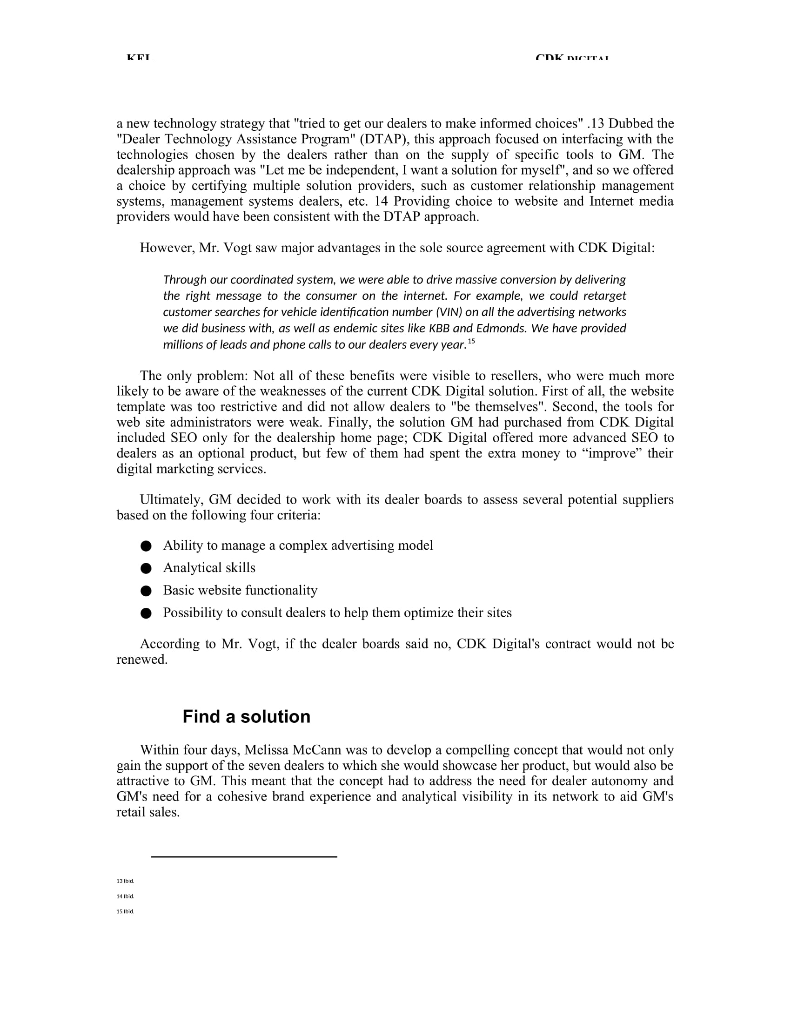
KEI KFI CAK NGITAL As a result, in 2011, manufacturers and dealers were concerned about reducing online brand defection during the buying process. Data from CDK Digital and Google suggested that the best approach to achieve this was to coordinate digital marketing between different levels of advertising, as this increased the effectiveness of both manufacturer and dealer marketing spend. In reality, the advertising and content of local and regional dealer websites were seldom aligned with the messages of the OEMs due to conflicting goals and lack of coordination. Dealer websites Manufacturers initially viewed dealer websites as part of franchisee brand compliance programs, as were store signage and facility design. Dealers have been penalized for not using websites provided by manufacturers or have been given financial incentives to encourage their adoption. However, the dealership had ultimate control: although a manufacturer could require a dealership to have a website, they could not require it to use it as the dealership's primary web presence. As a result, many dealerships had multiple websites, some provided by the manufacturers and others independently purchased and managed by the dealer. Automakers have used several approaches to deliver websites to their US dealerships. The simplest was a compliance program, which Toyota used. As part of a compliance program, a manufacturer created brand standards and required their dealers to adhere to those standards when they created their own websites. However, dealers were free to choose their own website designers and operators. OEMs regularly audited their websites and fined dealers who failed to meet standards. A manufacturer may also opt for a "single platform" model in which they engage a company to provide a common website platform for dealers. CDK Digital and Dealer.com were the primary vendors under the single platform model. CDK Digital had exclusive supplier agreements with the four brands GM (Chevrolet, Buick, GMC, Cadillac), Volkswagen and Hyundai. Subaru and Audi used Dealer.com. Some manufacturers, including Lexus, BMW, Kia, and Ford, have licensed two or three platform providers rather than just one. Finally, an OEM could outsource the entire program to an integrator who managed relationships with dealers and all approved suppliers. Chrysler used this approach (with Shift Digital), as did Ford (with its semi-autonomous Ford Direct unit). General Motors Founded in 1908, GM had been a leading manufacturer of automobiles and automotive and non-automotive components for over a century. From its inception, the company sold automobiles under different license plates (or brands), each of which was aimed at a specific demographic and socio-economic market segment. The brands - Chevrolet, Pontiac, Oldsmobile, Buick, and Cadillac - shared company management and some components to create economies of scale, but each developed a unique style and technology. This "ladder of success" was designed to meet the needs of entry-level buyers with Chevrolet vehicles, then encourage them to move on to Pontiac, Oldsmobile, Buick, and finally Cadillac. THE KELLOGGS MANAGEMENT SCHOOL CAK NITAT Between 2000 and 2008, GM dramatically improved the quality, productivity and fuel economy of its cars, and established a profitable business in China, the world's largest potential automotive market. The company also improved its cost position by reducing its workforce by 143,000 employees and negotiating a landmark deal with the United Auto Workers union that cut wages for new employees and benefits for retirees. However, when the global economic crisis hit in 2008, GM suffered more than most of its competitors: it recorded a loss of S 30.9 billion in 2008. On June 1, 2009, GM filed for reorganization under Chapter 11 of the United States Bankruptcy Law; Due to its age and stature, GM had a large and unwieldy dealer network. In 2007, it had more than 6,000 dealers, resulting in increased costs for GM and more price competition for dealers. By comparison, Toyota, which entered the US market in the late 1950s, in 2011 had nearly equal sales to GM with less than a third of the number of dealer franchises. GM tried to dislodge several hundred dealers when it went bankrupt in 2009, but court rulings prevented the automaker from seceding from its network. New entrants, such as Mini and Lexus, were able to build smaller networks, with stricter brand standards and more profitable dealerships. CDK Digital CDK Digital was founded in 1995 as The Cobalt Group by John Holt and Geof Barker, who believed the Internet would be more effective than classified connecting car buyers and sellers. At the time, other internet start-ups were creating business models that bypassed the traditional dealer, but Cobalt focused on connecting dealerships with buyers and builders. The following year, the company secured the endorsement of Lexus to supply websites for its entire dealer network. The following year, Mitsubishi, Acura, Nissan and Volkswagen gave it their support. In 1999, Cobalt went public, but went private again in 2001, during the dot-com crash, after a major investment by investment firm Warburg Pincus. In 2004, GM chose Cobalt to replace an in-house developed web system and in 2007 awarded Cobalt a five-year contract for a single platform to provide websites to its nationwide dealer network. ADP Dealer Services acquired Cobalt in 2010 for approximately $ 400 million. In 2014, ADP Dealer Services separated from ADP and Cobalt was renamed CDK Digital. Publicity Although CDK Digital started out as a website business, it has developed sophisticated capabilities in online advertising, CDK Digital's primary benefit to online advertising was its ability to track a significant portion of a car buyer's online journey using digital beacons (or cookies) on all CDK Digital dealership websites, all of them. OEM websites provided by CDK Digital and third party websites which have enabled CDK Digital to add its digital tags. This has cnabled it to track, for example, car makes and models searched, dealer websites visited, ads clicked, and models viewed on affiliated third-party automotive information sites. In fact, CDK Digital could even track cars that a consumer viewed in a dealer's inventory. "Our strength with 6KELLOGG SCHOOL OF MANAGEMENT KFI CAK NICIAL The answer to the question "What makes cars sell?" is that we are closer than anyone to answering the question "What makes cars sell?" To put this information to good use, CDK Digital bought out a company called Admission in 2008. Ad Mission has developed a technology that allows you to dynamically (that is to say in real time) show advertisements to each buyer according to their journey, unique online car buying. For example, if a consumer browses a Chevy Cruze on Chevrolet.com, they will see a Chevy Cruze ad the next time they visit a site where CDK Digital has placed ads. By combining data on the online journey of car buyers with content and inventory from local dealerships, CDK Digital could ensure that ads not only reflected consumer interests but also current dealer needs. CDK Digital's ability to target advertisements has enabled it to create a new line of business: placing advertisements for OEMs and dealerships on participating automotive sites. In addition, convinced that coordinating digital marketing between different levels of advertising increased the effectiveness of manufacturer and dealer marketing spend, CDK Digital also began to coordinate manufacturer and dealer bids on engine keywords. research. So Cadillac and its dealers did not increase the cost of the Google "Escalade" keyword by bidding against each other. Overall, CDK Digital has developed a sophisticated advertising platform that uses analytics to personalize real-time content based on each consumer's specific online car buying journey. CDK Digital has developed true "big data" capabilities, handling user interaction with over 20 million website visits and 1 billion ad impressions per month through hundreds of thousands of unique and creative executions Reed put it simply: "No other company in the automotive industry has this capability." 8 CDK Digital's 2007 Offer to GM Dealers In 2007, dealership websites were "the wild west," according to GM's Mr. Vogt. "We have seen an increasing tendency for consumers to leave third party and OEM sites to seek out a dealership connection in the digital space, and the media mix was not in line with customer behavior. Motors decided to amplify its brand message by having an integrated presence at dealerships that is linked to the brand's marketing messages "9. GM chose CDK Digital as its sole provider of digital marketing services after careful analysis of its capabilities and those of its competitors. When it launched its dealer website program in 2007, GM paid CDK Digital to provide each dealer with a basic website, SE010 and, most importantly, a relatively high level of digital marketing agency services by phone (web design, content updates, running promotions, etc. Ord, niew with ston. Norber 25, 2013. Edvininterview with the authors February 2014 19 SEO Search Engine Optimer is the grocess of winga website's promene in brand search engine red noser to increase the under at sikres. To do this, the corner and corpo weball cd carings the archaither, there arcad by the sand the grand chergh the target a chance. KELLOGG7 SCHOOL OF MANAGEMENT CAK NITAT GM offered the package to dealers as an optional service, but the vast majority of them used it. However, many dealers still had their own website in addition to the one provided by GM - only 43 percent of them used the site provided by GM as their primary website. According to Mr. Vogt, "They all wanted to be unique, and rightly so, the dealership brand is important. This results in consumer confusion as well as ineffective advertising; GM sites and Dealer sites often bid on the same advertising keywords, increasing costs for both. The marketing program put in place by CDK Digital received a lot of publicity and resources from GM, but most of the resources disappeared after the automaker filed for Chapter 11 bankruptcy protection in June. 2009. Subsequently, most of the marketing and communication with GM dealerships was carried out by a few staff members, most of whom were paid by CDK Digital, GM and CDK Digital measured the success of the program by the percentage of dealers who used CDK Digital's website as their primary website: from 2007 to 2011, half of dealers using non-GM websites canceled them, resulting in increased this percentage over 70%. However, some GM dealers were not satisfied with the program; a few dealers complained and showed little support for the dealer council meetings dominated by CDK Digital. Several reasons explain this dissatisfaction. One was that dealers felt (created by competitors to CDK Digital) that they were not getting high quality search engine optimization services. Another reason was GM-mandated rules that limited dealership control over their online presence. The dealers wanted to make changes to the appearance of their sites in order to differentiate themselves from other same-brand dealers in their markets. From their point of view, CDK Digital's analysis showed that 30-50% of visits to dealer websites were made by "brand lobbyists", that is, consumers who visited the site in response to branded advertising paid for by GM. The rest of the traffic came from many sources but was often generated by the dealer's own marketing expenses. Recontact with GM Between 2007 and 2011, the CDK Digital solution for GM evolved from a website solution to an Internet media solution, and from a brand compliance program to a program to provide sales opportunities to dealers. Mr. Vogt described it as follows: In the end, it was more than a website solution - it was a huge platform to drive traffic to our dealers online. We could actually coordinate media spending between ourselves, our dealers, and each individual dealership to optimize our presence for our consumers. 12 When it came to taking over the contract with CDK Digital, Vogt, who oversaw GM's marketing databases and dealer systems as well as the Internet, metrics and analytics teams, set up 11. vgl. in ew with the authors.ery 24, 2014 12 SKELLOGG SCHOOL OF MANAGEMENT KFI CAK NGITAL a new technology strategy that "tried to get our dealers to make informed choices" 13 Dubbed the "Dealer Technology Assistance Program" (DTAP), this approach focused on interfacing with the technologies chosen by the dealers rather than on the supply of specific tools to GM. The dealership approach was "Let me be independent, I want a solution for myself", and so we offered a choice by certifying multiple solution providers, such as customer relationship management systems, management systems dealers, etc. 14 Providing choice to website and internet media providers would have been consistent with the DTAP approach. However, Mr. Vogt saw major advantages in the sole source agreement with CDK Digital: Through our coordinated system, we were able to drive massive conversion by delivering the right message to the consumer on the internet. example, we could retarget customer searches for vehicle identification number (VIN) on all the advertising networks we did business with, as well as endemic sites like KBB and Edmonds. We have provided millions of leads and phone calls to our dealers every year. 15 The only problem: Not all of these benefits were visible to resellers, who were much more likely to be aware of the weaknesses of the current CDK Digital solution. First of all, the website template was too restrictive and did not allow dealers to "be themselves". Second, the tools for web site administrators were weak. Finally, the solution GM had purchased from CDK Digital included SEO only for the dealership home page; CDK Digital offered more advanced SEO to dealers as an optional product, but few of them had spent the extra money to improve their digital marketing services. Ultimately, GM decided to work with its dealer boards to assess several potential suppliers based on the following four criteria: Ability to manage a complex advertising model Analytical skills Basic website functionality Possibility to consult dealers to help them optimize their sites According to Mr. Vogt, if the dealer boards said no, CDK Digital's contract would not be renewed. Find a solution Within four days, Melissa McCann was to develop a compelling concept that would not only gain the support of the seven dealers to which she would showcase her product, but would also be attractive to GM. This meant that the concept had to address the need for dealer autonomy and GM's need for a cohesive brand experience and analytical visibility in its network to aid GM's retail sales. 13 od 15Step by Step Solution
There are 3 Steps involved in it
1 Expert Approved Answer
Step: 1 Unlock

Question Has Been Solved by an Expert!
Get step-by-step solutions from verified subject matter experts
Step: 2 Unlock
Step: 3 Unlock
 Study Help