







Question: PCA and PCB need to communicate. The path that the data takes between these end devices can travel through R1, R2, and R3, or
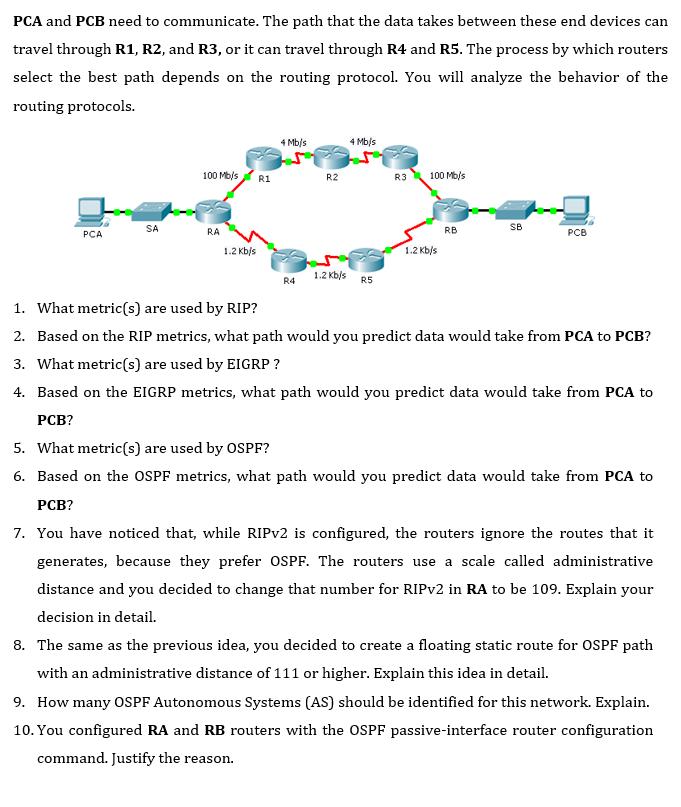
PCA and PCB need to communicate. The path that the data takes between these end devices can travel through R1, R2, and R3, or it can travel through R4 and R5. The process by which routers select the best path depends on the routing protocol. You will analyze the behavior of the routing protocols. 4 Mb/s 4 Mb/s 100 Mb/s R1 R2 R3 100 Mb/s SA PCA RA 1.2 kb/s R4 1.2 kb/s R5 SB RB PCB 1.2 kb/s 1. What metric(s) are used by RIP? 2. Based on the RIP metrics, what path would you predict data would take from PCA to PCB? 3. What metric(s) are used by EIGRP ? 4. Based on the EIGRP metrics, what path would you predict data would take from PCA to PCB? 5. What metric(s) are used by OSPF? 6. Based on the OSPF metrics, what path would you predict data would take from PCA to PCB? 7. You have noticed that, while RIPv2 is configured, the routers ignore the routes that it generates, because they prefer OSPF. The routers use a scale called administrative distance and you decided to change that number for RIPv2 in RA to be 109. Explain your decision in detail. 8. The same as the previous idea, you decided to create a floating static route for OSPF path with an administrative distance of 111 or higher. Explain this idea in detail. 9. How many OSPF Autonomous Systems (AS) should be identified for this network. Explain. 10. You configured RA and RB routers with the OSPF passive-interface router configuration command. Justify the reason.
Step by Step Solution
There are 3 Steps involved in it

Get step-by-step solutions from verified subject matter experts
 Study Help