







Question: I know there isn't specific values just solve it generally:Here is hint from my teacher to help solve: For Part 1b, please remember that if
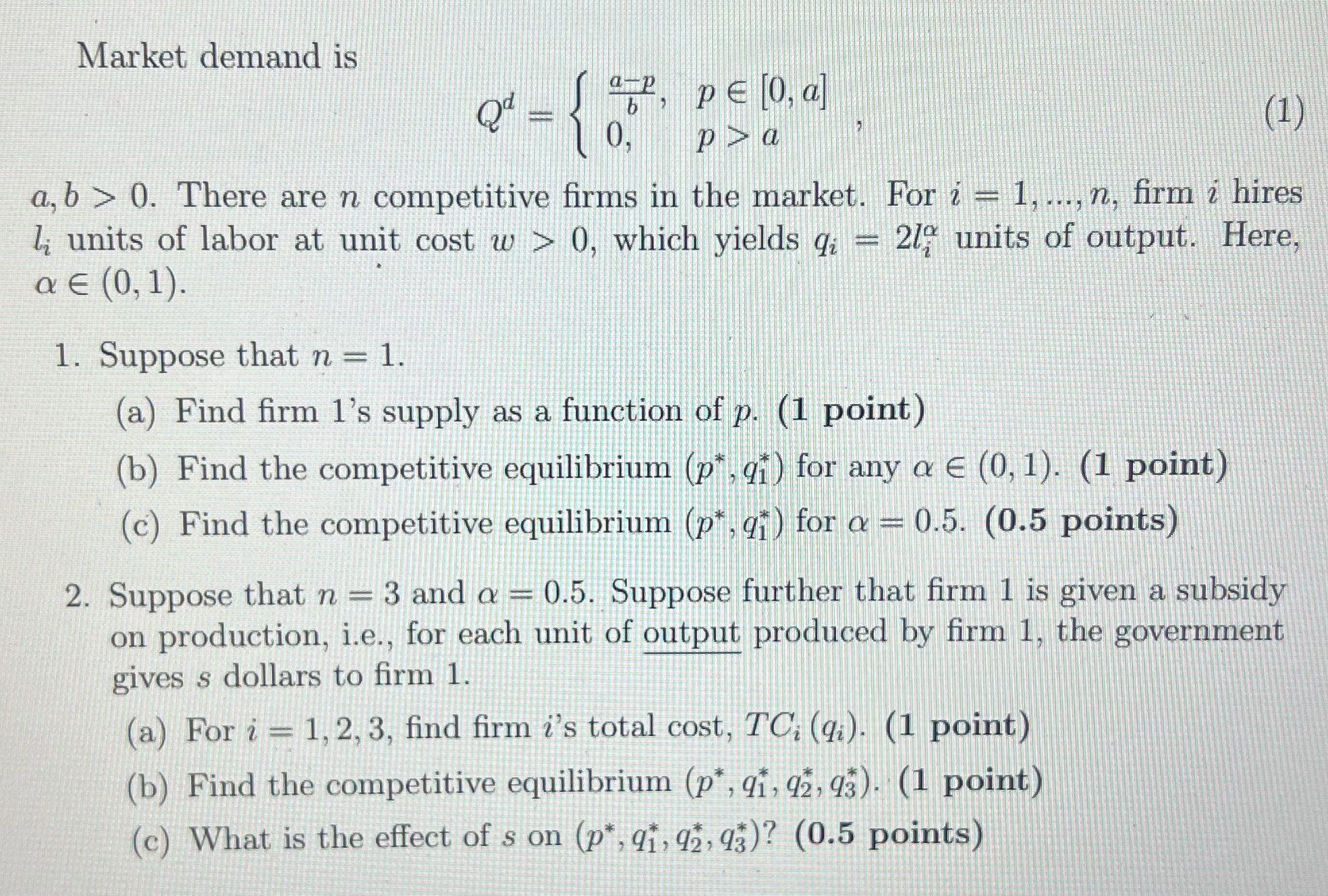
I know there isn't specific values just solve it generally:Here is hint from my teacher to help solve: For Part 1b, please remember that if you are unable to solve for p* explicitly, then use the graphical method learned in class with LHS and RHS and how a crossing implies existence of p*. For Part 1c, we need an explicit solution for p*.For Part 2, please assume that s is such that aw > 2bs.That is, we ignore the possibility or implication of p*
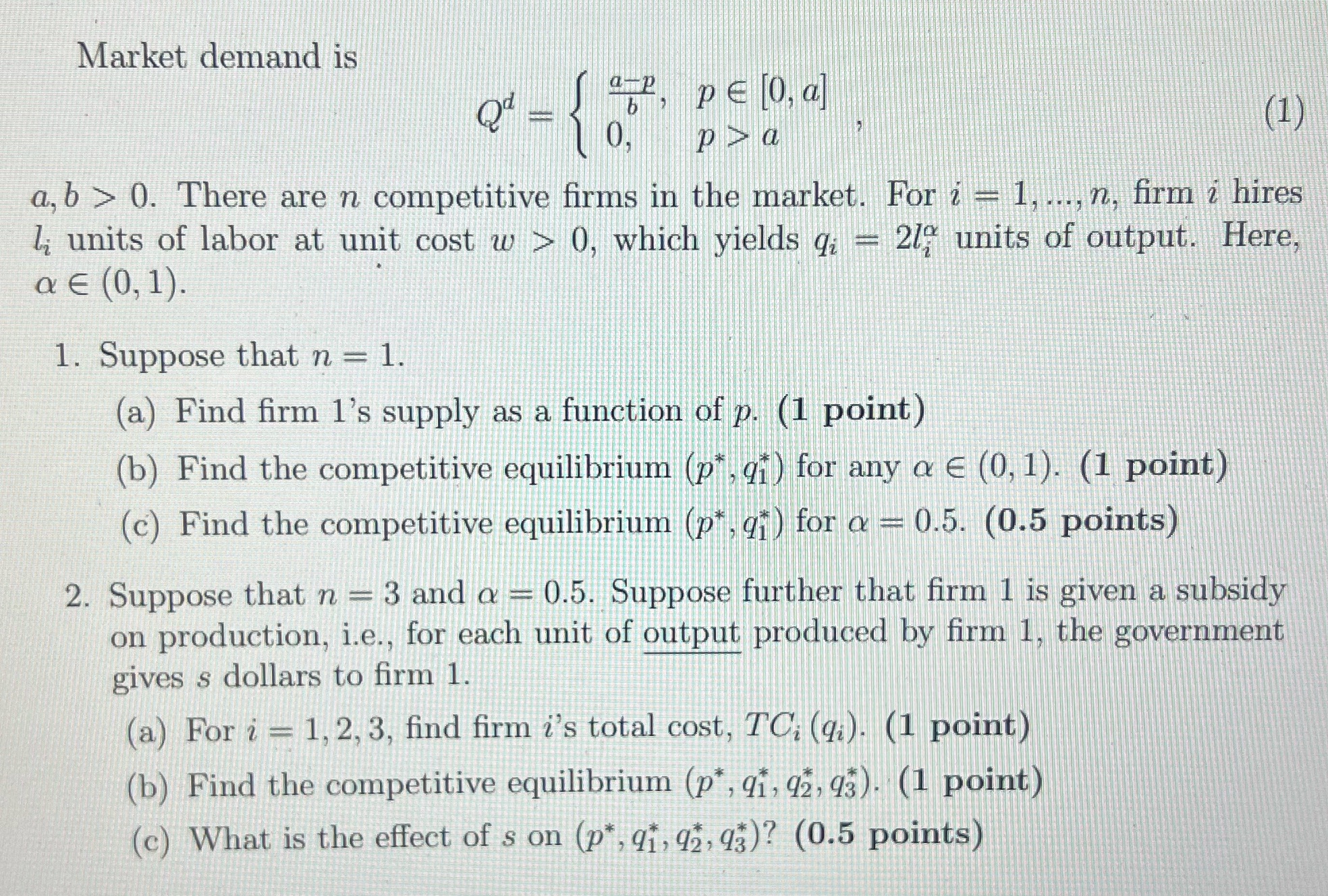
Market demand is 1 2, PE [0, a] (1) p > a a, b > 0. There are n competitive firms in the market. For 2 - 1, ...,n, firm i hires l units of labor at unit cost w > 0, which yields q; = 21% units of output. Here, a E (0, 1). 1. Suppose that n = 1. (a) Find firm 1's supply as a function of p. (1 point) (b) Find the competitive equilibrium (p, qi ) for any a E (0, 1). (1 point) (c) Find the competitive equilibrium (p*, q; ) for a - 0.5. (0.5 points) 2. Suppose that n = 3 and a - 0.5. Suppose further that firm 1 is given a subsidy on production, i.e., for each unit of output produced by firm 1, the government gives s dollars to firm 1. (a) For i - 1, 2, 3, find firm i's total cost, TC. (q.). (1 point) (b) Find the competitive equilibrium (p*, qi, 92, 93). (1 point) (c) What is the effect of s on (p*, qi, 92, 93)? (0.5 points)
Step by Step Solution
There are 3 Steps involved in it

Get step-by-step solutions from verified subject matter experts
 Study Help