







Question: i loose already three posts for this question , please please solve it especially b and c PLEASE just answer partA,B and C CKC manufactures
i loose already three posts for this question , please please solve it
especially b and c PLEASE 
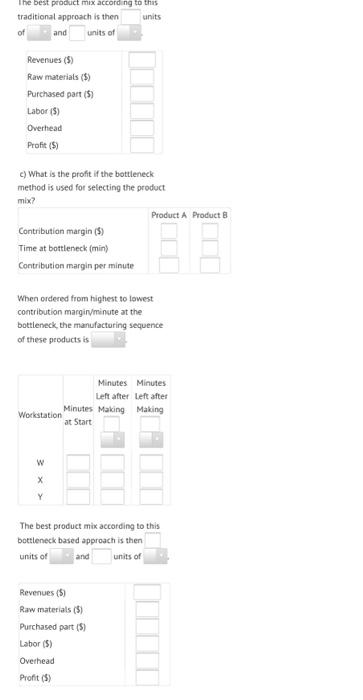
just answer partA,B and C
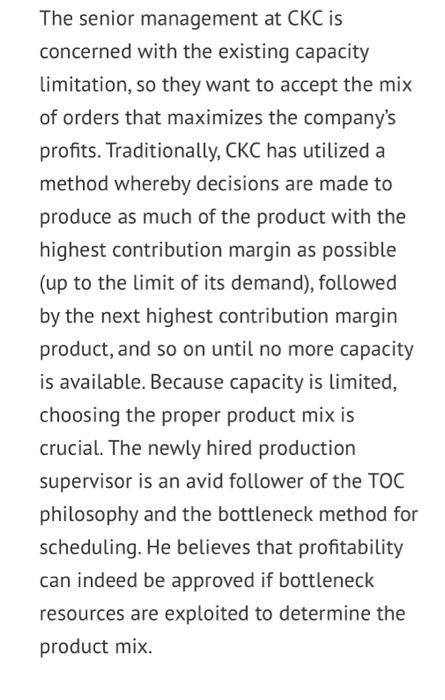
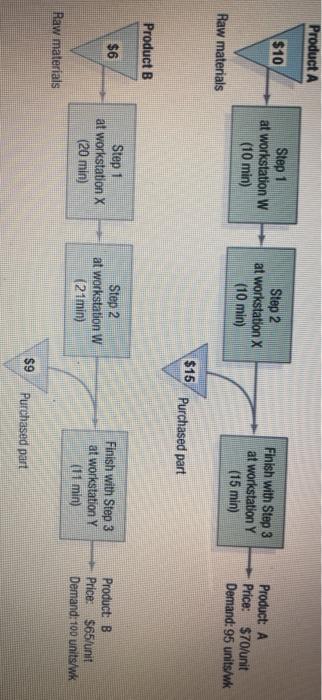
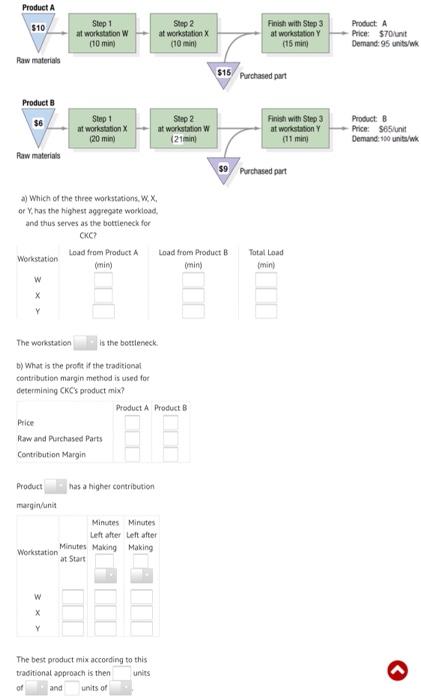
CKC manufactures two different types of toys (A and B, sold in 1,000-count boxes) that are manufactured and assembled on three different workstations (W, X, and Y) using a small-batch process (see Figure). Batch setup times are negligible. The flowchart denotes the path each product follows through the manufacturing process, and each product's price, demand per week, and processing times per unit are indicated as well. Purchased parts and raw materials consumed during production are represented by inverted triangles. CKC can make and sell up to the limit of its demand per week; no penalties are incurred for not being able to meet all the demand. Each workstation is staffed by a worker who is dedicated to work on that workstation alone and is paid $6 per hour. Total labor costs per week are fixed. Variable overhead costs are $3,500/week. The plant operates two 8-hour shifts per day, 5 days per week. The senior management at CKC is concerned with the existing capacity limitation, so they want to accept the mix of orders that maximizes the company's profits. Traditionally, CKC has utilized a method whereby decisions are made to produce as much of the product with the highest contribution margin as possible (up to the limit of its demand), followed by the next highest contribution margin product, and so on until no more capacity is available. Because capacity is limited, choosing the proper product mix is crucial. The newly hired production supervisor is an avid follower of the TOC philosophy and the bottleneck method for scheduling. He believes that profitability can indeed be approved if bottleneck resources are exploited to determine the product mix. Product A $10 Step 1 at workstation W (10 min) Step 2 at workstation X (10 min) Finish with Step 3 at workstation Y (15 min) Product A Price: $70/unit Demand: 95 units/wk Raw materials $15 Purchased part Product B $6 Step 1 at workstation X (20 min) Step 2 at workstation W (21 min) Finish with Step 3 at workstation Y (11 min) Product B Price: $65/unit Demand: 100 units/wk Raw materials $9 Purchased part Product A $10 Step 1 at workstation W (10 min) Step 2 at workstation X (10 min Finish with Step 3 at workstation Y Product A Price: $70/unit Demand: 95 units (15 min Raw materials $15 Purchased part Product B $6 Step 1 at workstation X (20 min) Step 2 at workstation W (21 min Finish with Step 3 at workstation Y (11 min Product B Price: $65 unit Demand 100 units Raw materials 59 Purchased port a) Which of the three workstations. W.X or y, has the highest aggregate workload, and thus serves as the bottleneck for ? Workstation Load from Product Load from Product B (min) imin W Total Load mini X Y The workstation is the bottleneck b) What is the profit if the traditional contribution margin method is used for determining CKC's product mix? Product A Products Price Raw and Purchased Parts Contribution Margin Product has a higher contribution margin/unit Minutes Minutes Left after Left after Workstation Minutes Making Making at Start W Y The best product mix according to this traditional approach is then units of and units of The best product mix according to this traditional approach is then units and units of Revenues (5) Raw materials (5) Purchased part (5) Labor (5) Overhead Profit (5) c) What is the profit if the bottleneck method is used for selecting the product mix? Product A Product B Contribution margin (5) Time at bottleneck (min) Contribution margin per minute When ordered from highest to lowest contribution margir minute at the bottleneck, the manufacturing sequence of these products is Minutes Minutes Left after left after Minutes Making Making Workstation at Start w Y The best product mix according to this bottleneck based approach is then units of and units of Revenues (5) Raw materials (5) Purchased part (5) Labor (5) Overhead Profit() Step by Step Solution
There are 3 Steps involved in it
1 Expert Approved Answer
Step: 1 Unlock

Question Has Been Solved by an Expert!
Get step-by-step solutions from verified subject matter experts
Step: 2 Unlock
Step: 3 Unlock
 Study Help