







Question: I need help for the assignment below, the first part requires DBDL with AK, FK, and SK. The second part needs a database to test
I need help for the assignment below, the first part requires DBDL with AK, FK, and SK. The second part needs a database to test the first part. Thanks
This assignment will consist of two parts: design and implementation.
For the first part you are asked to think of a unique application to handle the transactions of a business, organization, etc.It is up to you to find the topic. Once you determine the application you wish to accomplish, design your database.
Design your database keeping in mind you want to minimize redundancy and avoid anomalies. Give this enough thought; trying to get fast results may not result in a good design. For this assignment you are expected to come up with an application that would require at least 5 tables. Remember, youll use this design for the second part of the assignment, the implementation of it using a DBMS
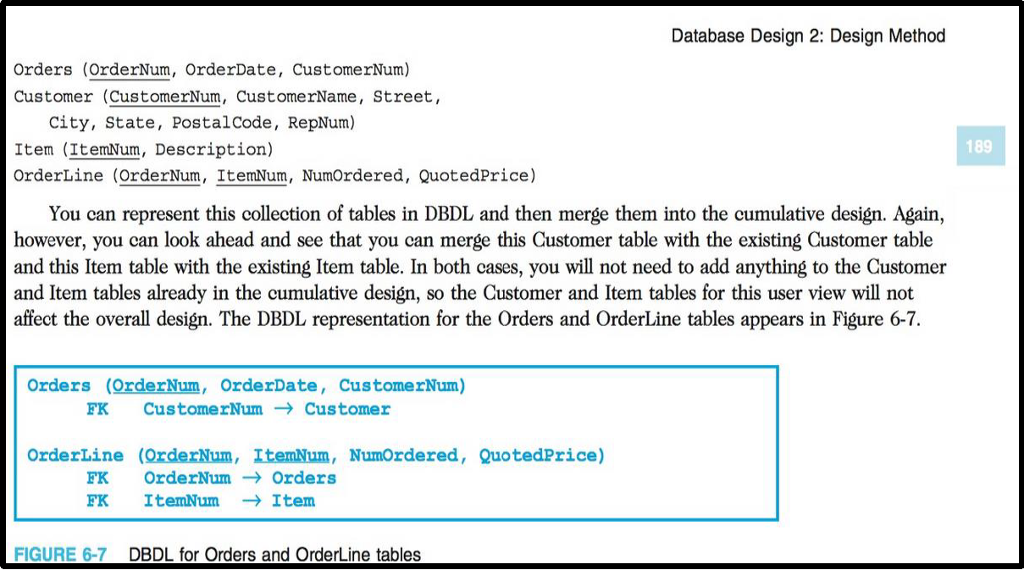
Part 1 Specifications 1. Write a few paragraphs to fully describe what the database is supposed to accomplish 2. Express each table in Database Definition Language. Below is a screenshot of page 189. Use it as an example to guide you expressing the definition of your tables. Remember, youll use these definitions to create the actual database
Part 2
Based on what you created for Part 1 Specifications,
Create an Access database. Make sure to enforce referential integrity in the Relationships window before entering any records. Enter enough records to fully test the usefulness of your database
Database Design 2: Design Method Orders (OrderNum, OrderDate, CustomerNum) Customer (CustomerNum, CustomerName, Street, City, State, PostalCode, RepNum) 189 Item (ItemNum, Description) OrderLine (OrderNum, ItemNum, Numordered, QuotedPrice) You can represent this collection of tables in DBDL and then merge them into the cumulative design. Again however, you can look ahead and see that you can merge this Customer table with the existing Customer table and this Item table with the existing Item table. In both cases, you will not need to add anything to the Customer and Item tables already in the cumulative design, so the Customer and Item tables for this user view will not affect the overall design. The DBDL representation for the Orders and OrderLine tables appears in Fiure 6-7. Orders (OrderNum, OrderDate, CustomerNum) FK CustomerNum Customer OrderLine (OrderNum, ItemNum, NumOrdered, QuotedPrice) FK FK OrderNum-> Orders ItemNum .Item FIGURE 6-7 DBDL for Orders and OrderLine tables Database Design 2: Design Method Orders (OrderNum, OrderDate, CustomerNum) Customer (CustomerNum, CustomerName, Street, City, State, PostalCode, RepNum) 189 Item (ItemNum, Description) OrderLine (OrderNum, ItemNum, Numordered, QuotedPrice) You can represent this collection of tables in DBDL and then merge them into the cumulative design. Again however, you can look ahead and see that you can merge this Customer table with the existing Customer table and this Item table with the existing Item table. In both cases, you will not need to add anything to the Customer and Item tables already in the cumulative design, so the Customer and Item tables for this user view will not affect the overall design. The DBDL representation for the Orders and OrderLine tables appears in Fiure 6-7. Orders (OrderNum, OrderDate, CustomerNum) FK CustomerNum Customer OrderLine (OrderNum, ItemNum, NumOrdered, QuotedPrice) FK FK OrderNum-> Orders ItemNum .Item FIGURE 6-7 DBDL for Orders and OrderLine tables
Step by Step Solution
There are 3 Steps involved in it

Get step-by-step solutions from verified subject matter experts
 Study Help