







Question: I need it ASAP Read the case study below and answer ALL the questions that follow. MANAGING THE WESBANK WAY Wesbank is a division of
I need it ASAP
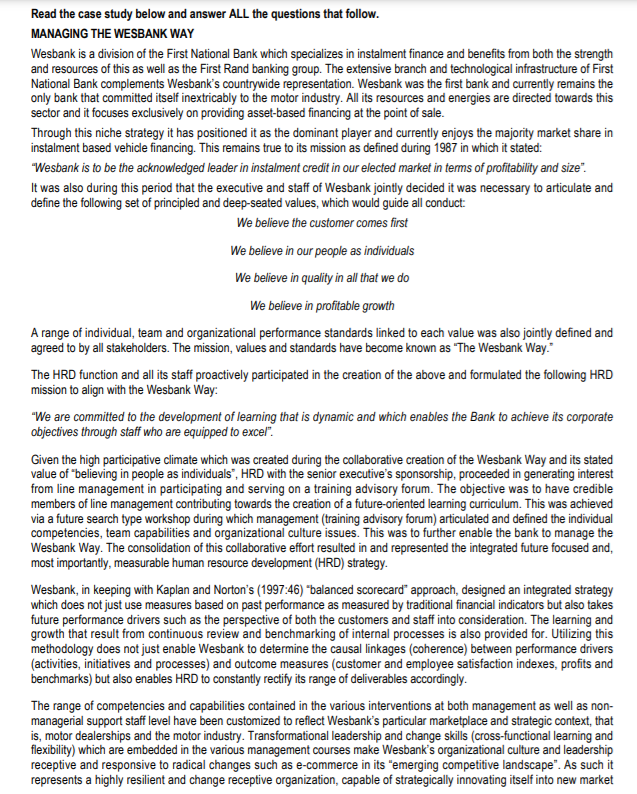
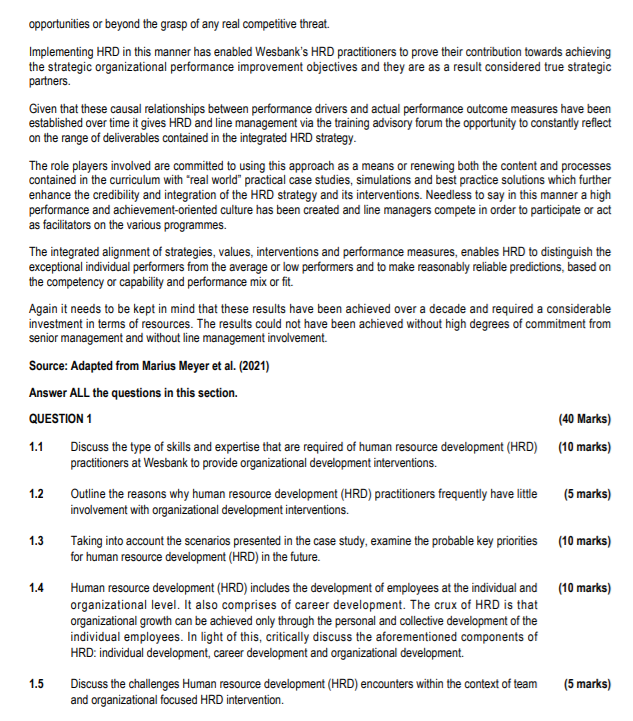
Read the case study below and answer ALL the questions that follow. MANAGING THE WESBANK WAY Wesbank is a division of the First National Bank which specializes in instalment finance and benefits from both the strength and resources of this as well as the First Rand banking group. The extensive branch and technological infrastructure of First National Bank complements Wesbank's countrywide representation. Wesbank was the first bank and currently remains the only bank that committed itself inextricably to the motor industry. All its resources and energies are directed towards this sector and it focuses exclusively on providing asset-based financing at the point of sale. Through this niche strategy it has positioned it as the dominant player and currently enjoys the majority market share in instalment based vehicle financing. This remains true to its mission as defined during 1987 in which it stated: Wesbank is to be the acknowledged leader in instalment credit in our elected market in terms of profitability and size". It was also during this period that the executive and staff of Wesbank jointly decided it was necessary to articulate and define the following set of principled and deep-seated values, which would guide all conduct: We believe the customer comes first We believe in our people as individuals We believe in quality in all that we do We believe in profitable growth A range of individual, team and organizational performance standards linked to each value was also jointly defined and agreed to by all stakeholders. The mission, values and standards have become known as "The Wesbank Way The HRD function and all its staff proactively participated in the creation of the above and formulated the following HRD mission to align with the Wesbank Way: "We are committed to the development of learning that is dynamic and which enables the Bank to achieve its corporate objectives through staff who are equipped to excel". Given the high participative climate which was created during the collaborative creation of the Wesbank Way and its stated value of believing in people as individuals", HRD with the senior executive's sponsorship, proceeded in generating interest from line management in participating and serving on a training advisory forum. The objective was to have credible members of line management contributing towards the creation of a future-oriented learning curriculum. This was achieved via a future search type workshop during which management (training advisory forum) articulated and defined the individual competencies, team capabilities and organizational culture issues. This was to further enable the bank to manage the Wesbank Way. The consolidation of this collaborative effort resulted in and represented the integrated future focused and, most importantly, measurable human resource development (HRD) strategy. Wesbank, in keeping with Kaplan and Norton's (1997:46) "balanced Scorecard' approach, designed an integrated strategy which does not just use measures based on past performance as measured by traditional financial indicators but also takes future performance drivers such as the perspective of both the customers and staff into consideration. The learning and growth that result from continuous review and benchmarking of internal processes is also provided for. Utilizing this methodology does not just enable Wesbank to determine the causal linkages (coherence) between performance drivers (activities, initiatives and processes) and outcome measures (customer and employee satisfaction indexes, profits and benchmarks) but also enables HRD to constantly rectify its range of deliverables accordingly. The range of competencies and capabilities contained in the various interventions at both management as well as non- managerial support staff level have been customized to reflect Wesbank's particular marketplace and strategic context, that is, motor dealerships and the motor industry. Transformational leadership and change skills (cross-functional learning and flexibility) which are embedded in the various management courses make Wesbank's organizational culture and leadership receptive and responsive to radical changes such as e-commerce in its "emerging competitive landscape". As such it represents a highly resilient and change receptive organization, capable of strategically innovating itself into new market opportunities or beyond the grasp of any real competitive threat. Implementing HRD in this manner has enabled Wesbank's HRD practitioners to prove their contribution towards achieving the strategic organizational performance improvement objectives and they are as a result considered true strategic partners. Given that these causal relationships between performance drivers and actual performance outcome measures have been established over time it gives HRD and line management via the training advisory forum the opportunity to constantly reflect on the range of deliverables contained in the integrated HRD strategy The role players involved are committed to using this approach as a means or renewing both the content and processes contained in the curriculum with real world" practical case studies, simulations and best practice solutions which further enhance the credibility and integration of the HRD strategy and its interventions. Needless to say in this manner a high performance and achievement-oriented culture has been created and line managers compete in order to participate or act as facilitators on the various programmes. The integrated alignment of strategies, values, interventions and performance measures, enables HRD to distinguish the exceptional individual performers from the average or low performers and to make reasonably reliable predictions, based on the competency or capability and performance mix or fit. Again it needs to be kept in mind that these results have been achieved over a decade and required a considerable investment in terms of resources. The results could not have been achieved without high degrees of commitment from senior management and without line management involvement. Source: Adapted from Marius Meyer et al. (2021) Answer ALL the questions in this section. QUESTION 1 (40 Marks) Discuss the type of skills and expertise that are required of human resource development (HRD) (10 marks) practitioners at Wesbank to provide organizational development interventions. Outline the reasons why human resource development (HRD) practitioners frequently have little (5 marks) involvement with organizational development interventions. Taking into account the scenarios presented in the case study, examine the probable key priorities (10 marks) for human resource development (HRD) in the future. Human resource development (HRD) includes the development of employees at the individual and (10 marks) organizational level. It also comprises of career development. The crux of HRD is that organizational growth can be achieved only through the personal and collective development of the individual employees. In light of this, critically discuss the aforementioned components of HRD: individual development, career development and organizational development. Discuss the challenges Human resource development (HRD) encounters within the context of team (5 marks) and organizational focused HRD intervention 1.1 1.2 1.3 1.4 1.5Step by Step Solution
There are 3 Steps involved in it
1 Expert Approved Answer
Step: 1 Unlock

Question Has Been Solved by an Expert!
Get step-by-step solutions from verified subject matter experts
Step: 2 Unlock
Step: 3 Unlock
 Study Help