





Question: I need the answer to this question, but, I need a new answer to the one already on chegg PLEASE! do not copy and paste

I need the answer to this question, but, I need a new answer to the one already on chegg PLEASE! do not copy and paste the answer that already exists! I would appreciate it very much if it is a write and not images and I would vote for your answer if you give me a new one. Please!, answer the question of the first image in reference to the other image, I would greatly appreciate it.

I need the answer to this question, but, I need aI need the answer to this question, but, I need a

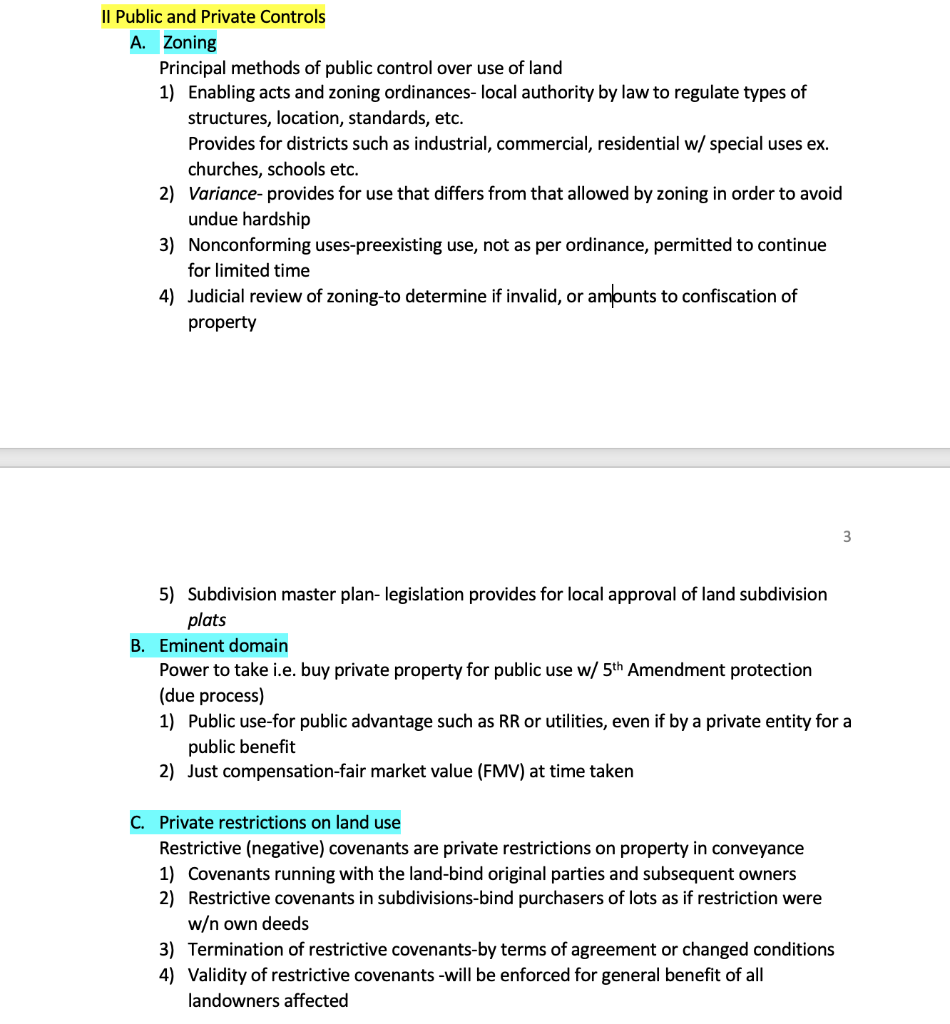
5) Control over the possession and use of real property may be exerted through the enactment of zoning ordinances, exercise of eminent domain, as well as the imposition of restrictive covenants. Explain the type of controls these processes impose. (Ch 49). II Public and Private Controls A. Zoning Principal methods of public control over use of land 1) Enabling acts and zoning ordinances- local authority by law to regulate types of structures, location, standards, etc. Provides for districts such as industrial, commercial, residential w/ special uses ex. churches, schools etc. 2) Variance- provides for use that differs from that allowed by zoning in order to avoid undue hardship 3) Nonconforming uses-preexisting use, not as per ordinance, permitted to continue for limited time 4) Judicial review of zoning-to determine if invalid, or amounts to confiscation of property 3 5) Subdivision master plan- legislation provides for local approval of land subdivision plats B. Eminent domain Power to take i.e. buy private property for public use w/ 5th Amendment protection (due process) 1) Public use-for public advantage such as RR or utilities, even if by a private entity for a public benefit 2) Just compensation-fair market value (FMV) at time taken C. Private restrictions on land use Restrictive (negative) covenants are private restrictions on property in conveyance 1) Covena running with the land-bind original and subsequent owners 2) Restrictive covenants in subdivisions-bind purchasers of lots as if restriction were w own deeds 3) Termination of restrictive covenants-by terms of agreement or changed conditions 4) Validity of restrictive covenants-will be enforced for general benefit of all landowners affected

Step by Step Solution

There are 3 Steps involved in it

1 Expert Approved Answer
Step: 1 Unlock blur-text-image

Question Has Been Solved by an Expert!

Get step-by-step solutions from verified subject matter experts

Step: 2 Unlock
Step: 3 Unlock

Students Have Also Explored These Related General Management Questions!