







Question: I will vote up quickly if the answer is correct. Thanks! 3. (12 marks) Consider a market of two assets, namely a risky asset S
I will vote up quickly if the answer is correct. Thanks!
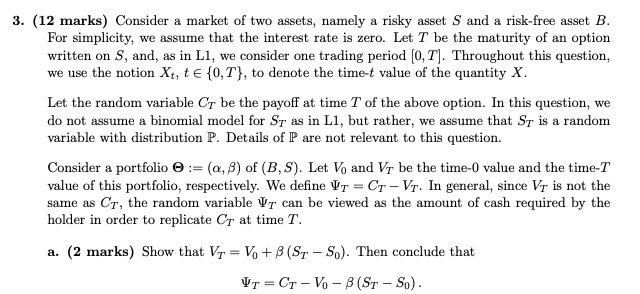
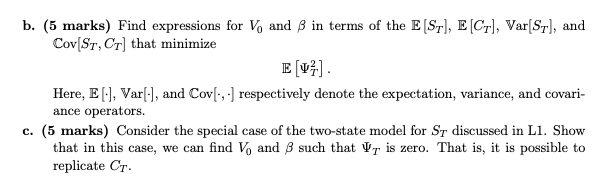
3. (12 marks) Consider a market of two assets, namely a risky asset S and a risk-free asset B. For simplicity, we assume that the interest rate is zero. Let T be the maturity of an option written on S, and, as in L1, we consider one trading period (0,T]. Throughout this question, we use the notion Xt, t {0,T}, to denote the time-t value of the quantity X. Let the random variable Cy be the payoff at time T of the above option. In this question, we do not assume a binomial model for St as in Li, but rather, we assume that St is a random variable with distribution P. Details of P are not relevant to this question. Consider a portfolio :=(Q, B) of (B, S). Let V, and Vr be the time-0 value and the time-T value of this portfolio, respectively. We define VT = Cr-Vr. In general, since Vr is not the same as Cr, the random variable Vt can be viewed as the amount of cash required by the holder in order to replicate Cr at time T. a. (2 marks) Show that Vj = V0 + B (ST - S.). Then conclude that VT = Cr-V-B (ST - So). b. (5 marks) Find expressions for V and 8 in terms of the E (ST), E (Cr), Var(ST), and Cov(St, Cr] that minimize E[v] Here, E (-), Var(-), and Cov[,-) respectively denote the expectation, variance, and covari- ance operators. c. (5 marks) Consider the special case of the two-state model for St discussed in Ll. Show that in this case, we can find V, and B such that is zero. That is, it is possible to replicate Cr 3. (12 marks) Consider a market of two assets, namely a risky asset S and a risk-free asset B. For simplicity, we assume that the interest rate is zero. Let T be the maturity of an option written on S, and, as in L1, we consider one trading period (0,T]. Throughout this question, we use the notion Xt, t {0,T}, to denote the time-t value of the quantity X. Let the random variable Cy be the payoff at time T of the above option. In this question, we do not assume a binomial model for St as in Li, but rather, we assume that St is a random variable with distribution P. Details of P are not relevant to this question. Consider a portfolio :=(Q, B) of (B, S). Let V, and Vr be the time-0 value and the time-T value of this portfolio, respectively. We define VT = Cr-Vr. In general, since Vr is not the same as Cr, the random variable Vt can be viewed as the amount of cash required by the holder in order to replicate Cr at time T. a. (2 marks) Show that Vj = V0 + B (ST - S.). Then conclude that VT = Cr-V-B (ST - So). b. (5 marks) Find expressions for V and 8 in terms of the E (ST), E (Cr), Var(ST), and Cov(St, Cr] that minimize E[v] Here, E (-), Var(-), and Cov[,-) respectively denote the expectation, variance, and covari- ance operators. c. (5 marks) Consider the special case of the two-state model for St discussed in Ll. Show that in this case, we can find V, and B such that is zero. That is, it is possible to replicate Cr
Step by Step Solution
There are 3 Steps involved in it

Get step-by-step solutions from verified subject matter experts
 Study Help