







Question: i=2 j=7 k=10 last digit =0, use Dijkstras shortest-path algorithm to compute the shortest path from node e to all network nodes. Task 6. Routing
i=2
j=7
k=10
last digit =0, use Dijkstras shortest-path algorithm to compute the shortest path from node e to all network nodes.
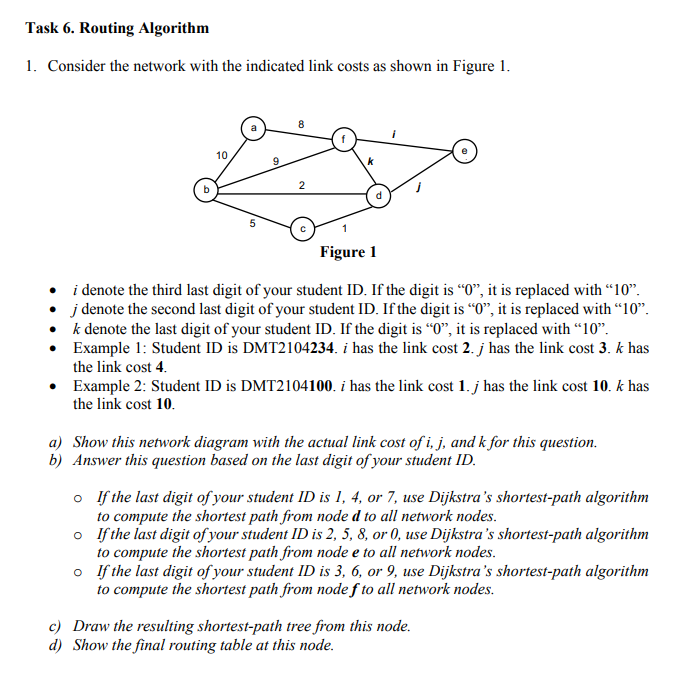
Task 6. Routing Algorithm 1. Consider the network with the indicated link costs as shown in Figure 1. 10 9 k 2 d 5 Figure 1 i denote the third last digit of your student ID. If the digit is O, it is replaced with 10. j denote the second last digit of your student ID. If the digit is 0, it is replaced with 10. k denote the last digit of your student ID. If the digit is O, it is replaced with 10. Example 1: Student ID is DMT2104234. i has the link cost 2. j has the link cost 3. k has the link cost 4. Example 2: Student ID is DMT2104100. i has the link cost 1. j has the link cost 10. k has the link cost 10. a) Show this network diagram with the actual link cost of i, j, and k for this question. b) Answer this question based on the last digit of your student ID. o If the last digit of your student ID is 1, 4, or 7, use Dijkstra's shortest-path algorithm to compute the shortest path from node d to all network nodes. If the last digit of your student ID is 2, 5, 8, or 0, use Dijkstra's shortest-path algorithm to compute the shortest path from node e to all network nodes. o If the last digit of your student ID is 3, 6, or 9, use Dijkstra's shortest-path algorithm to compute the shortest path from nodef to all network nodes. c) Draw the resulting shortest-path tree from this node. d) Show the final routing table at this node
Step by Step Solution
There are 3 Steps involved in it

Get step-by-step solutions from verified subject matter experts
 Study Help