







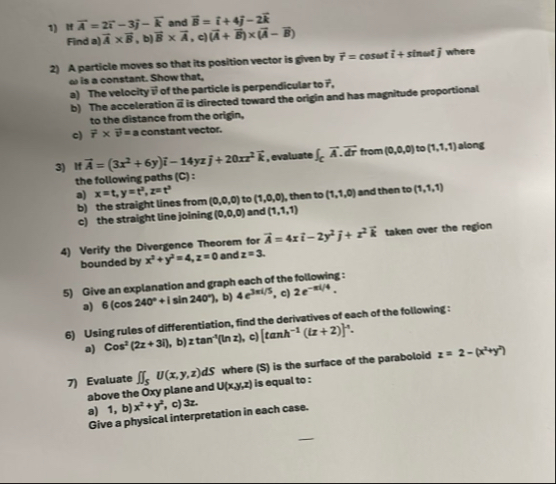
Question: if vec ( A ) = 2 vec ( i ) - 3 vec ( j ) - vec ( k ) and vec (
if vecvecvecvec and vecvecvec
Find a vecvec b vecvec c vecvec
A particle moves so that its position vector is given by vec where ai is a constant. Show that,
a The velocity vec of the particle is perpendicular to vec
b The acceleration vec is directed toward the origin and has magnitude proportional to the distance from the origin,
c vecvec a constant vector.
If vecyzvecvec evaluate vec from to along the following paths :
a
b the straight lines from to then to and then to
c the straight line joining and
Verify the Divergence Theorem for vecxvecvecvec taken over the region bounded by and
Give an explanation and graph each of the following:
a b c
Using rules of differentiation, find the derivatives of each of the following:
a b c
Evaluate where is the surface of the parabolold above the Oxy plane and is equal to: a b c Give a physical interpretation in each case.
Step by Step Solution
There are 3 Steps involved in it
1 Expert Approved Answer
Step: 1 Unlock

Question Has Been Solved by an Expert!
Get step-by-step solutions from verified subject matter experts
Step: 2 Unlock
Step: 3 Unlock
 Study Help