







Question: III. Stokes' theorem at a boundary Consider the same boundary as before. A. The curl is given by: 7x7 = CO RECEPCO . 1. For
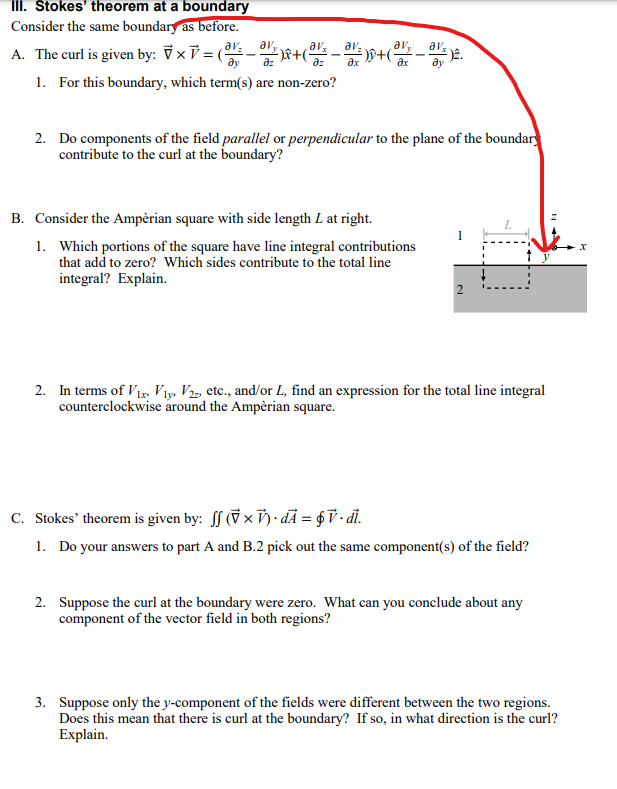
III. Stokes' theorem at a boundary Consider the same boundary as before. A. The curl is given by: 7x7 = CO RECEPCO . 1. For this boundary, which term(s) are non-zero? 2. Do components of the field parallel or perpendicular to the plane of the boundar contribute to the curl at the boundary? B. Consider the Amprian square with side length L at right. 1. Which portions of the square have line integral contributions that add to zero? Which sides contribute to the total line integral? Explain. 2 2. In terms of VlxVly, V2, etc., and/or L, find an expression for the total line integral counterclockwise around the Amprian square. C. Stokes theorem is given by: S (7 x 7). d= $7.di. 1. Do your answers to part A and B.2 pick out the same component(s) of the field? 2. Suppose the curl at the boundary were zero. What can you conclude about any component of the vector field in both regions? 3. Suppose only the y-component of the fields were different between the two regions. Does this mean that there is curl at the boundary? If so, in what direction is the curl? Explain. III. Stokes' theorem at a boundary Consider the same boundary as before. A. The curl is given by: 7x7 = CO RECEPCO . 1. For this boundary, which term(s) are non-zero? 2. Do components of the field parallel or perpendicular to the plane of the boundar contribute to the curl at the boundary? B. Consider the Amprian square with side length L at right. 1. Which portions of the square have line integral contributions that add to zero? Which sides contribute to the total line integral? Explain. 2 2. In terms of VlxVly, V2, etc., and/or L, find an expression for the total line integral counterclockwise around the Amprian square. C. Stokes theorem is given by: S (7 x 7). d= $7.di. 1. Do your answers to part A and B.2 pick out the same component(s) of the field? 2. Suppose the curl at the boundary were zero. What can you conclude about any component of the vector field in both regions? 3. Suppose only the y-component of the fields were different between the two regions. Does this mean that there is curl at the boundary? If so, in what direction is the curl? Explain
Step by Step Solution
There are 3 Steps involved in it

Get step-by-step solutions from verified subject matter experts
 Study Help