



Question: immiscibility. Suppose we are at a state where G1/RT=0.1 and G2/RT =0.3. The Gibbs energy of mixing quantifies the Gibbs energy of the mixture relative
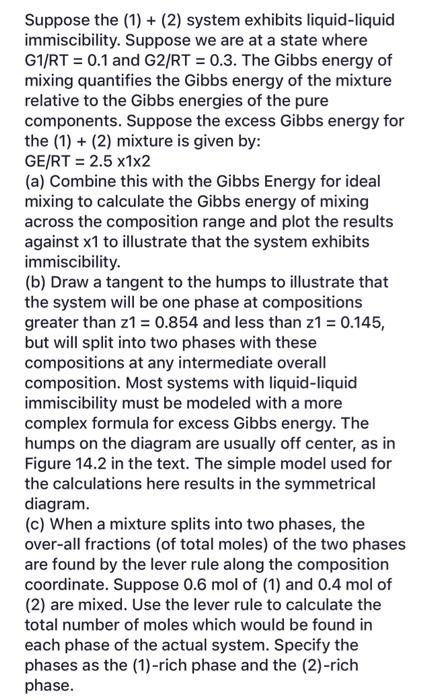
immiscibility. Suppose we are at a state where G1/RT=0.1 and G2/RT =0.3. The Gibbs energy of mixing quantifies the Gibbs energy of the mixture relative to the Gibbs energies of the pure components. Suppose the excess Gibbs energy for the (1)+(2) mixture is given by: GE/RT=2.512 (a) Combine this with the Gibbs Energy for ideal mixing to calculate the Gibbs energy of mixing across the composition range and plot the results against x1 to illustrate that the system exhibits immiscibility. (b) Draw a tangent to the humps to illustrate that the system will be one phase at compositions greater than z1=0.854 and less than z1=0.145, but will split into two phases with these compositions at any intermediate overall composition. Most systems with liquid-liquid immiscibility must be modeled with a more complex formula for excess Gibbs energy. The humps on the diagram are usually off center, as in Figure 14.2 in the text. The simple model used for the calculations here results in the symmetrical diagram. (c) When a mixture splits into two phases, the over-all fractions (of total moles) of the two phases are found by the lever rule along the composition coordinate. Suppose 0.6mol of (1) and 0.4mol of (2) are mixed. Use the lever rule to calculate the total number of moles which would be found in each phase of the actual system. Specify the phases as the (1)-rich phase and the (2)-rich phase
Step by Step Solution
There are 3 Steps involved in it

Get step-by-step solutions from verified subject matter experts