







Question: import unittest # Import the Python unit testingframeworkimport maths # Our code to test class MathsTest(unittest.TestCase): ''' Unit tests for our maths functions. ''' def
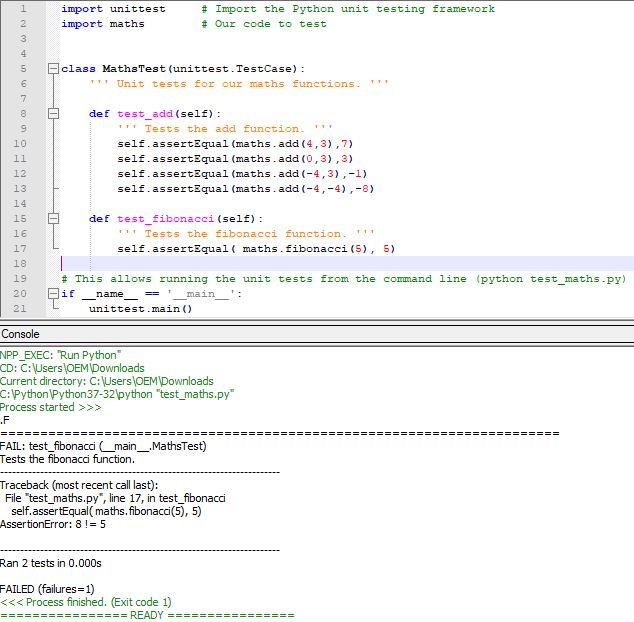
import unittest # Import the Python unit testingframeworkimport maths # Our code to test
class MathsTest(unittest.TestCase): ''' Unit tests for our maths functions. '''
def test_add(self): ''' Tests the add function.''' self.assertEqual(maths.add(4,3),7) self.assertEqual(maths.add(0,3),3) self.assertEqual(maths.add(-4,3),-1) self.assertEqual(maths.add(-4,-4),-8)
def test_fibonacci(self): ''' Tests the fibonaccifunction. ''' self.assertEqual(maths.fibonacci(5), 5)
# This allows running the unit tests from the command line(python test_maths.py)if __name__ == '__main__': unittest.main()
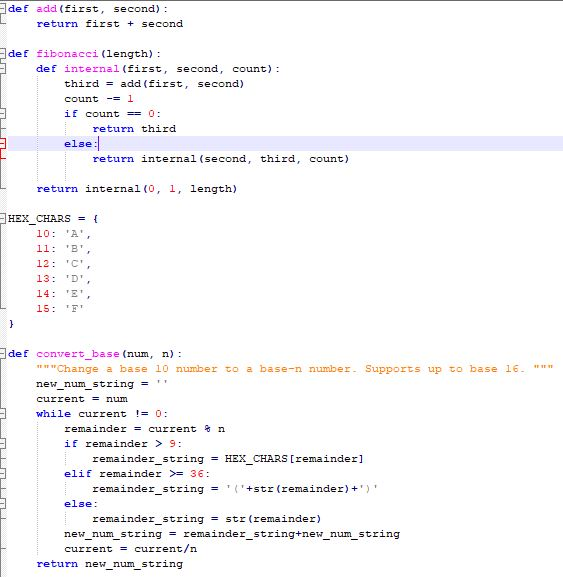
def add(first, second): return first + second
def fibonacci(length): def internal(first, second, count): third = add(first, second) count -= 1 if count == 0: return third else: return internal(second,third, count)
return internal(0, 1, length)
HEX_CHARS = { 10: 'A', 11: 'B', 12: 'C', 13: 'D', 14: 'E', 15: 'F'}
def convert_base(num, n): """Change a base 10 number to a base-n number.Supports up to base 16. """ new_num_string = '' current = num while current != 0: remainder = current % n if remainder > 9: remainder_string =HEX_CHARS[remainder] elif remainder >= 36: remainder_string ='('+str(remainder)+')' else: remainder_string =str(remainder) new_num_string =remainder_string+new_num_string current = current/n return new_num_string
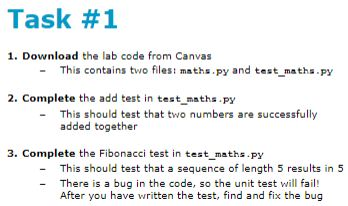
Task #1 1. Download the lab code from Canvas - This contains two files: maths.py and test_maths.py 2. Complete the add test in test_maths.py This should test that two numbers are successfully added together 3. Complete the Fibonacci test in test_maths.py This should test that a sequence of length 5 results in 5 There is a bug in the code, so the unit test will fail! After you have written the test, find and fix the bug
Step by Step Solution
3.43 Rating (150 Votes )
There are 3 Steps involved in it
In these given code ... View full answer

Get step-by-step solutions from verified subject matter experts
 Study Help