







Question: In most x86 systems, pages are ___________ (how big?) bytes. This implies that, when a memory reference is made to a byte that is not
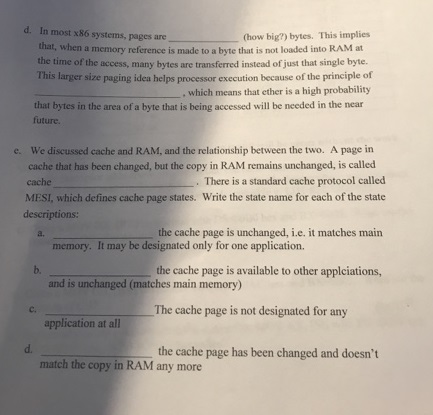
In most x86 systems, pages are ___________ (how big?) bytes. This implies that, when a memory reference is made to a byte that is not loaded into RAM at the time of the access, many bytes are transferred instead of just that single byte. This larger size paging idea helps processor execution because of the principle of ______________, which means that other is a high probability that bytes in the area of a byte that is being accessed will be needed in the near future. We discussed cache and RAM, and the relationship between the two. A page in cache that has been changed, but the copy in RAM remains unchanged, is called cache _____________. There is a standard cache protocol called MESI, which defines cache page states. Write the state name for each of the state descriptions: a. ____________ the cache page is unchanged, i.e. it matches main memory. It may be designated only for one application. b. ____________ the cache page is available to other applications, and is unchanged (matches main memory) c. __________ The cache page is not designated for any application at all d. __________ the cache page has been changed and doesn't match the copy in RAM any more
Step by Step Solution
There are 3 Steps involved in it

Get step-by-step solutions from verified subject matter experts
 Study Help