







Question: In the cell below is an example of a nested loop. Beginning with your code from Question 5 (and using the nested loop example below
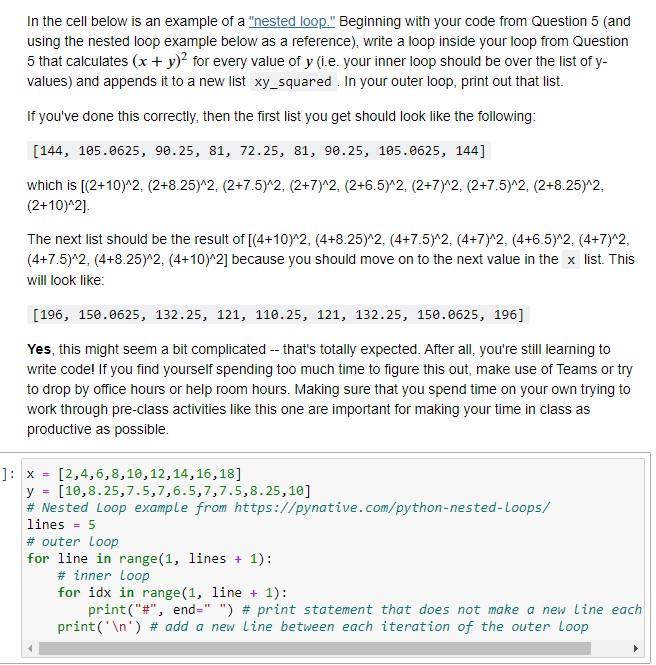
In the cell below is an example of a "nested loop." Beginning with your code from Question 5 (and using the nested loop example below as a reference), write a loop inside your loop from Question 5 that calculates (x+y)2 for every value of y (i.e. your inner loop should be over the list of y - If you've done this correctly, then the first list you get should look like the following: [144,105.0625,90.25,81,72.25,81,90.25,105.0625,144] which is [(2+10)2,(2+8.25)2,(2+7.5)2,(2+7)2,(2+6.5)2,(2+7)2,(2+7.5)2,(2+8.25)2, (2+10)2]. The next list should be the result of [(4+10)2,(4+8.25)2,(4+7.5)2,(4+7)2,(4+6.5)2,(4+7)2, (4+7.5)2,(4+8.25)2,(4+10)2] because you should move on to the next value in the x list. This will look like: [196,150.0625,132.25,121,110.25,121,132.25,150.0625,196] Yes, this might seem a bit complicated - that's totally expected. After all, you're still learning to write code! If you find yourself spending too much time to figure this out, make use of Teams or try to drop by office hours or help room hours. Making sure that you spend time on your own trying to work through pre-class activities like this one are important for making your time in class as productive as possible. x=[2,4,6,8,10,12,14,16,18] y=[10,8.25,7.5,7,6.5,7,7.5,8.25,10] \# Nested Loop example from https://pynative.com/python-nested-loops/ lines =5 \# outer loop for line in range (1, lines +1) : \# inner loop for idx in range (1,1 line +1) : print("\#", end=" ") \# print statement that does not make a new line each print(' ") \# add a new line between each iteration of the outer loop
Step by Step Solution
There are 3 Steps involved in it

Get step-by-step solutions from verified subject matter experts
 Study Help