







Question: In this problem we will derive a party posi- tion equilibrium with partisan politics and probabilistic voting. The math involved is a little complicated,
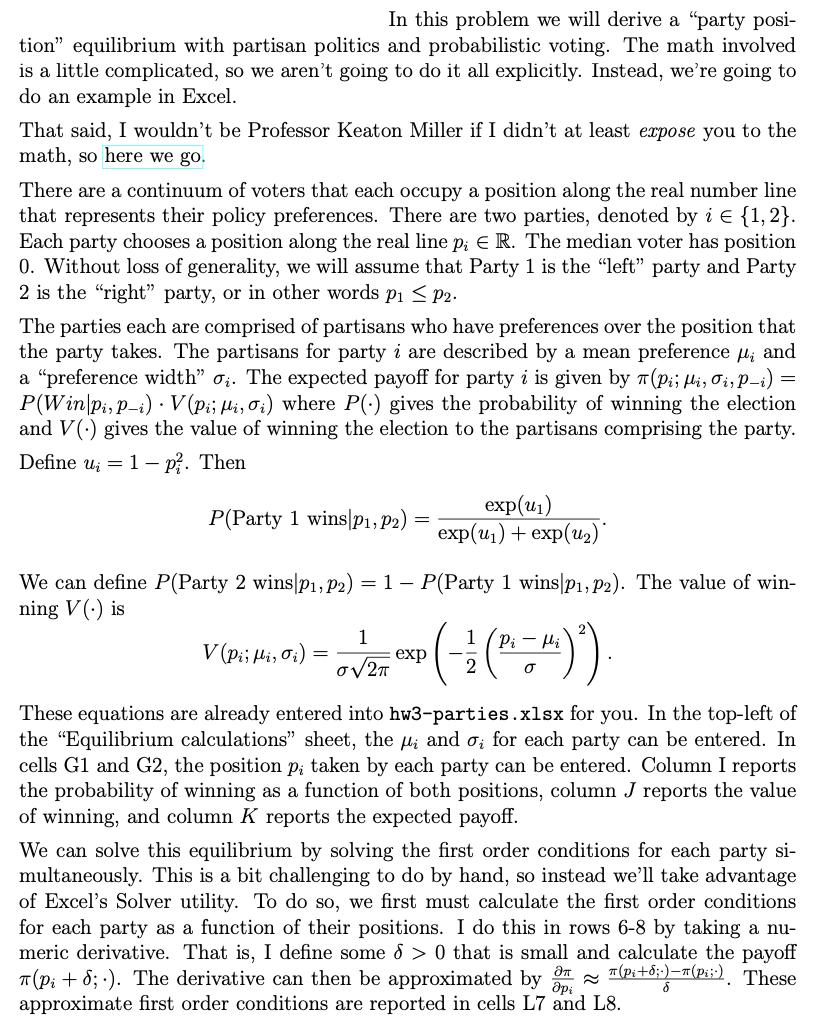


In this problem we will derive a "party posi- tion" equilibrium with partisan politics and probabilistic voting. The math involved is a little complicated, so we aren't going to do it all explicitly. Instead, we're going to do an example in Excel. That said, I wouldn't be Professor Keaton Miller if I didn't at least expose you to the math, so here we go. There are a continuum of voters that each occupy a position along the real number line that represents their policy preferences. There are two parties, denoted by i = {1, 2}. Each party chooses a position along the real line pi R. The median voter has position 0. Without loss of generality, we will assume that Party 1 is the "left" party and Party 2 is the "right" party, or in other words p P2. The parties each are comprised of partisans who have preferences over the position that the party takes. The partisans for party i are described by a mean preference, and a "preference width" o. The expected payoff for party i is given by (Pi; i, Oi, P-i) = P(Win pi, p-i). V(Pi; i, oi) where P() gives the probability of winning the election and V() gives the value of winning the election to the partisans comprising the party. Define u = 1-p. Then P(Party 1 wins P, P2) We can define P(Party 2 wins P, P2) = 1 - P(Party 1 wins/p, p2). The value of win- ning V() is V (Pij Mi, Oi) = = exp(u) exp(u) + exp(u) 1 O2 Pi Hi exp P(-1/2 (-=-^^)^). These equations are already entered into hw3-parties.xlsx for you. In the top-left of the "Equilibrium calculations" sheet, the ; and o, for each party can be entered. In cells G1 and G2, the position p; taken by each party can be entered. Column I reports the probability of winning as a function of both positions, column J reports the value of winning, and column K reports the expected payoff. We can solve this equilibrium by solving the first order conditions for each party si- multaneously. This a bit challenging to do by hand, so instead we'll take advantage of Excel's Solver utility. To do so, we first must calculate the first order conditions for each party as a function of their positions. I do this in rows 6-8 by taking a nu- meric derivative. That is, I define some d > 0 that is small and calculate the payoff T(pi+d;). The derivative can then be approximated by (pi+8;-)-(Pi). These approximate first order conditions are reported in cells L7 and L8. OTT Opi
Step by Step Solution
3.42 Rating (149 Votes )
There are 3 Steps involved in it
a The correct answer is The equilibrium positions are p1 05 and p2 05 The expected position of the w... View full answer

Get step-by-step solutions from verified subject matter experts
 Study Help