







Question: investigate the spontaneous joking performance: FIELDWORK ASSIGNMENT Ethnographic report on the telling of a joke Length: 3-4 pages, single spaced. Your task for this assignment
investigate the spontaneous joking performance: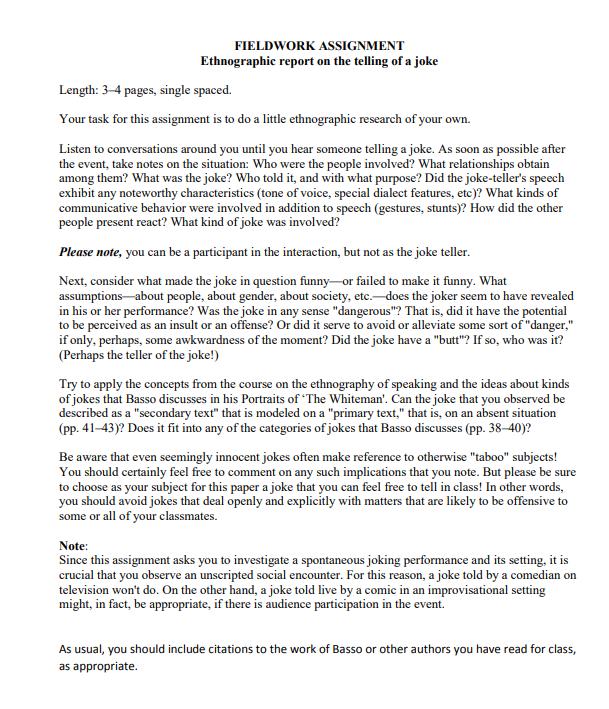
FIELDWORK ASSIGNMENT Ethnographic report on the telling of a joke Length: 3-4 pages, single spaced. Your task for this assignment is to do a little ethnographic research of your own. Listen to conversations around you until you hear someone telling a joke. As soon as possible after the event, take notes on the situation: Who were the people involved? What relationships obtain among them? What was the joke? Who told it, and with what purpose? Did the joke-teller's speech exhibit any noteworthy characteristics (tone of voice, special dialect features, etc)? What kinds of communicative behavior were involved in addition to speech (gestures, stunts)? How did the other people present react? What kind of joke was involved? Please note, you can be a participant in the interaction, but not as the joke teller. Next, consider what made the joke in question funny-or failed to make it funny. What assumptions about people, about gender, about society, etc.-does the joker seem to have revealed in his or her performance? Was the joke in any sense "dangerous"? That is, did it have the potential to be perceived as an insult or an offense? Or did it serve to avoid or alleviate some sort of "danger," if only, perhaps, some awkwardness of the moment? Did the joke have a "butt"? If so, who was it? (Perhaps the teller of the joke!) Try to apply the concepts from the course on the ethnography of speaking and the ideas about kinds of jokes that Basso discusses in his Portraits of "The Whiteman'. Can the joke that you observed be described as a "secondary text" that is modeled on a "primary text," that is, on an absent situation (pp. 41-43)? Does it fit into any of the categories of jokes that Basso discusses (pp. 38-40)? Be aware that even seemingly innocent jokes often make reference to otherwise "taboo" subjects! You should certainly feel free to comment on any such implications that you note. But please be sure to choose as your subject for this paper a joke that you can feel free to tell in class! In other words, you should avoid jokes that deal openly and explicitly with matters that are likely to be offensive to some or all of your classmates. Note: Since this assignment asks you to investigate a spontaneous joking performance and its setting, it is crucial that you observe an unscripted social encounter. For this reason, a joke told by a comedian on television won't do. On the other hand, a joke told live by a comic in an improvisational setting might, in fact, be appropriate, if there is audience participation in the event. As usual, you should include citations to the work of Basso or other authors you have read for class, as appropriate.
Step by Step Solution
3.45 Rating (158 Votes )
There are 3 Steps involved in it
Answer The circumstance was in which a man popped joke through word or expression he used to portray the joke about something ordinary It isnt implied as silliness in the regular sense however as kind ... View full answer

Get step-by-step solutions from verified subject matter experts
 Study Help