Question: iorked Solution (Spreadsheet Solution). Us Data table Sis : is (Click on the icon here D in order to copy the contents of the data
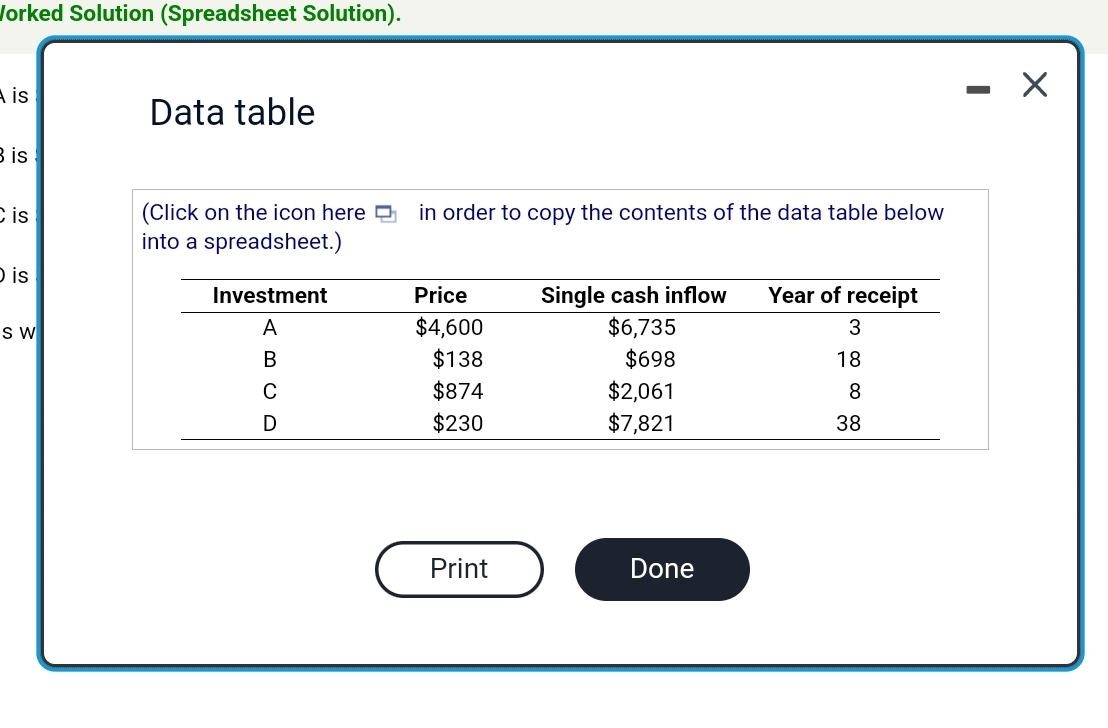
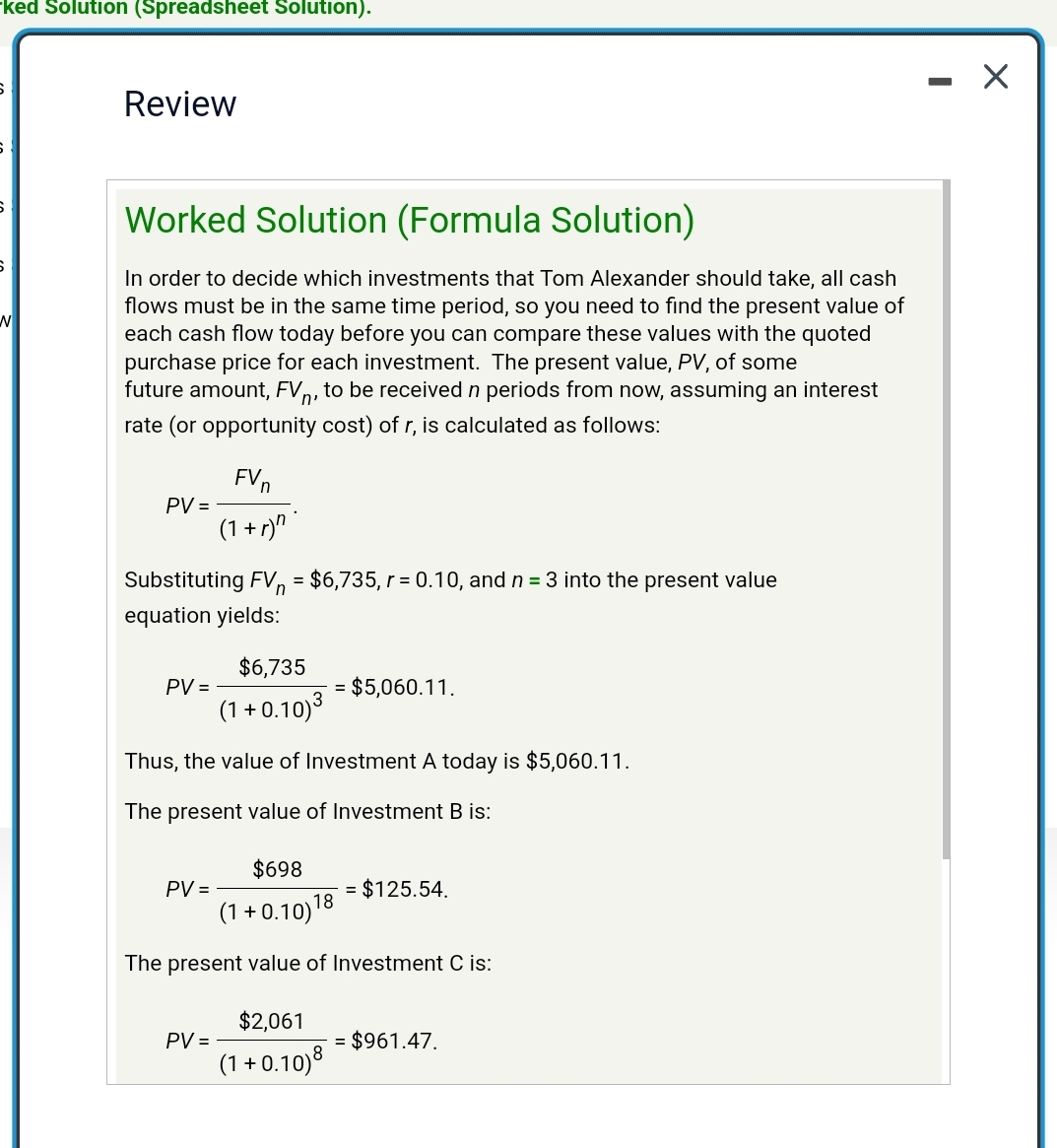
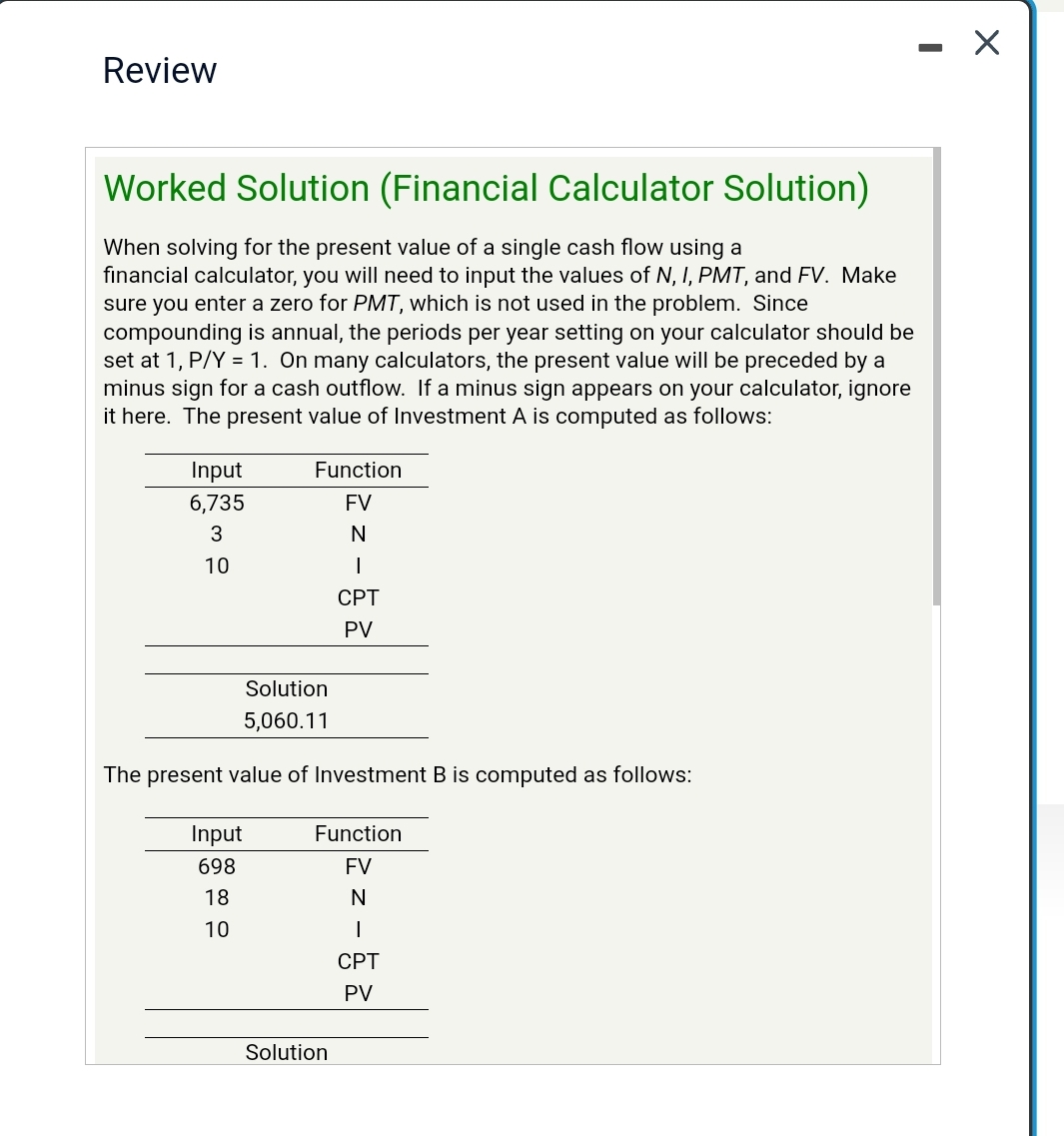
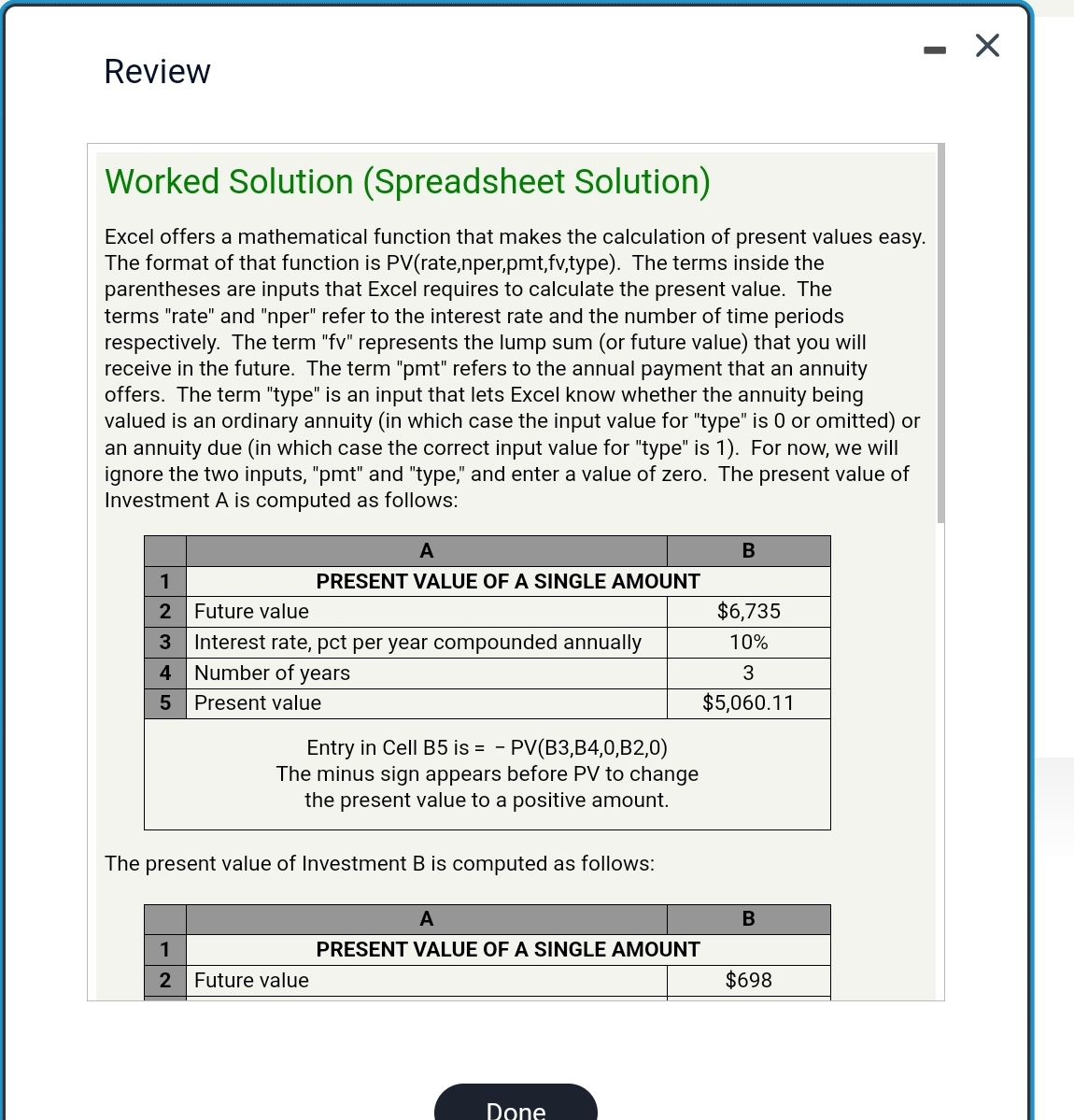
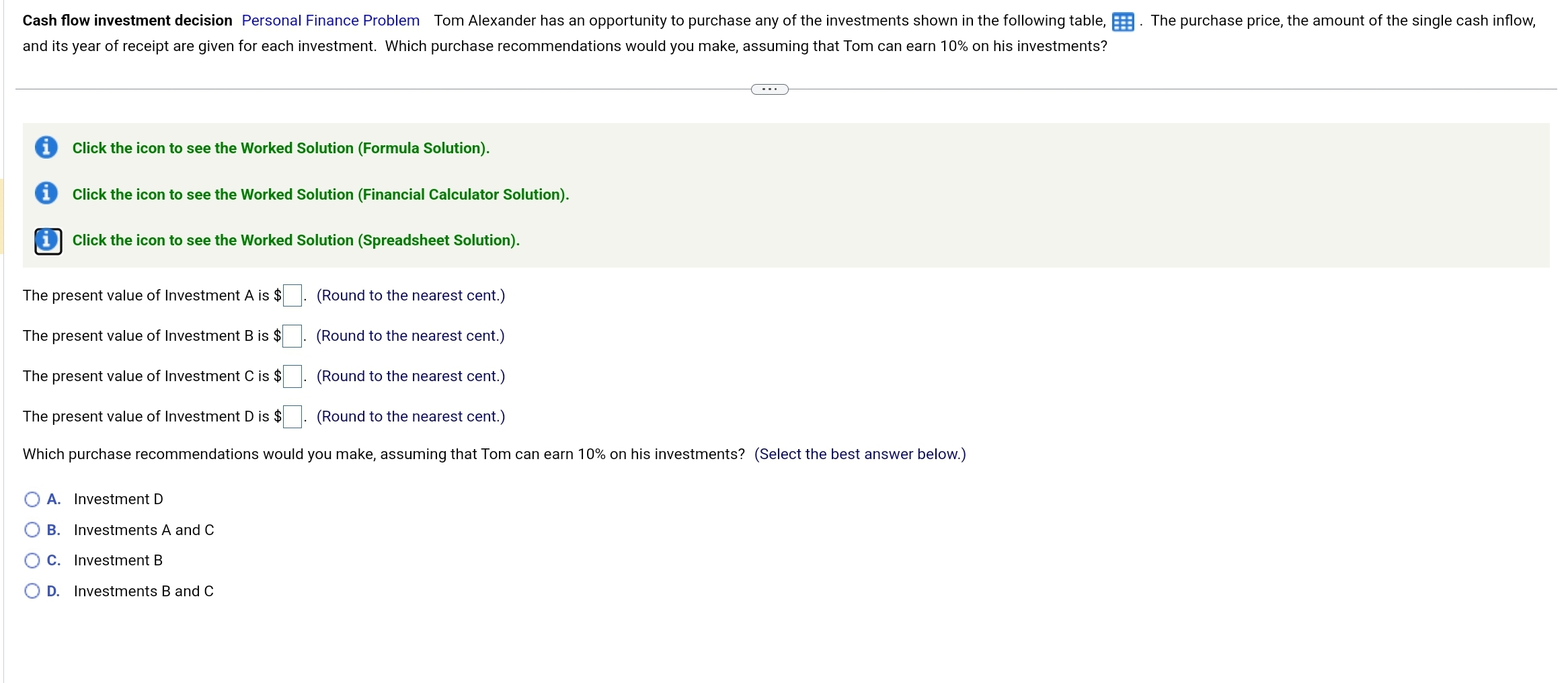
iorked Solution (Spreadsheet Solution). Us Data table Sis : is (Click on the icon here D in order to copy the contents of the data table below into a spreadsheet.) Investment Price Single cash inow Year of receipt 3 w A $4,600 $6,735 3 $138 $698 18 3 0 $374 $2,061 8 D $230 $7,821 38 -m 'KEU SOIUIIDH {Spreadsheet SOIUIIDH). Review Worked Solution (Formula Solution) In order to decide which investments that Tom Alexander should take, all cash flows must be in the same time period, so you need to find the present value of each cash flow today before you can compare these values with the quoted purchase price for each investment. The present value, PV, of some future amount, FVn, to be received n periods from now, assuming an interest rate (or opportunity cost) of r, is calculated as follows: FV n PV= . (1 +r)\" Substituting Fl = $6,735, r= 0.10, and n = 3 into the present value equation yields: $a735 PV=-=$5D601i (1+4110)3 Thus, the value of Investment A today is $5,060.11. The present value of Investment B is: $698 Pv==$1255 n-+0J03 The present value of Investment C is: $2061 Pv==$96147. n +110)8 Review Worked Solution (Financial Calculator Solution) When solving for the present value of a single cash flow using a nancial calculator, you will need to input the values of N, I, PMT, and FV. Make sure you enter a zero for PMT, which is not used in the problem. Since compounding is annual, the periods per year setting on your calculator should be set at 'I, PM = 1. On many calculators, the present value will be preceded by a minus sign for a cash outflow. If a minus sign appears on your calculator, ignore it here. The present value of Investment A is computed as follows: Input Function 6,735 FV 3 N \"IO I CPT PV Solution 5,060.11 The present value of Investment B is computed as follows: Input Function 698 FV 18 N 'IO I CPT PV Solution Review Worked Solution (Spreadsheet Solution) Excel offers a mathematical function that makes the calculation of present values easy. The format of that function is PV(rate,nper,pmt,fv,type). The terms inside the parentheses are inputs that Excel requires to calculate the present value. The terms "rate" and "nper" refer to the interest rate and the number of time periods respectively. The term "fv" represents the lump sum (or future value) that you will receive in the future. The term \"pmt" refers to the annual payment that an annuity offers. The term \"type" is an input that lets Excel know whether the annuity being valued is an ordinary annuity (in which case the input value for "type" is 0 or omitted) or an annuity due (in which case the correct input value for "type" is 1). For now, we will ignore the two inputs, \"pmt" and "type," and enter a value of zero. The present value of Investment A is computed as follows: PRESENT VALUE OF A SINGLE AMOUNT Future value $6,735 Interest rate, pct per year compounded annually 10% Number of years 3 Present value $5,060.11 Entry in Cell BS is = PV(BS,B4,0,BZ,0) The minus sign appears before PV to change the present value to a positive amount. The present value of Investment B is computed as follows: PRESENT VALUE OF A SINGLE AMOUNT Future value Cash ow investment decision Personal Finance Problem Torn Alexander has an opportunity to purchase any of the investments shown in the following table, a. The purchase price, the amount of the single cash inow, and its year of receipt are given for each investment. Which purchase recommendations would you make, assuming that Tom can earn 10% on his investments? 0 Click the icon to see the Worked Solution (Formula Solution). 0 Click the icon to see the Worked Solution (Financial Calculator Solution). Click the icon to see the Worked Solution (Spreadsheet Solution). The present value of Investment A is $ . (Round to the nearest cent.) The present value of Investment B is $ . (Round to the nearest cent.) The present value of Investment C is $ . (Round to the nearest cent.) The present value of Investment D is $ . (Round to the nearest cent.) Which purchase recommendations would you make, assuming that Tom can earn 10% on his investments? (Select the best answer below.) {:3 A. Investment D Investments A and C Investment B Investments B and C
Step by Step Solution
There are 3 Steps involved in it
1 Expert Approved Answer
Step: 1 Unlock
Question Has Been Solved by an Expert!
Get step-by-step solutions from verified subject matter experts
Step: 2 Unlock
Step: 3 Unlock
Students Have Also Explored These Related Finance Questions!









 Study Help