







Question: Is it possible to design a device that superimposes two linearly polarized waves with the same wavelength and different amplitudes in such a way,
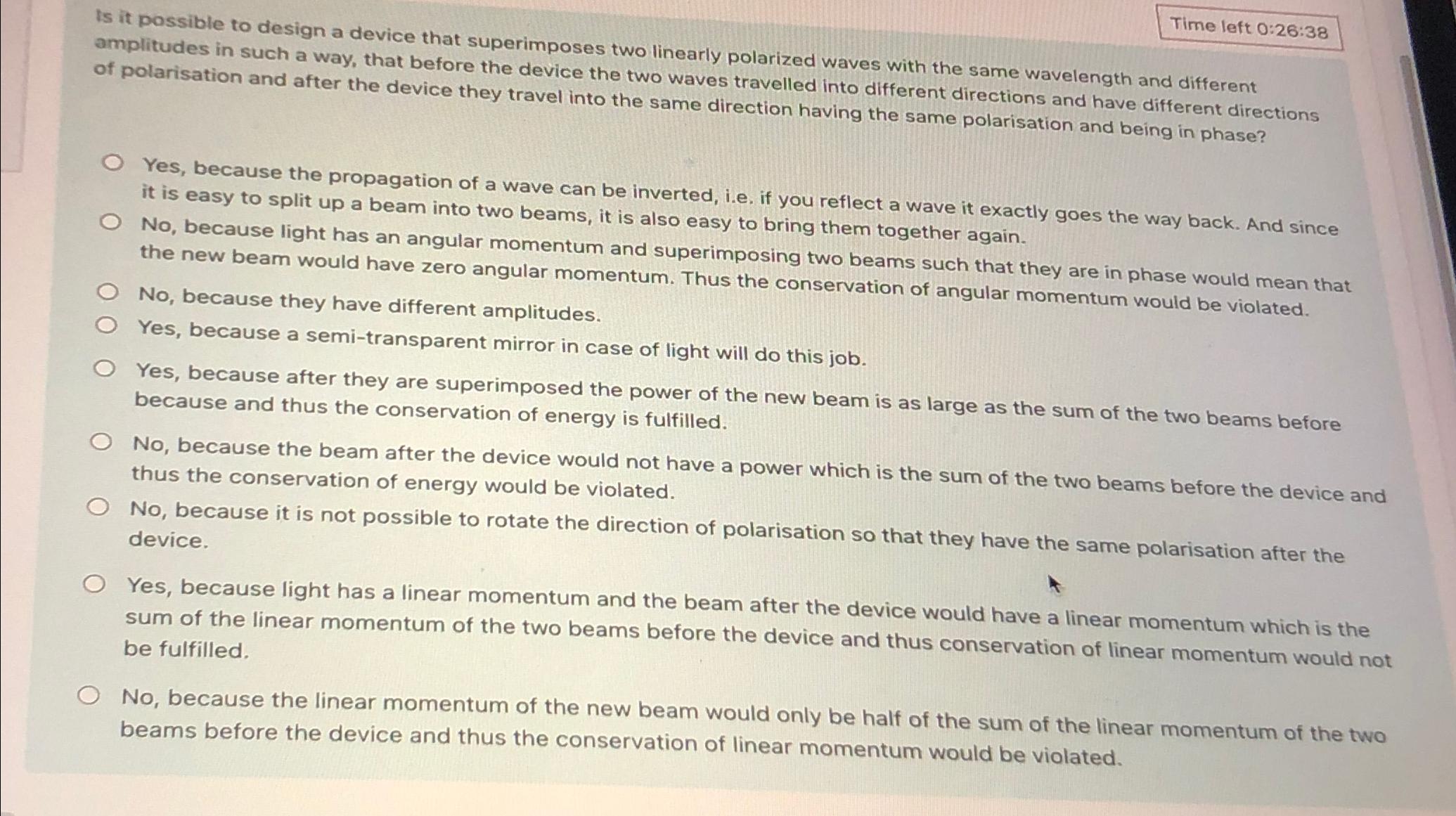
Is it possible to design a device that superimposes two linearly polarized waves with the same wavelength and different amplitudes in such a way, that before the device the two waves travelled into different directions and have different directions of polarisation and after the device they travel into the same direction having the same polarisation and being in phase? Time left 0:26:38 O Yes, because the propagation of a wave can be inverted, i.e. if you reflect a wave it exactly goes the way back. And since it is easy to split up a beam into two beams, it is also easy to bring them together again. O No, because light has an angular momentum and superimposing two beams such that they are in phase would mean that the new beam would have zero angular momentum. Thus the conservation of angular momentum would be violated. No, because they have different amplitudes. Yes, because a semi-transparent mirror in case of light will do this job. Yes, because after they are superimposed the power of the new beam is as large as the sum of the two beams before because and thus the conservation of energy is fulfilled. No, because the beam after the device would not have a power which is the sum of the two beams before the device and thus the conservation of energy would be violated. O No, because it is not possible to rotate the direction of polarisation so that they have the same polarisation after the device. O Yes, because light has a linear momentum and the beam after the device would have a linear momentum which is the sum of the linear momentum of the two beams before the device and thus conservation of linear momentum would not be fulfilled. No, because the linear momentum of the new beam would only be half of the sum of the linear momentum of the two beams before the device and thus the conservation of linear momentum would be violated.
Step by Step Solution
There are 3 Steps involved in it
Yes because a semitransparent mirror in the case of light can superimpose two linea... View full answer

Get step-by-step solutions from verified subject matter experts
 Study Help