







Question: J 3 Styles 1. Consider the reduced order BWR model dn(t) =25000 [ p(1)-0.0056] n(1) + 0.08C()+25000p(?) dC(t) =140n(1) -0.08C(1) dt dT (t) = 25.044[m(/)-A]-0.2325T(1)
J 3
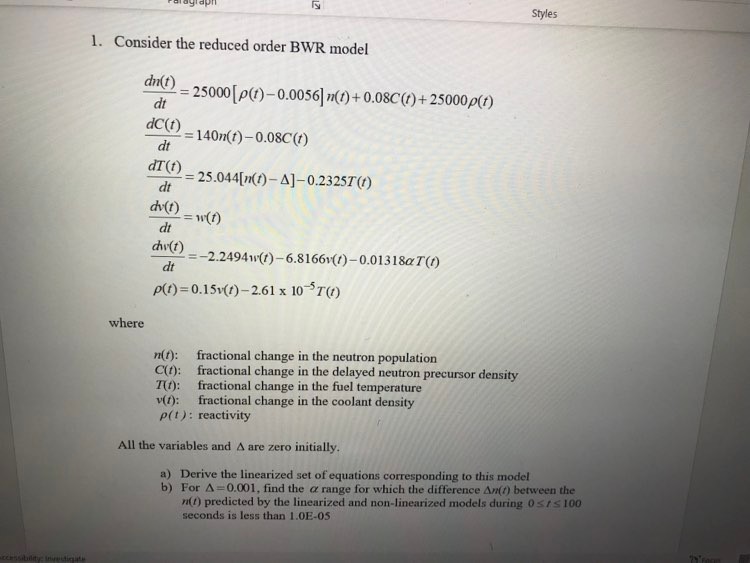
Styles 1. Consider the reduced order BWR model dn(t) =25000 [ p(1)-0.0056] n(1) + 0.08C()+25000p(?) dC(t) =140n(1) -0.08C(1) dt dT (t) = 25.044[m(/)-A]-0.2325T(1) dt dv (t )_ = W(n) di chi(t ) -2.2494w(r)-6.8166v(/)-0.01318aT(1) dt p(r)=0.15v(/) -2.61 x 10 'T(1) where m(f): fractional change in the neutron population C(f): fractional change in the delayed neutron precursor density In): fractional change in the fuel temperature v(n): fractional change in the coolant density p(t ) : reactivity All the variables and & are zero initially. a) Derive the linearized set of equations corresponding to this model b) For A=0.001, find the a range for which the difference Am(?) between the n(f) predicted by the linearized and non-linearized models during 05/ $ 100 seconds is less than 1.DE-05Styles 1. Consider the reduced order BWR model dn(t) =25000 [ p(1)-0.0056] n(1) + 0.08C()+25000p(?) dC(t) =140n(1) -0.08C(1) dt dT (t) = 25.044[m(/)-A]-0.2325T(1) dt dv (t )_ = W(n) di chi(t ) -2.2494w(r)-6.8166v(/)-0.01318aT(1) dt p(r)=0.15v(/) -2.61 x 10 'T(1) where m(f): fractional change in the neutron population C(f): fractional change in the delayed neutron precursor density In): fractional change in the fuel temperature v(n): fractional change in the coolant density p(t ) : reactivity All the variables and & are zero initially. a) Derive the linearized set of equations corresponding to this model b) For A=0.001, find the a range for which the difference Am(?) between the n(f) predicted by the linearized and non-linearized models during 05/ $ 100 seconds is less than 1.DE-05
Step by Step Solution
There are 3 Steps involved in it

Get step-by-step solutions from verified subject matter experts
 Study Help