







Question: Java program: In this project you will write the code to implement the following Shape hierarchy. In this exercise, Shape shall be defined as an
Java program:
In this project you will write the code to implement the following Shape hierarchy. In this exercise, Shape shall be defined as an abstract class, which contains:
- Two protected instance variables color(String) and filled(boolean).
The protected variables can be accessed by its subclasses and classesin the same package. They are denoted with a '#' sign in the class diagram.
- Getter and setter for all the instance variables, and toString().
- Two abstract methods getArea() and getPerimeter() (shown in italics in the class diagram).
- The subclasses Circle and Rectangle shall override the abstract methods getArea() and g etPerimeter() and provide the proper implementation. They also override the toString().
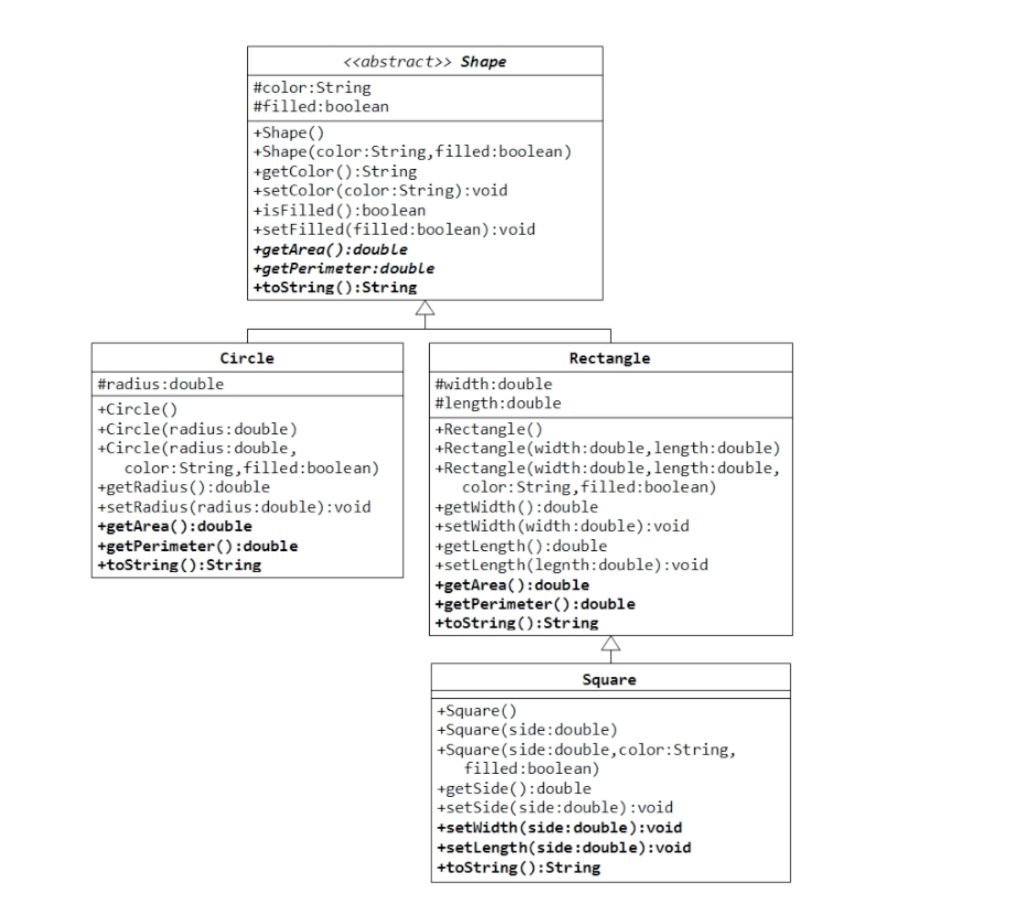
Write a test class to test these statements involving polymorphism and explain the outputs. Some statements may trigger compilation errors. Explain the errors, if any. Include the answers as comments inside the code:
Shape s1 = new Circle(5.5, "RED", false); // Upcast Circle to Shape
System.out.println(s1); // which version?
System.out.println(s1.getArea()); // which version?
System.out.println(s1.getPerimeter()); // which version?
System.out.println(s1.getColor());
System.out.println(s1.isFilled());
System.out.println(s1.getRadius());
Circle c1 = (Circle)s1; // Downcast back to Circle
System.out.println(c1);
System.out.println(c1.getArea());
System.out.println(c1.getPerimeter());
System.out.println(c1.getColor());
System.out.println(c1.isFilled());
System.out.println(c1.getRadius());
Shape s2 = new Shape();
Shape s3 = new Rectangle(1.0, 2.0, "RED", false); // Upcast
System.out.println(s3); System.out.println(s3.getArea());
System.out.println(s3.getPerimeter());
System.out.println(s3.getColor());
System.out.println(s3.getLength());
Rectangle r1 = (Rectangle)s3; // downcast
System.out.println(r1);
System.out.println(r1.getArea());
System.out.println(r1.getColor());
System.out.println(r1.getLength());
Shape s4 = new Square(6.6); // Upcast
System.out.println(s4);
System.out.println(s4.getArea());
System.out.println(s4.getColor());
System.out.println(s4.getSide());
// Take note that we downcast Shape s4 to Rectangle,
// which is a superclass of Square, instead of Square
Rectangle r2 = (Rectangle)s4;
System.out.println(r2);
System.out.println(r2.getArea());
System.out.println(r2.getColor());
System.out.println(r2.getSide());
System.out.println(r2.getLength());
// Downcast Rectangle r2 to Square
Square sq1 = (Square)r2;
System.out.println(sq1);
System.out.println(sq1.getArea());
System.out.println(sq1.getColor());
System.out.println(sq1.getSide());
System.out.println(sq1.getLength());
> Shape #color:String #filled:boolean +Shape() +Shape (color:String, filled:boolean) +getColor(): String +set Color (color:String):void +isFilled(): boolean +setFilled(filled: boolean):void +getArea(): double +getPerimeter:double +toString(): String Circle #radius: double +Circle() +Circle(radius: double) +Circle(radius: double, color: String, filled:boolean) +getRadius(): double +setRadius(radius: double):void +getArea(): double +getPerimeter(): double +toString(): String Rectangle #width:double #length:double +Rectangle() +Rectangle(width:double, length: double) +Rectangle(width:double, length: double, color: String, filled:boolean) +getWidth(): double +setWidth(width: double):void +getLength(): double +setLength(legnth:double):void +getArea(): double +getPerimeter() : double +toString(): String Square +Square) +Square(side: double) +Square(side:double, color:String, filled : boolean) +getSide(): double +setSide (side: double):void +setWidth(side: double):void +setLength(side: double):void +toString(): String
Step by Step Solution
There are 3 Steps involved in it

Get step-by-step solutions from verified subject matter experts
 Study Help