







Question: Let a: Z R be a function. We write an instead of a(n). We define the limit 00 k n=- N n=-N n=k+1 where
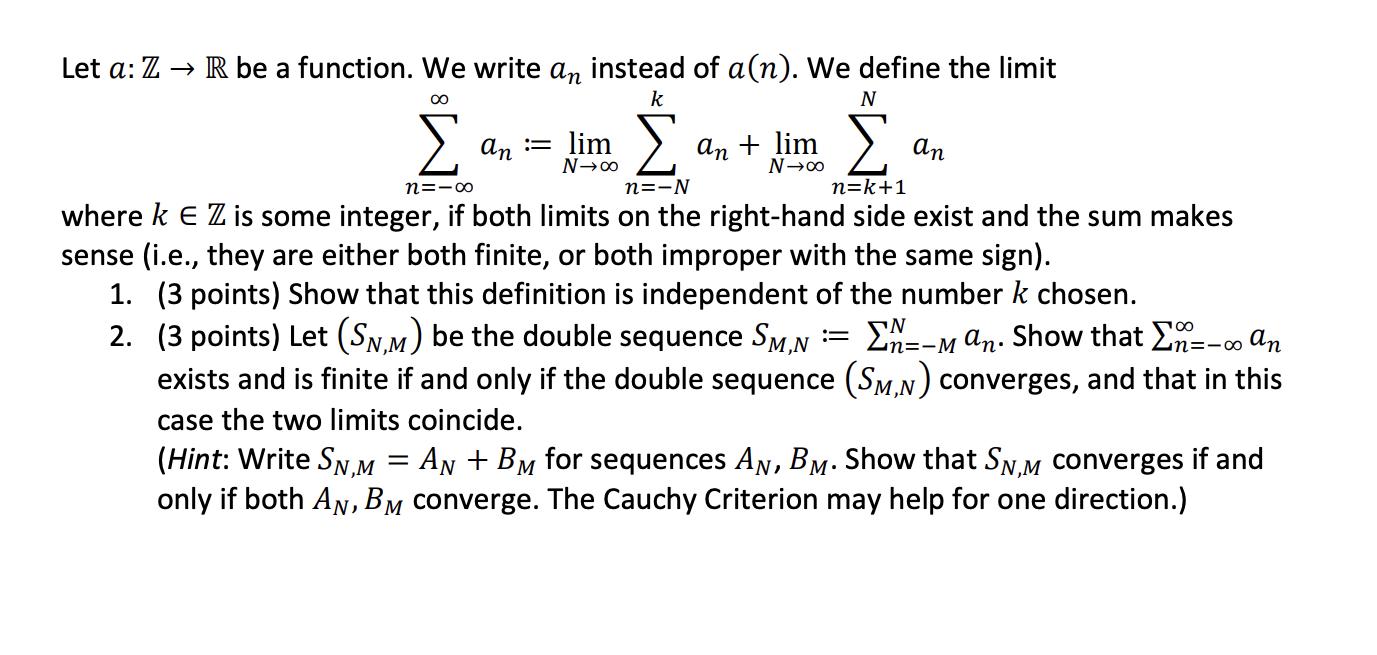
Let a: Z R be a function. We write an instead of a(n). We define the limit 00 k n=- N n=-N n=k+1 where k E Z is some integer, if both limits on the right-hand side exist and the sum makes sense (i.e., they are either both finite, or both improper with the same sign). 2. 1. (3 points) Show that this definition is independent of the number k chosen. (3 points) Let (SN,M) be the double sequence SM,N = n=-Man. Show that -- an exists and is finite if and only if the double sequence (SM,N) converges, and that in this case the two limits coincide. an := lim N an + lim N = an (Hint: Write SN,M = AN + BM for sequences AN, BM. Show that SN,M converges if and only if both AN, BM converge. The Cauchy Criterion may help for one direction.)
Step by Step Solution
3.43 Rating (150 Votes )
There are 3 Steps involved in it
1 To show that the definition is independent of the number k chosen we need to demonstrate that for any k and k if both limits on the righthand side e... View full answer

Get step-by-step solutions from verified subject matter experts
 Study Help