







Question: Let n 0 be a given integer. In this exercise, we study the conversion of n in base 10 (the usual decimal base), into
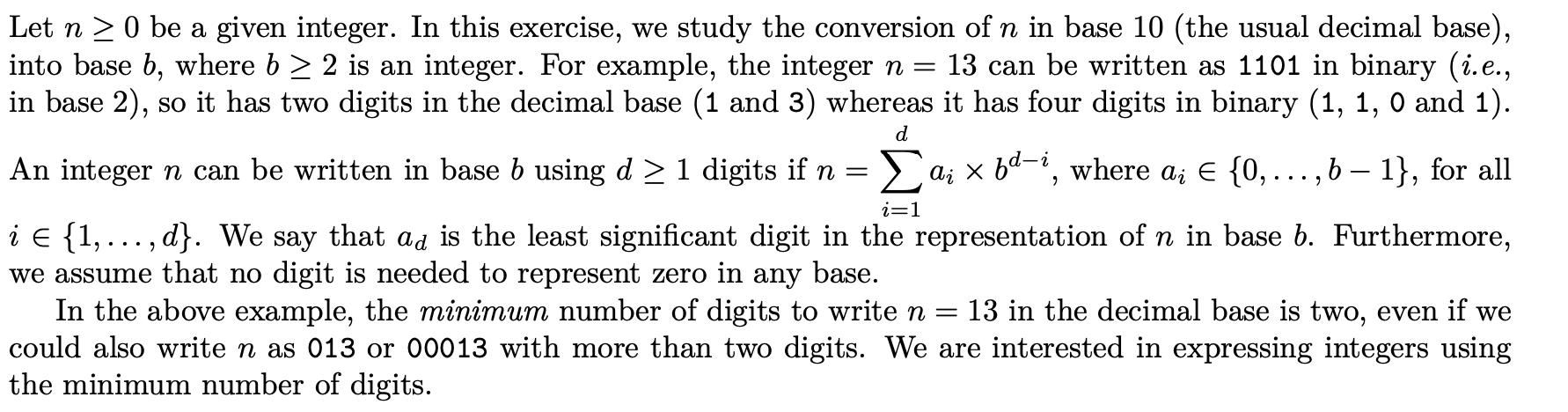
Let n 0 be a given integer. In this exercise, we study the conversion of n in base 10 (the usual decimal base), into base b, where b 2 is an integer. For example, the integer n = 13 can be written as 1101 in binary (i.e., in base 2), so it has two digits in the decimal base (1 and 3) whereas it has four digits in binary (1, 1, 0 and 1). d An integer n can be written in base 6 using d 1 digits if n = ai fd-i, where a {0, ...,b 1}, for all i=1 i {1,...,d}. We say that ad is the least significant digit in the representation of n in base b. Furthermore, we assume that no digit is needed to represent zero in any base. In the above example, the minimum number of digits to write n = 13 in the decimal base is two, even if we could also write n as 013 or 00013 with more than two digits. We are interested in expressing integers using the minimum number of digits.
Step by Step Solution
There are 3 Steps involved in it
The image provides an instructional guide for representing an integer n in base b complete with a cl... View full answer

Get step-by-step solutions from verified subject matter experts
 Study Help