







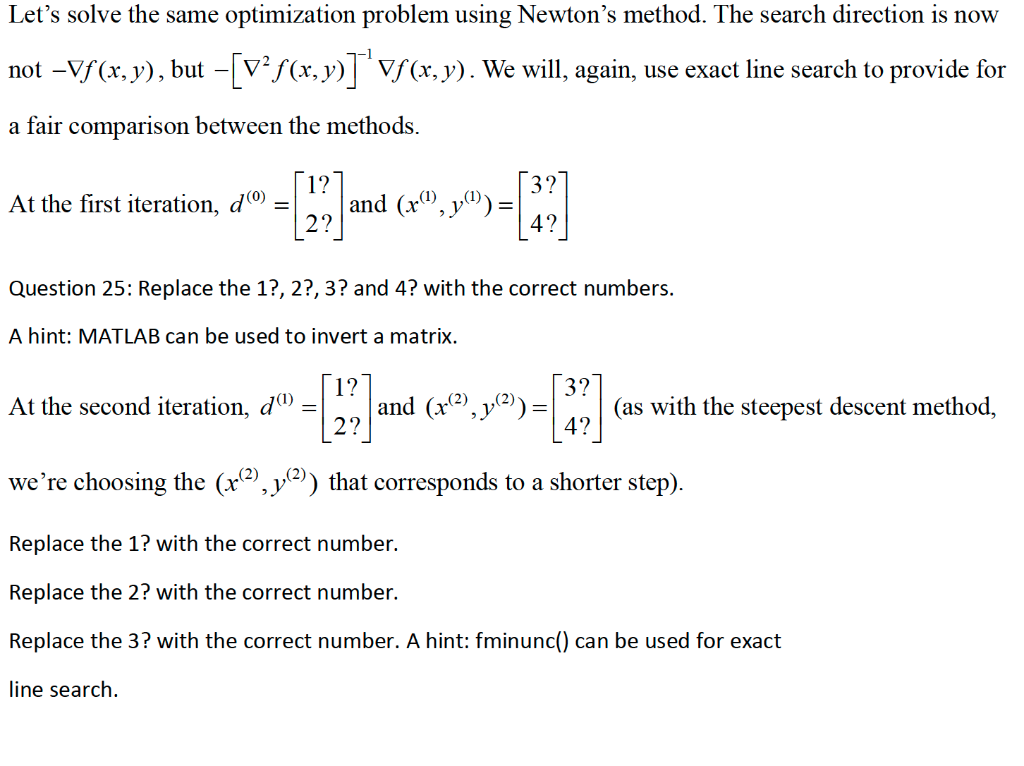
Question: Let's solve the same optimization problem using Newton's method. The search direction is now not - Vf(x,y), but -[vf(x,y)] Vf(x, y). We will, again,
 \
\
![direction is now not - Vf(x,y), but -[vf(x,y)] Vf(x, y). We will,](https://s3.amazonaws.com/si.experts.images/answers/2024/09/66e2873965e8d_78566e287391212a.jpg)
Let's solve the same optimization problem using Newton's method. The search direction is now not - Vf(x,y), but -[vf(x,y)] Vf(x, y). We will, again, use exact line search to provide for a fair comparison between the methods. At the first iteration, d) At the first iteration, d' =[22]and (x","=( and (1) Question 25: Replace the 1?, 22,3? and 4? with the correct numbers. A hint: MATLAB can be used to invert a matrix. 1? At the second iteration, d' (as with the steepest descent method, 2? we're choosing the (r(2), y(?)) that corresponds to a shorter step). Replace the 1? with the correct number. Replace the 2? with the correct number. Replace the 3? with the correct number. A hint: fminunc() can be used for exact line search. Replace the 4? with the correct number. Let's solve the same optimization problem using Newton's method. The search direction is now not - Vf(x,y), but -[vf(x,y)] Vf(x, y). We will, again, use exact line search to provide for a fair comparison between the methods. At the first iteration, d) At the first iteration, d' =[22]and (x","=( and (1) Question 25: Replace the 1?, 22,3? and 4? with the correct numbers. A hint: MATLAB can be used to invert a matrix. 1? At the second iteration, d' (as with the steepest descent method, 2? we're choosing the (r(2), y(?)) that corresponds to a shorter step). Replace the 1? with the correct number. Replace the 2? with the correct number. Replace the 3? with the correct number. A hint: fminunc() can be used for exact line search. Replace the 4? with the correct number
Step by Step Solution
There are 3 Steps involved in it

Get step-by-step solutions from verified subject matter experts
 Study Help