







Question: Many compilers may not generate a warning if operator = is mistakenly used instead of operator == That is, even though you mistakenly write
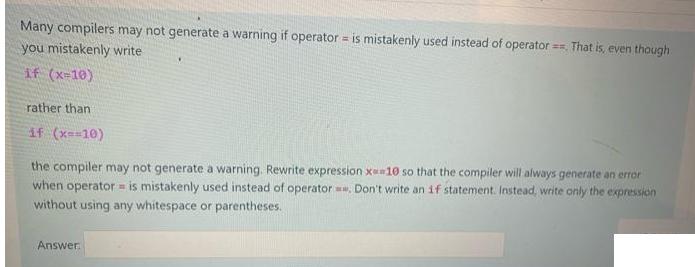
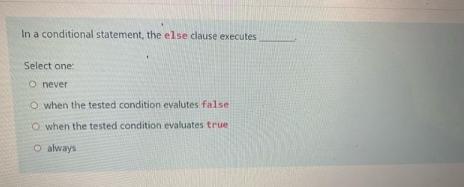
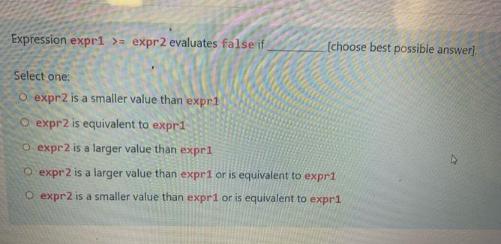
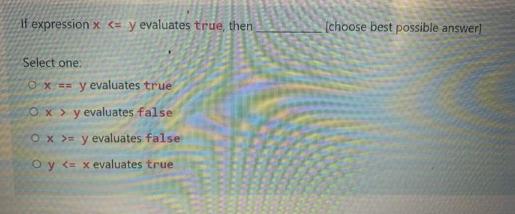
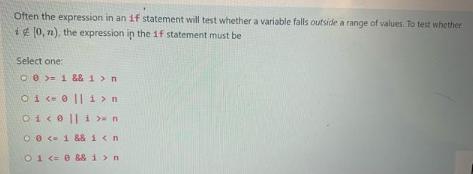
Many compilers may not generate a warning if operator = is mistakenly used instead of operator == That is, even though you mistakenly write if (x-10) rather than if (x==10) the compiler may not generate a warning. Rewrite expression xem10 so that the compiler will always generate an error when operator = is mistakenly used instead of operator. Don't write an if statement. Instead, write only the expression without using any whitespace or parentheses. Answer In a conditional statement, the else clause executes Select one: O never Owhen the tested condition evalutes false O when the tested condition evaluates true O always Expression expr1 >= expr2 evaluates false if Select one: O expr2 is a smaller value than expr1 O expr2 is equivalent to expr-1 O expr2 is a larger value than expri [choose best possible answer] O expr 2 is a larger value than expr1 or is equivalent to expr1 O expr2 is a smaller value than expr1 or is equivalent to expri If expression x y evaluates false Ox>= y evaluates false Oy Often the expression in an if statement will test whether a variable falls outside a range of values. To test whether i 10, n), the expression in the 1f statement must be Select one: 001 && 1 > n 01 n 01 n 00
Step by Step Solution
3.34 Rating (151 Votes )
There are 3 Steps involved in it

Get step-by-step solutions from verified subject matter experts
 Study Help