







Question: _ Modular Arithmetic. Let p be a prime number, such as 2, 3, 5, 7, 11, . . .. We write IF}, for integers with
_
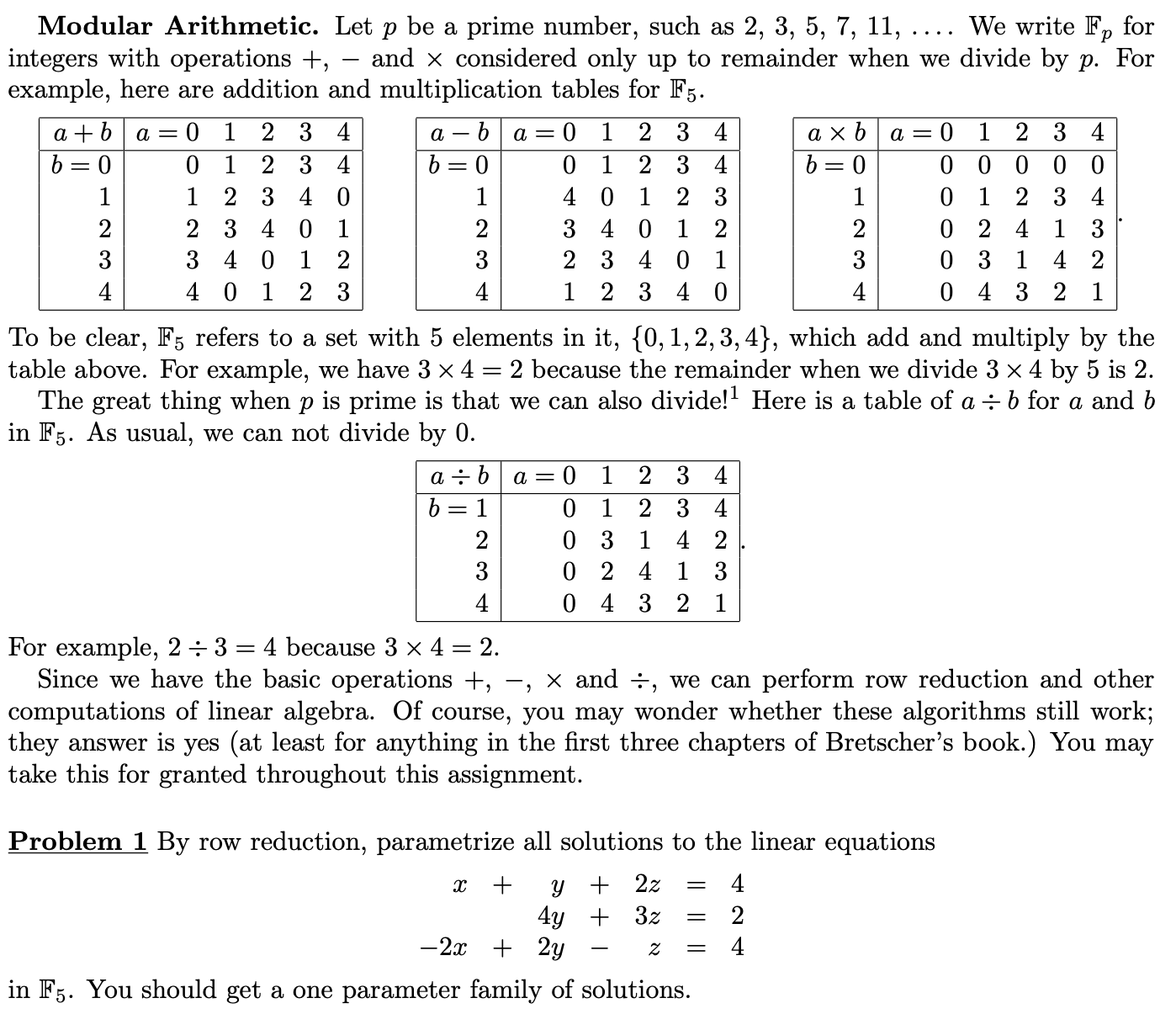
Modular Arithmetic. Let p be a prime number, such as 2, 3, 5, 7, 11, . . .. We write IF}, for integers with operations +, and X considered only up to remainder when we divide by 13. For example, here are addition and multiplication tables for F5. To be clear, ]F5 refers to a set with 5 elements in it, {0, 1, 2, 3, 4}, which add and multiply by the table above. For example, we have 3 X 4 = 2 because the remainder when we divide 3 x 4 by 5 is 2. The great thing when p is prime is that we can also divide!1 Here is a table of a + b for a. and b in ]F5. As usual, we can not divide by 0. For example, 2 + 3 = 4 because 3 x 4 = 2. Since we have the basic operations +, , x and +, we can perform row reduction and other computations of linear algebra. Of course, you may wonder whether these algorithms still work; they answer is yes (at least for anything in the rst three chapters of Bretscher's book.) You may take this for granted throughout this assignment. Problem 1 By row reduction, parametrize all solutions to the linear equations a: + y + 22 = 4 43; + 32 = 2 2a: + 23,: z = 4 in F5. You should get a one parameter family of solutions
Step by Step Solution
There are 3 Steps involved in it

Get step-by-step solutions from verified subject matter experts
 Study Help