







Question: Narrow Distinctiveness Source of Advantage Sources: Based on Michael E. Porter. (1980). Competitive Strategy: Techniques for Analyzing Industries and Competitors. New York: Free Press; Michael
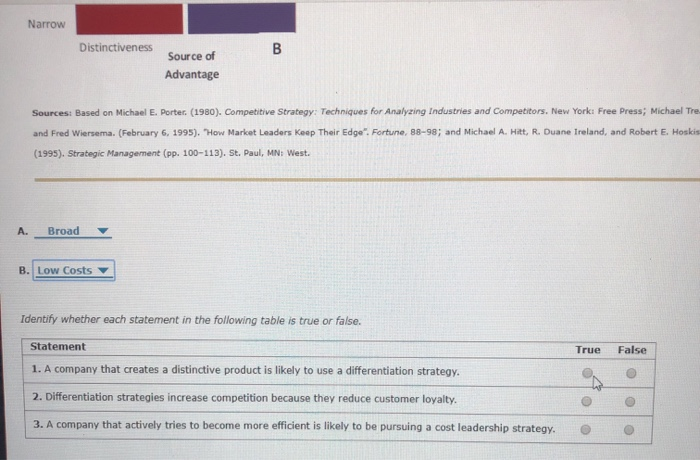
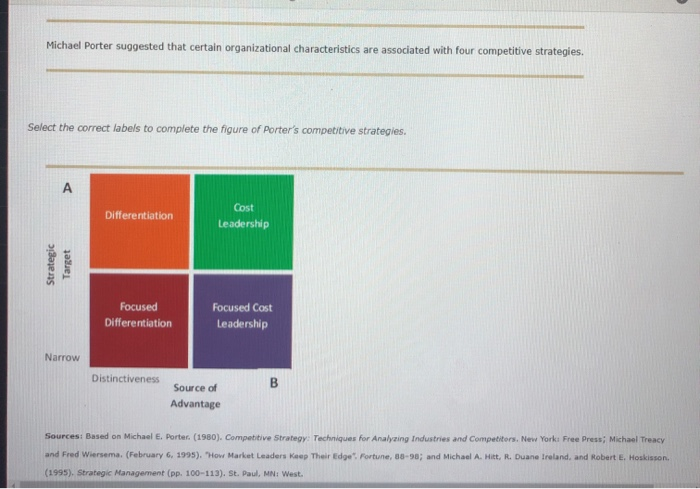
Narrow Distinctiveness Source of Advantage Sources: Based on Michael E. Porter. (1980). Competitive Strategy: Techniques for Analyzing Industries and Competitors. New York: Free Press; Michael Tre and Fred Wiersema. (February 6, 1995). "How Market Leaders Keep Their Edge". Fortune, 88-98; and Michael A. Hitt, R. Duane Ireland, and Robert E. Hoskis (1995). Strategic Management (pp. 100-113). St. Paul, MN: West. A. Broad B. Low Costs Identify whether each statement in the following table is true or false. Statement True False 1. A company that creates a distinctive product is likely to use a differentiation strategy. 2. Differentiation strategies increase competition because they reduce customer loyalty. 3. A company that actively tries to become more efficient is likely to be pursuing a cost leadership strategy. Michael Porter suggested that certain organizational characteristics are associated with four competitive strategies. Select the correct labels to complete the figure of Porter's competitive strategies. Differentiation Cost Leadership Strategic Target Focused Differentiation Focused Cost Leadership Narrow Distinctiveness Source of Advantage Sources: Based on Michael E. Porter (1980). Competitive Strategy: Techniques for Analyzing Industries and Competitors. New York Free Press Michael Treacy and Fred Wiersema. (February 6, 1995). How Market leaders Keep Their Edge Fortune, 85-98; and Michael A. Hitt, R. Duane Ireland, and Robert E. Hoskisson (1995). Strategic Management (pp. 100-113), St. Paul, MN West
Step by Step Solution
There are 3 Steps involved in it

Get step-by-step solutions from verified subject matter experts
 Study Help