







Question: . . necessities study the give records deeply and Drawing conclusions refers to records this is implied or inferred. ... the use of those clues
.
.
necessities study the give records deeply and Drawing conclusions refers to records this is implied or inferred. ... the use of those clues to give for deeper information And provide the details Conclusions
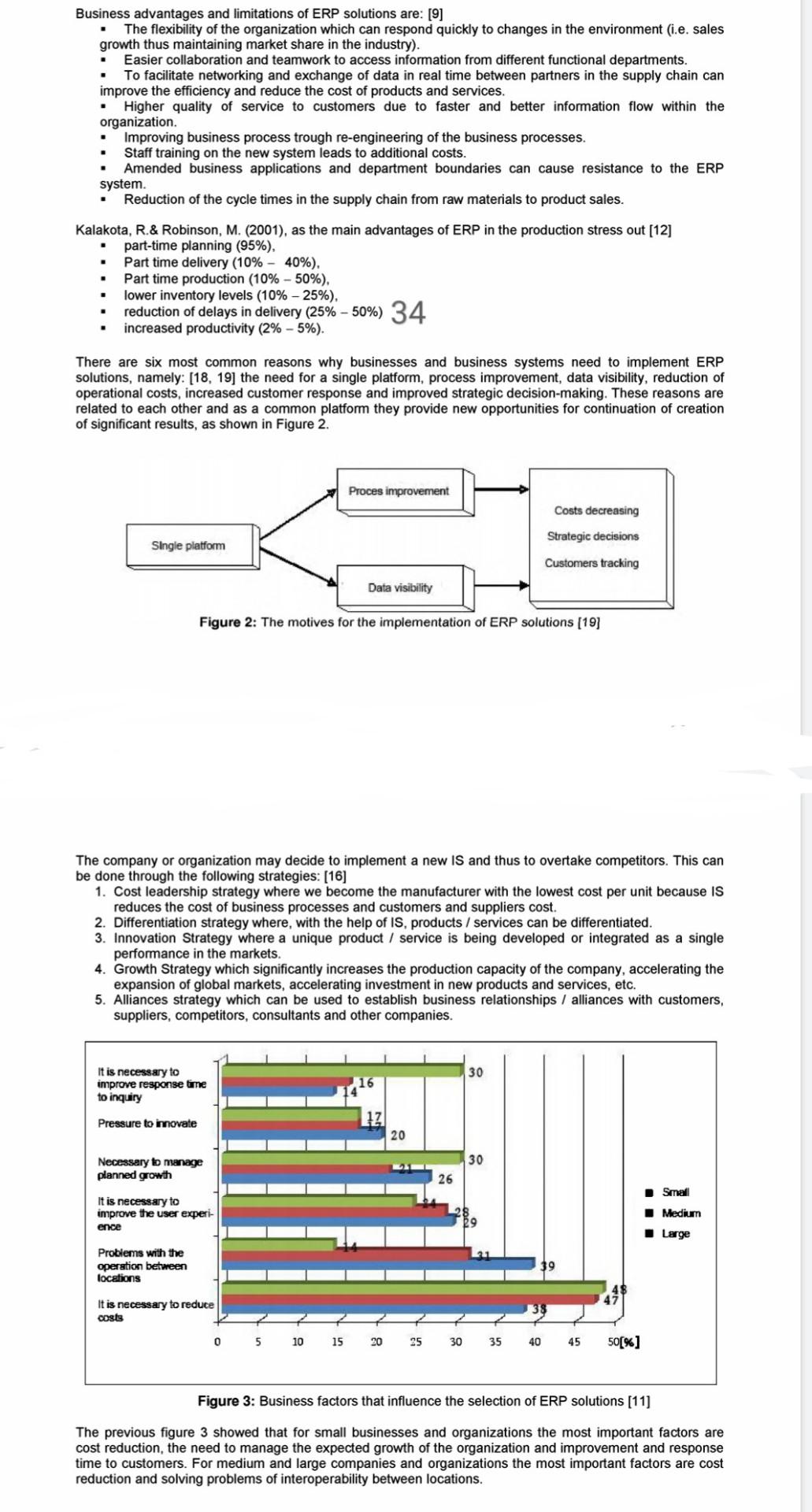
. . Business advantages and limitations of ERP solutions are: [9] The flexibility of the organization which can respond quickly to changes in the environment (i.e. sales growth thus maintaining market share in the industry). Easier collaboration and teamwork to access information from different functional departments. To facilitate networking and exchange of data in real time between partners in the supply chain can improve the efficiency and reduce the cost of products and services. Higher quality of service to customers due to faster and better information flow within the organization. Improving business process trough re-engineering of the business processes. Staff training on the new system leads to additional costs. Amended business applications and department boundaries can cause resistance to the ERP system. Reduction of the cycle times in the supply chain from raw materials to product sales. . . . . Kalakota, R.& Robinson, M. (2001), as the main advantages of ERP in the production stress out [12] part-time planning (95%), Part time delivery (10% - 40%). Part time production (10% - 50%), lower inventory levels (10% - 25%), reduction of delays in delivery (25% 50%) 34 increased productivity (2% - 5%). . There are six most common reasons why businesses and business systems need to implement ERP solutions, namely: [18, 19] the need for a single platform, process improvement, data visibility, reduction of operational costs, increased customer response and improved strategic decision-making. These reasons are related to each other and as a common platform they provide new opportunities for continuation of creation of significant results, as shown in Figure 2. Proces improvement Costs decreasing Strategic decisions Single platform Customers tracking Data visibility Figure 2: The motives for the implementation of ERP solutions (19) The company or organization may decide to implement a new IS and thus to overtake competitors. This can be done through the following strategies: [16] 1. Cost leadership strategy where we become the manufacturer with the lowest cost per unit because IS reduces the cost of business processes and customers and suppliers cost. 2. Differentiation strategy where, with the help of IS, products / services can be differentiated. 3. Innovation Strategy where a unique product / service is being developed or integrated as a single performance in the markets. 4. Growth Strategy which significantly increases the production capacity of the company, accelerating the expansion of global markets, accelerating investment in new products and services, etc. 5. Alliances strategy which can be used to establish business relationships / alliances with customers, suppliers, competitors, consultants and other companies. 30 It is necessary to improve response time to inquiry Pressure to imovate 20 30 Necessary to manage planned growth 26 1 Small It is necessary to improve the user experi- ence Medium Large Problems with the operation between locations It is necessary to reduce costs 05 10 15 20 25 30 35 40 45 50[%] Figure 3: Business factors that influence the selection of ERP solutions [11] The previous figure 3 showed that for small businesses and organizations the most important factors are cost reduction, the need to manage the expected growth of the organization and improvement and response time to customers. For medium and large companies and organizations the most important factors are cost reduction and solving problems of interoperability between locationsStep by Step Solution
There are 3 Steps involved in it
1 Expert Approved Answer
Step: 1 Unlock

Question Has Been Solved by an Expert!
Get step-by-step solutions from verified subject matter experts
Step: 2 Unlock
Step: 3 Unlock
 Study Help