







Question: . necessities study the give records deeply and Drawing conclusions refers to records this is implied or inferred. ... the use of those clues to
. necessities study the give records deeply and Drawing conclusions refers to records this is implied or inferred. ... the use of those clues to give for deeper information And provide the details Conclusions
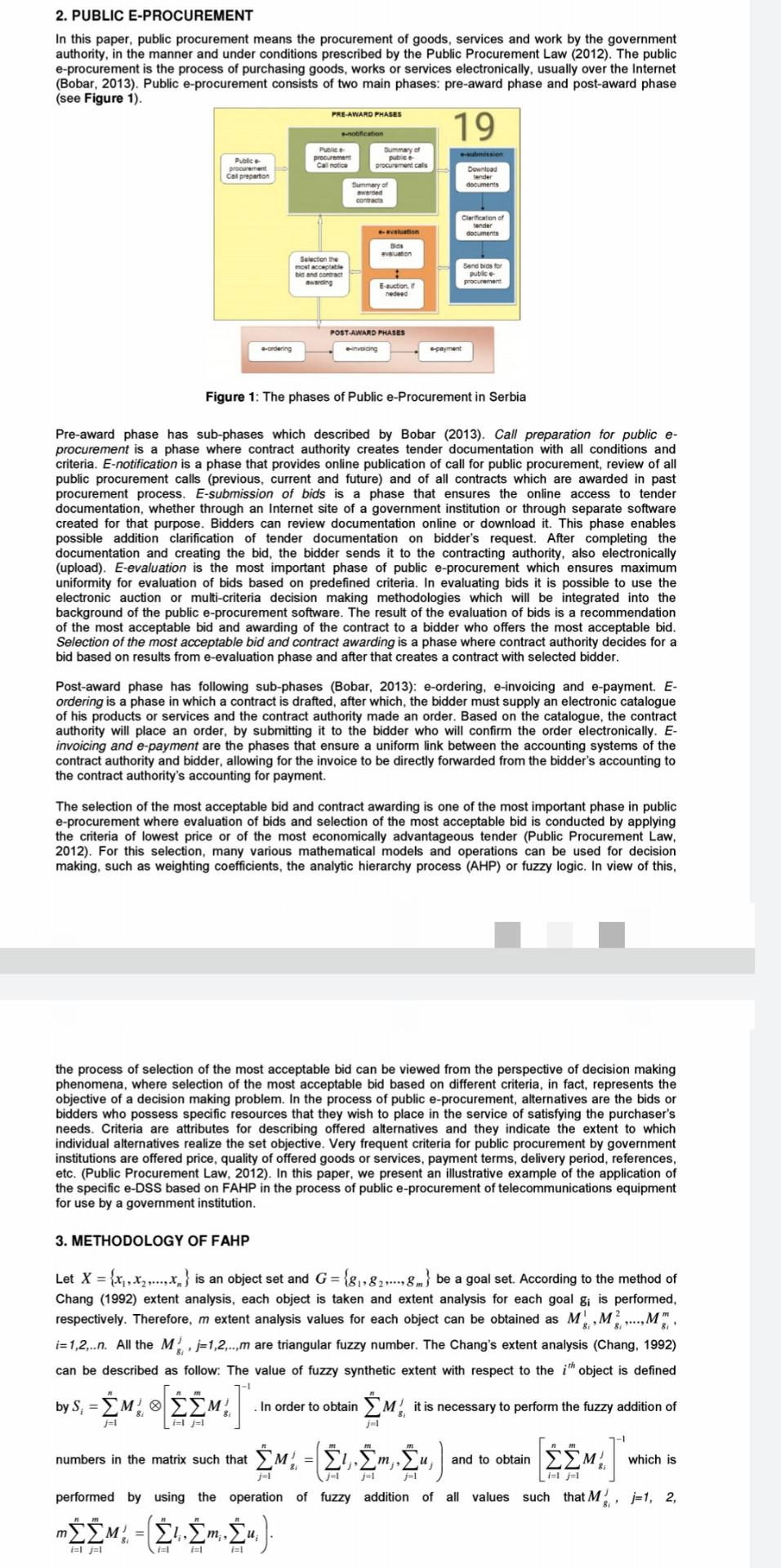
2. PUBLIC E-PROCUREMENT In this paper, public procurement means the procurement of goods, services and work by the government authority, in the manner and under conditions prescribed by the Public Procurement Law (2012). The public e-procurement is the process of purchasing goods, works or services electronically, usually over the Internet (Bobar, 2013). Public e-procurement consists of two main phases: pre-award phase and post-award phase (see Figure 1). PRE-AWARD PHASES 19 notification Publice procurement Cal preparton procurement Cal notice Summary of pubice procurement als Download ander documents Summary of twarded contract Clarification or andel dobums vaatia Vston Selection the most accepte bid and contract warding Send bids to public procurement E-auction nedeed POST AWARD PHASES e-ordering ving e-payment Figure 1: The phases of Public e-Procurement in Serbia Pre-award phase has sub-phases which described by Bobar (2013). Call preparation for public e- procurement is a phase where contract authority creates tender documentation with all conditions and criteria. E-notification is a phase that provides online publication of call for public procurement, review of all public procurement calls (previous, current and future) and of all contracts which are awarded in past procurement process. E-submission of bids is a phase that ensures the online access to tender documentation, whether through an Internet site of a government institution or through separate software created for that purpose. Bidders can review documentation online or download it. This phase enables possible addition clarification of tender documentation on bidder's request. After completing the documentation and creating the bid, the bidder sends it to the contracting authority, also electronically (upload). E-evaluation is the most important phase of public e-procurement which ensures maximum uniformity for evaluation of bids based on predefined criteria. In evaluating bids it is possible to use the electronic auction or multi-criteria decision making methodologies which will be integrated into the background of the public e-procurement software. The result of the evaluation of bids is a recommendation of the most acceptable bid and awarding of the contract to a bidder who offers the most acceptable bid. Selection of the most acceptable bid and contract awarding is a phase where contract authority decides for a bid based on results from e-evaluation phase and after that creates a contract with selected bidder. Post-award phase has following sub-phases (Bobar, 2013): e-ordering, e-invoicing and e-payment. E- ordering is a phase in which a contract is drafted, after which, the bidder must supply an electronic catalogue of his products or services and the contract authority made an order. Based on the catalogue, the contract authority will place an order, by submitting it to the bidder who will confirm the order electronically. E- invoicing and e-payment are the phases that ensure a uniform link between the accounting systems of the contract authority and bidder, allowing for the invoice to be directly forwarded from the bidder's accounting to the contract authority's accounting for payment. The selection of the most acceptable bid and contract awarding is one of the most important phase in public e-procurement where evaluation of bids and selection the most acceptable bid is conducted by applying the criteria of lowest price or of the most economically advantageous tender (Public Procurement Law, 2012). For this selection, many various mathematical models and operations can be used for decision making, such as weighting coefficients, the analytic hierarchy process (AHP) or fuzzy logic. In view of this, the process of selection of the most acceptable bid can be viewed from the perspective of decision making phenomena, where selection of the most acceptable bid based on different criteria, in fact, represents the objective of a decision making problem. In the process of public e-procurement, alternatives are the bids or bidders who possess specific resources that they wish to place in the service of satisfying the purchaser's needs. Criteria are attributes for describing offered alternatives and they indicate the extent to which individual alternatives realize the set objective. Very frequent criteria for public procurement by government institutions are offered price, quality of offered goods or services, payment terms, delivery period, references, etc. (Public Procurement Law, 2012). In this paper, we present an illustrative example of the application of the specific e-DSS based on FAHP in the process of public e-procurement of telecommunications equipment for use by a government institution. 3. METHODOLOGY OF FAHP Let X = {x1,x2,...},} is an object set and G={81,82,...,8.m} be a goal set. According to the method of Chang (1992) extent analysis, each object is taken and extent analysis for each goal di is performed, respectively. Therefore, m extent analysis values for each object can be obtained as M.,,M.....,M. i=1,2,..n. All the Mj=1,2,..,m are triangular fuzzy number. The Chang's extent analysis (Chang, 1992) can be described as follow: The value of fuzzy synthetic extent with respect to the ith object is defined bys, = M: In order to obtain M it is necessary to perform the fuzzy addition of . j=1 i=1 /=1 -1 , M M and to obtain E&M which is performed by using the operation of fuzzy addition of all values such that Mj=1, 2, ESM: m . - (...). i=1 j=1Step by Step Solution
There are 3 Steps involved in it
1 Expert Approved Answer
Step: 1 Unlock

Question Has Been Solved by an Expert!
Get step-by-step solutions from verified subject matter experts
Step: 2 Unlock
Step: 3 Unlock
 Study Help