







Question: . . necessities study the give records deeply and Drawing conclusions refers to records this is implied or inferred. ... the use of those clues
.
.
necessities study the give records deeply and Drawing conclusions refers to records this is implied or inferred. ... the use of those clues to give for deeper information And provide the details Conclusions
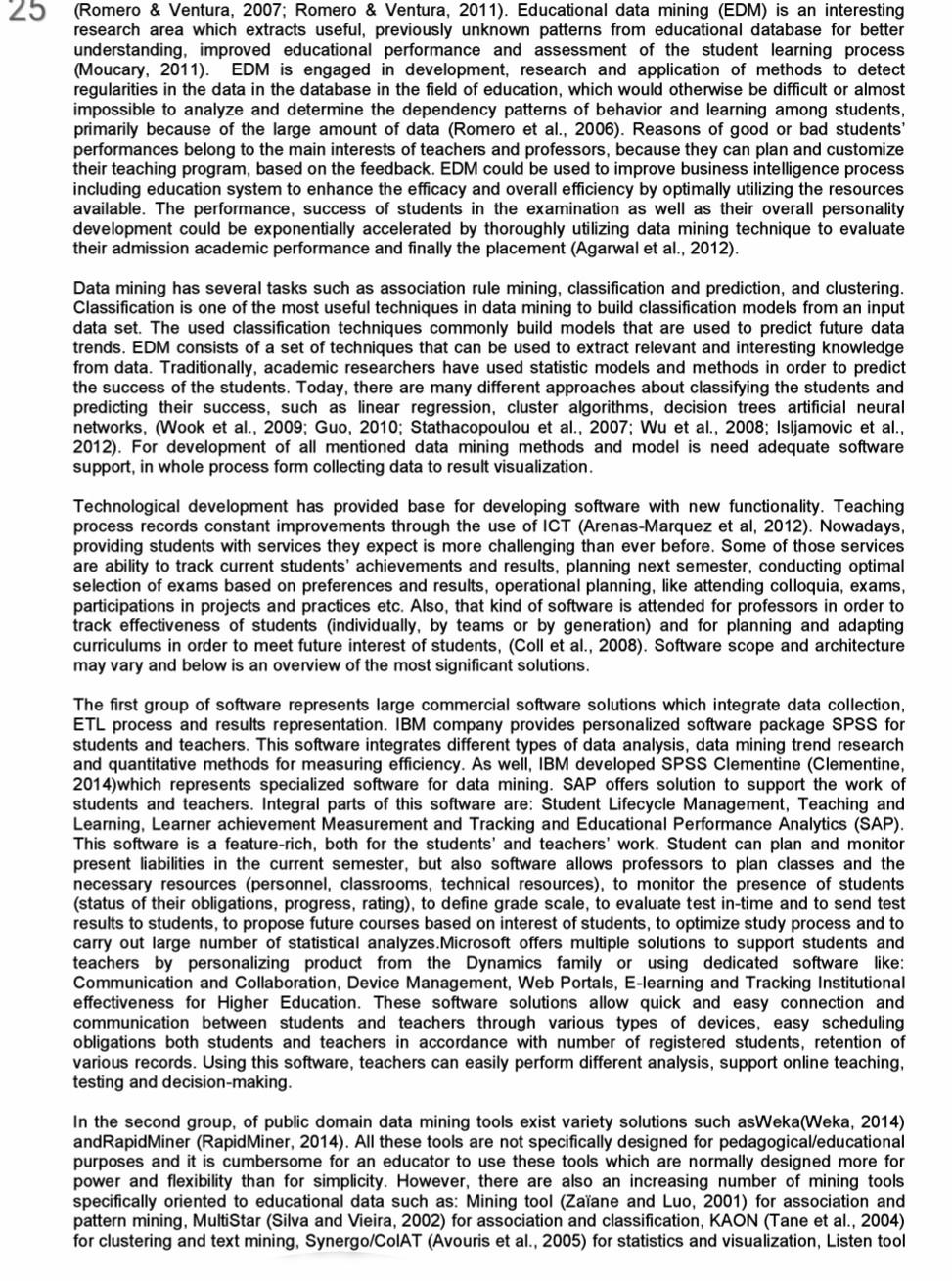
25 (Romero & Ventura, 2007; Romero & Ventura, 2011). Educational data mining (EDM) is an interesting research area which extracts useful, previously unknown patterns from educational database for better understanding, improved educational performance and assessment of the student learning process (Moucary, 2011). EDM is engaged in development, research and application of methods to detect regularities in the data in the database in the field of education, which would otherwise be difficult or almost impossible to analyze and determine the dependency patterns of behavior and learning among students, primarily because of the large amount of data (Romero et al., 2006). Reasons of good or bad students' performances belong to the main interests of teachers and professors, because they can plan and customize their teaching program, based on the feedback. EDM could be used to improve business intelligence process including education system to enhance the efficacy and overall efficiency by optimally utilizing the resources available. The performance, success of students in the examination as well as their overall personality development could be exponentially accelerated by thoroughly utilizing data mining technique to evaluate their admission academic performance and finally the placement (Agarwal et al., 2012). Data mining has several tasks such as association rule mining, classification and prediction, and clustering. Classification is one of the most useful techniques in data mining to build classification models from an input data set. The used classification techniques commonly build models that are used to predict future data trends. EDM consists of a set of techniques that can be used to extract relevant and interesting knowledge from data. Traditionally, academic researchers have used statistic models and methods in order to predict the success of the students. Today, there are many different approaches about classifying the students and predicting their success, such as linear regression, cluster algorithms, decision trees artificial neural networks, (Wook et al., 2009; Guo, 2010; Stathacopoulou et al., 2007; Wu et al., 2008; Isljamovic et al., 2012). For development of all mentioned data mining methods and model is need adequate software support, in whole process form collecting data to result visualization. Technological development has provided base for developing software with new functionality. Teaching process records constant improvements through the use of ICT (Arenas-Marquez et al, 2012). Nowadays, providing students with services they expect is more challenging than ever before. Some of those services are ability to track current students' achievements and results, planning next semester, conducting optimal selection of exams based on preferences and results, operational planning, like attending colloquia, exams, participations in projects and practices etc. Also, that kind of software is attended for professors in order to track effectiveness of students (individually, by teams or by generation) and for planning and adapting curriculums in order to meet future interest of students, (Coll et al., 2008). Software scope and architecture may vary and below is an overview of the most significant solutions. The first group of software represents large commercial software solutions which integrate data collection, ETL process and results representation. IBM company provides personalized software package SPSS for students and teachers. This software integrates different types of data analysis, data mining trend research and quantitative methods for measuring efficiency. As well, IBM developed SPSS Clementine (Clementine, 2014)which represents specialized software for data mining. SAP offers solution to support the work of students and teachers. Integral parts of this software are: Student Lifecycle Management, Teaching and Learning, Learner achievement Measurement and Tracking and Educational Performance Analytics (SAP). This software is a feature-rich, both for the students' and teachers' work. Student can plan and monitor present liabilities in the current semester, but also software allows professors to plan classes and the necessary resources (personnel, classrooms, technical resources), to monitor the presence of students (status of their obligations, progress, rating), to define grade scale, to evaluate test in-time and to send test results to students, to propose future courses based on interest of students, to optimize study process and to carry out large number of statistical analyzes. Microsoft offers multiple solutions to support students and teachers by personalizing product from the Dynamics family or using dedicated software like: Communication and Collaboration, Device Management, Web Portals, E-learning and Tracking Institutional effectiveness for Higher Education. These software solutions allow quick and easy connection and communication between students and teachers through various types of devices, easy scheduling obligations both students and teachers in accordance with number of registered students, retention of various records. Using this software, teachers can easily perform different analysis, support online teaching, testing and decision-making. In the second group, of public domain data mining tools exist variety solutions such asWeka(Weka, 2014) andRapidMiner (RapidMiner, 2014). All these tools are not specifically designed for pedagogical/educational purposes and it is cumbersome for an educator to use these tools which are normally designed more for power and flexibility than for simplicity. However, there are also an increasing number of mining tools specifically oriented to educational data such as: Mining tool (Zaane and Luo, 2001) for association and pattern mining, MultiStar (Silva and Vieira, 2002) for association and classification, KAON (Tane et al., 2004) for clustering and text mining, Synergo/CoIAT (Avouris et al., 2005) for statistics and visualization, Listen toolStep by Step Solution
There are 3 Steps involved in it
1 Expert Approved Answer
Step: 1 Unlock

Question Has Been Solved by an Expert!
Get step-by-step solutions from verified subject matter experts
Step: 2 Unlock
Step: 3 Unlock
 Study Help