







Question: need help going theough the pyrhon script step by step on each problem. Q1: Use fromkeys() method/function to build a dictionary based on the given
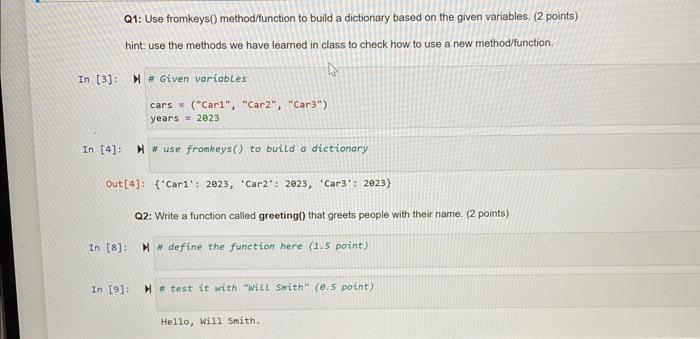
![[3]: H \# Given variables cars=("Car1","Car2","Car3")years=2023 In [4]: M \# use fromkeys()](https://s3.amazonaws.com/si.experts.images/answers/2024/07/66aa3a30ecb82_04866aa3a308c19b.jpg)
![to build a dictionary Out[4]:{Car:2023,Car2:2023,Car:2023} Q2: Write a function called greeting0 that](https://s3.amazonaws.com/si.experts.images/answers/2024/07/66aa3a318c021_04966aa3a312fb8a.jpg)
![greets people with their name. (2 points) In [8]: M " define](https://s3.amazonaws.com/si.experts.images/answers/2024/07/66aa3a32246f7_04966aa3a31b0fe8.jpg)
![the function here (1.5 point ) In [9]: M \#test it with](https://s3.amazonaws.com/si.experts.images/answers/2024/07/66aa3a32c1cd0_05066aa3a325e20a.jpg)
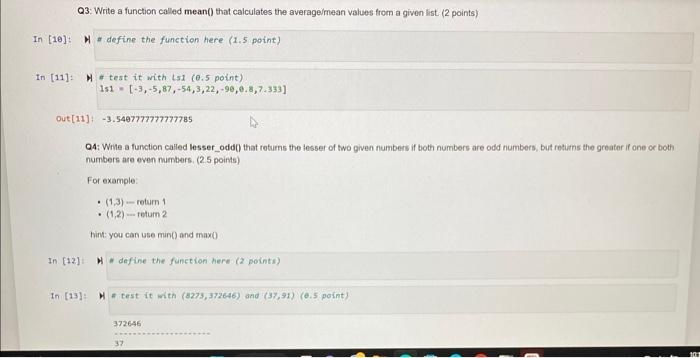
![points) ]: M= define the function here (1,5 point ) 11]: M=testitwithls1(e.5point)151=[3,5,87,54,3,22,90,6.8,7.333]](https://s3.amazonaws.com/si.experts.images/answers/2024/07/66aa3a34728fb_05266aa3a3407349.jpg)
![Dut[11]:-3.5407777777777785 Q4: Wine a function called lesser_odd0 that roturns the lesser of](https://s3.amazonaws.com/si.experts.images/answers/2024/07/66aa3a3502c76_05266aa3a34a6626.jpg)
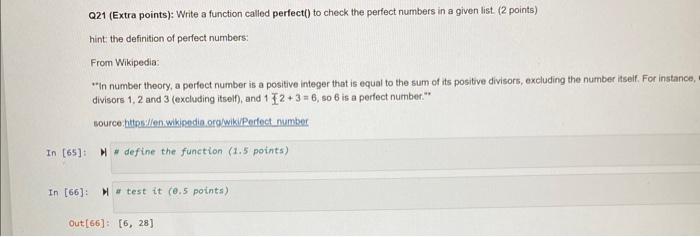
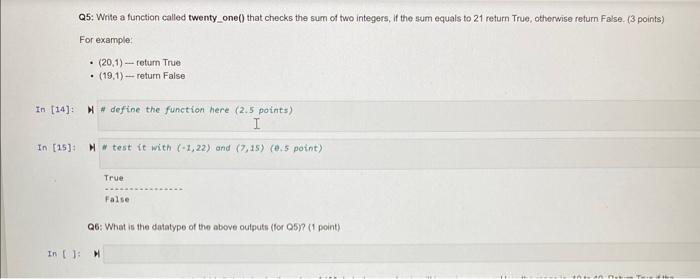
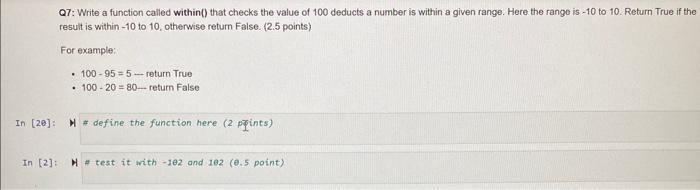
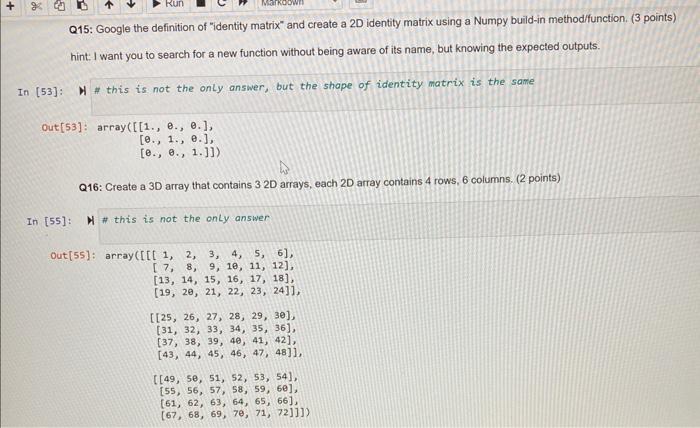
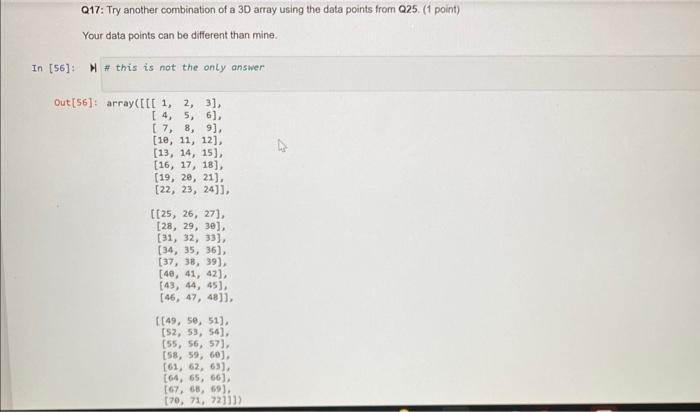
Q1: Use fromkeys() method/function to build a dictionary based on the given variables. ( 2 points) hint: use the methods we have learned in class to check how to use a new method/function. In [3]: H \# Given variables cars=("Car1","Car2","Car3")years=2023 In [4]: M \# use fromkeys() to build a dictionary Out[4]:{Car:2023,Car2:2023,Car:2023} Q2: Write a function called greeting0 that greets people with their name. (2 points) In [8]: M " define the function here (1.5 point ) In [9]: M \#test it with "Will smith" (0.5 point ) He11o, Will Smith. Q3: Write a function called mean() that calculates the average/mean values from a given list (2 points) ]: M= define the function here (1,5 point ) 11]: M=testitwithls1(e.5point)151=[3,5,87,54,3,22,90,6.8,7.333] Dut[11]:-3.5407777777777785 Q4: Wine a function called lesser_odd0 that roturns the lesser of two given numbers if both numbers are odd numbers, but retums the greater if one or both numbers are even numbers. ( 2.5 points) For example: - (1,3) retum 1 - (1,2) - rotum 2 hint: you can use min0 and max0 [12]: H= define the function here ( 2 points) [13]: H n test it with (0273,372646) and (37,31)(0.5 point ] 372646 37 Q5: Write a function called twenty_one() that checks the sum of two integers, if the sum equals to 21 refurn True, othorwise refurn False. (3 points) For example: - (20,1) - return True - (19,1) - return False [14]: M H define the function here (2.5 points) [15]: M " test it with (1,22) and (7,15) (e.,5 point) True false Q6: What is the datatype of the above oulputs (for Q5)? (1 point) Q7: Write a function called within() that checks the value of 100 deducts a number is within a given range. Here the range is - 10 to 10 . Return True if the result is within 10 to 10 , otherwise return False. (2.5 points) For example: - 10095=5 - return True - 10020=80 - return False M \# define the function here (2 peints) H \# test it with 102 and 102(0.5 point Q8: Write a function called five_neighbors() that checks a list of numbers, If there are a couple. of 55 next to each other, retum True. Otherwise, return Faise. (3.5 points) For example: - Is 1=[1,5,5] retum True - Is2 =[5,1,5] return False hints: 1. you may use range(len(hsts)) to stice the list and use for 100p to check the eiements one by one. 2. if idex 1=5 and index 2=5, means there are two 5 sext to each other 6]) H = define the function here (3 points) [1] ; MHestitwiththefolLowinglists(e,5point)1s2=[23,45,77,8,1,5,5,2,5,5,5]1s3=[23,5,45,5,77,5,2,5,8,5,1] Q9: Write a function called black jack(), if the sum of 3 integers is less than or equals to 21, retum their sum. The integers' range is from 1 to 11 . If their sum. greater than 21 and one of the integers is 11 , subtract 10 from the sum and return the sum values. Finally, if the sum still greater than 21 after deducting 10 from the value, retum "BUST", (5 points) For example: - 1+7+13=21 return 21 - 1+5+13=19 return 19 - 11+7+13==3110==21 retum 21 - 15+7+11=3310=23 return 1 I =3ST I define the function here (4 pointr) W i test it with the fot towing nuabers (d point) =(5,6,7) H(2,9,10) =(11,3,10) N (3,9,10) 18 21. 19 BUST Q10: Write a function called volume() that computes the volume of a sphere given its radius. (3 points) hint the volume equations is V=4/3r2 (use 3.14 to replace ) In [32]: M define the function here (2.5 points) In [33]: M \# test it with 7 and 5 (e.5 poipt) 1436.0266666666666523.3333333333334 Q11: Given a list of integers, write a function called count_odd() that returns the number of odd numbers in the list. (4.5 points) hint: this is asking to count the number of odd numbers, not just print the odd numbers In [69]:M Nefine the function here (3.5 points) In [7e]: H \# test it with the following list (1 point) 154=[1,2,3,4,5,6,7,8,9,11] Out[7e]6 Q12: Write a function called unique() to remove all the duplicates in a given list and remain the unique numbers. (4 points) In [46]: M \#efine the function here ( 3.5 points) In [47]: M \# test it with the following list ( .5 point) 1s5=[1,2,2,2,4,3,2,4,4,5,3,5,51,1,1,1] out [47]:[1,2,4,3,5,51] Q13: Import the Numpy library and create a 2D array using ones() function. (2 points) hint always check the descriptions/documentations when you see a new function. In [50]: H " for example: 2 rows 10 columns (this is not the only answer) Out[50]:array([[1,1.1,1,1,1,1,1,1,1.1,1.],[1,1,1,1,1,1,1,1.1.1.1]) Q14: Create a 33 matrix (2D) array using numbers from 0 to 8 ( 9 numbers). (2 points) In [51]: M " this is the only answer Out[52]:array([[6,1,2],[3,4,5],[6,7,8]}) Q15: Google the definition of "identity matrix" and create a 2D identity matrix using a Numpy build-in method/function, (3 points) hint: I want you to search for a new function without being aware of its name, but knowing the expected outputs. In [53]: M \# this is not the only answer, but the shape of identity matrix is the same Out[53]:array([[1,0.,0], [0.,1.0], [0.,0.,1]]. Q16: Create a 3D array that contains 32D arrays, each 2D array contains 4 rows, 6 columns. (2 points) In [55]: M \# this is not the only answer Q17: Try another combination of a 3D array using the data points from Q25. (1 point) Your data points can be different than mine. In [56]: M \# this is not the only answer In [4]: H given array matrix = np.arange (1,41), reshape (4,2,5) matrix Out[4]; array[[[[1,2,3,4,5],[6,7,8,9,10]],[[11,12,13,14,15],[16,17,18,19,28]][[21,22,23,24,25],[26,27,28,29,30]][[31,32,33,34,35],[36,37,38,39,40]]]) In [ ]: Q19: How many dimensions of the above array (Q27)? (1 points) In []=H Q20: Create a 4D array using random numbers. (2 points) You may set up a seed. (optional) In [64]:M W this is not the only answer Out[64]:array([[[[61,27,59,24,46]],[[34,47,45,37,46]]],[[[52,54,36,56,42]],[[60,61,49,56,38]]],[[[42,52,56,34,25]],[[46,23,49,39,57]]],[[[25,33,44,38,61]],[[56,52,45,25,26]]]]) Q21 (Extra points): Write a function called perfect() to check the perfect numbers in a given list. (2. points) hint the definition of perfect numbers: From Wikipedia: "In number theory, a perfect number is a positive integer that is equal to the sum of its positive divisors, excluding the number itseif. For instance, divisors 1, 2 and 3 (excluding itself), and 12+3=6, so 6 is a perfect number." source.hittevilen wikigedia orgiwikiperfect number 65]: M define the function ( 1.5 points) [66]: M= test it (0.5 points) Out [66]:[6,28]
Step by Step Solution
There are 3 Steps involved in it

Get step-by-step solutions from verified subject matter experts
 Study Help