







Question: need help this this problem (all parts ) 2. Proteins are the most common of the biological polymers in living things. There are 20 common
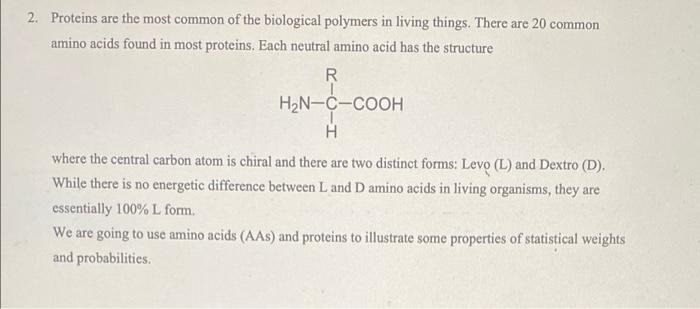
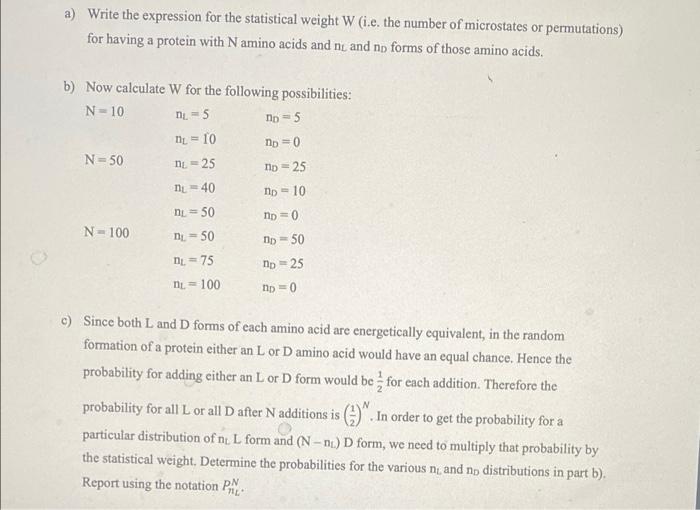
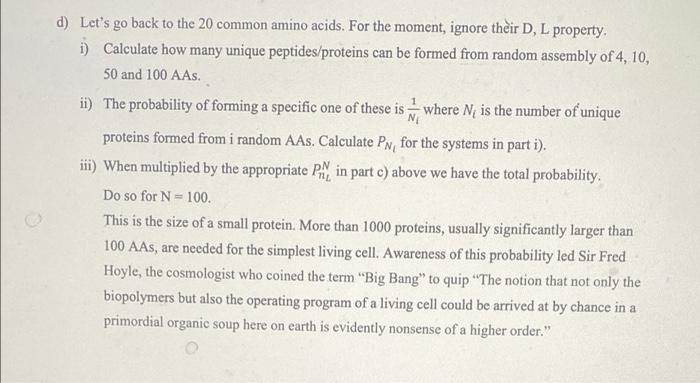
2. Proteins are the most common of the biological polymers in living things. There are 20 common amino acids found in most proteins. Each neutral amino acid has the structure R H2N-C-COOH H where the central carbon atom is chiral and there are two distinct forms: Levo (L) and Dextro (D). While there is no energetic difference between L and D amino acids in living organisms, they are essentially 100% L form. We are going to use amino acids (AAs) and proteins to illustrate some properties of statistical weights and probabilities. a) Write the expression for the statistical weight W (i.e. the number of microstates or permutations) for having a protein with N amino acids and nu and no forms of those amino acids. N-50 b) Now calculate W for the following possibilities: N=10 ni = 5 np = 5 n = 10 np = 0 n = 25 np = 25 n 40 np - 10 n = 50 np = 0 ni - 50 Dp = 50 n = 75 no 25 nu-100 np = 0 N=100 c) Since both L and D forms of each amino acid are energetically equivalent, in the random formation of a protein either an L or D amino acid would have an equal chance. Hence the probability for adding either an L or D form would be for each addition. Therefore the probability for all L or all D after N additions is (). In order to get the probability for a particular distribution of n L form and (N-1) D form, we need to multiply that probability by the statistical weight, Determine the probabilities for the various n and no distributions in part b). Report using the notation PN d) Let's go back to the 20 common amino acids. For the moment, ignore their D, L property. i) Calculate how many unique peptides/proteins can be formed from random assembly of 4, 10, 50 and 100 AAs. ii) The probability of forming a specific one of these is where N is the number of unique NA proteins formed from i random AAs. Calculate Pn, for the systems in part i). iii) When multiplied by the appropriate PA, in part c) above we have the total probability, Do so for N-100. This is the size of a small protein. More than 1000 proteins, usually significantly larger than 100 AAs, are needed for the simplest living cell. Awareness of this probability led Sir Fred Hoyle, the cosmologist who coined the term "Big Bang to quip "The notion that not only the biopolymers but also the operating program of a living cell could be arrived at by chance in a primordial organic soup here on earth is evidently nonsense of a higher order
Step by Step Solution
There are 3 Steps involved in it

Get step-by-step solutions from verified subject matter experts
 Study Help