







Question: Need help with MATLAB Convolve with a Shifted Delta Function: Create a new impulse response hin) that is also 20 samples in length. Create the
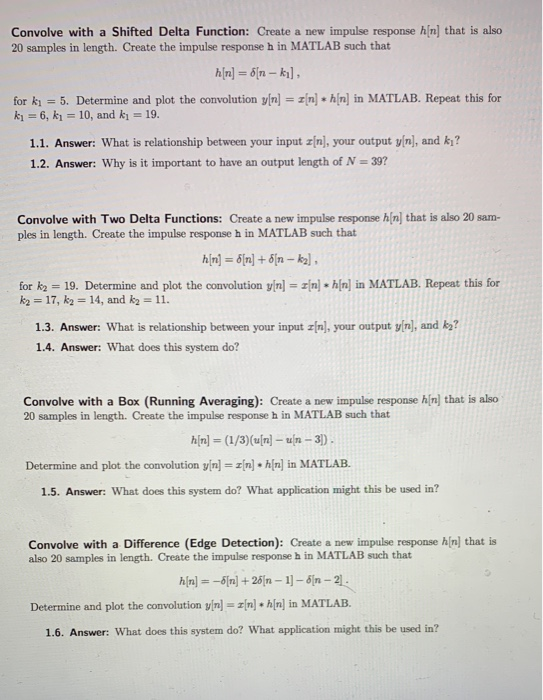
Convolve with a Shifted Delta Function: Create a new impulse response hin) that is also 20 samples in length. Create the impulse response h in MATLAB such that h[n] = 6[n k1], for ki = 5. Determine and plot the convolution y[n] = [nh[n] in MATLAB. Repeat this for k = 6, ki = 10, and ki = 19. 1.1. Answer: What is relationship between your input z[n], your output y[n], and ki? 1.2. Answer: Why is it important to have an output length of N = 39? Convolve with Two Delta Functions: Create a new impulse response h[n that is also 20 sam ples in length. Create the impulse response h in MATLAB such that h[n] = b[n] + 5 n-ka. for ky = 19. Determine and plot the convolution y[n] = [n] - h[n) in MATLAB. Repeat this for kg = 17, k2 = 14, and k2 = 11. 1.3. Answer: What is relationship between your input[n], your output y[m], and ky? 1.4. Answer: What does this system do? Convolve with a Box (Running Averaging): Create a new impulse response h[n] that is also 20 samples in length. Create the impulse response h in MATLAB such that h[n] = (1/3)(un-un -3). Determine and plot the convolution yin] =(n) h[n) in MATLAB 1.5. Answer: What does this system do? What application might this be used in? Convolve with a Difference (Edge Detection): Create a new impulse response in that is also 20 samples in length. Create the impulse response h in MATLAB such that h[n] = -0[n] + 26[n - 1] - [n- 21. Determine and plot the convolution y(n) = z[n] *h[n] in MATLAB. 1.6. Answer: What does this system do? What application might this be used in
Step by Step Solution
There are 3 Steps involved in it

Get step-by-step solutions from verified subject matter experts
 Study Help